Your benefits broker may be missing a large part of what broker support should include. A Ladson benefits broker should work with employers throughout the year, helping with plan decisions, costs, enrollment, employee questions, administration, and renewal planning.
The relationship should make benefits easier for HR and clearer for employees. This guide is for Ladson employers who want to understand what their broker should handle, where their responsibilities begin, and how to tell whether the current relationship is working.
Key Takeaways
- A Ladson benefits broker should work with your business throughout the year, not only when renewal quotes arrive.
- Your broker should first understand your workforce, budget, employee needs, and current benefits problems before recommending plans.
- Plan comparisons should include total employer and employee costs, networks, coverage, funding structure, and administration requirements.
- A strong broker should help coordinate enrollment, employee communication, carrier issues, and ongoing benefits administration.
- Employers should know who manages the account, what support is included, and how the broker is compensated.
Start With Your Workforce, Budget, and Benefits Goals
A benefits conversation should not start with a stack of carrier quotes. Your broker first needs to understand how your business works. That includes your employee count, where employees live, what you currently contribute, how many employees enroll, what HR struggles with, and what employees say about the existing benefits.
Ladson has a substantial working population. U.S. Census Bureau data shows that 65.6% of residents age 16 and older were in the civilian labor force during 2020–2024. That makes workforce needs a practical part of the local benefits discussion, especially for employers competing for employees across the Charleston-area market. What Is Working and What Is Not. Before changing coverage, identify the actual problem. An employer might be dealing with:
- A large renewal increase
- Low employee participation
- High payroll deductions
- Employee complaints about the provider network
- Too much manual enrollment work
- Confusion about who handles carrier problems
- Benefits that no longer fit the workforce
The broker should help separate the issues caused by the plan from the problems caused by administration, communication, or contribution strategy. That matters because changing carriers will not fix every benefits problem.
Understand What Employees Actually Need
Employee needs should also influence plan design. A workforce with employees spread across several counties may have different provider access than a workforce concentrated near one office. Younger employees may value different coverage than employees supporting families. Some groups may care more about predictable copays, while others focus heavily on payroll deductions. The broker should help the employer weigh those needs against the company’s budget rather than assuming the richest plan or lowest premium is automatically the best choice.
Compare More Than the Renewal Premium
A lower premium can look attractive during renewal, but it does not tell you what the plan will actually cost the business or its employees. Your broker should help compare the full picture, including:
- Employer contributions
- Employee payroll deductions
- Deductibles
- Copays and coinsurance
- Out-of-pocket maximums
- Provider networks
- Prescription coverage
- Funding risk
- Administration requirements
A plan that saves the employer money could increase employee costs sharply. Another option might have a higher premium but provide a network that fits the workforce better. The goal is to understand the tradeoffs before making a decision.
Look at Total Employer and Employee Cost
Employers should know how much they will pay and what employees may face when they actually use the plan. That includes more than the monthly premium. If employees pay part of their premiums, the broker should also explain whether a Section 125 plan may allow eligible payroll deductions to be taken on a pre-tax basis. The broker should put the numbers into a format that makes comparison easy. You should not have to piece together contributions, deductibles, and plan differences from several separate documents.
Compare Funding and Plan Structures
Traditional fully insured group health coverage may make sense for one employer, while another business may have reasons to consider level-funded coverage or an Individual Coverage Health Reimbursement Arrangement. A broker should explain the differences without pushing every employer toward the same answer. For some businesses, the comparison may include group coverage alongside ICHRA options, particularly when employee locations, contribution budgets, or individual plan choice make the arrangement worth reviewing.
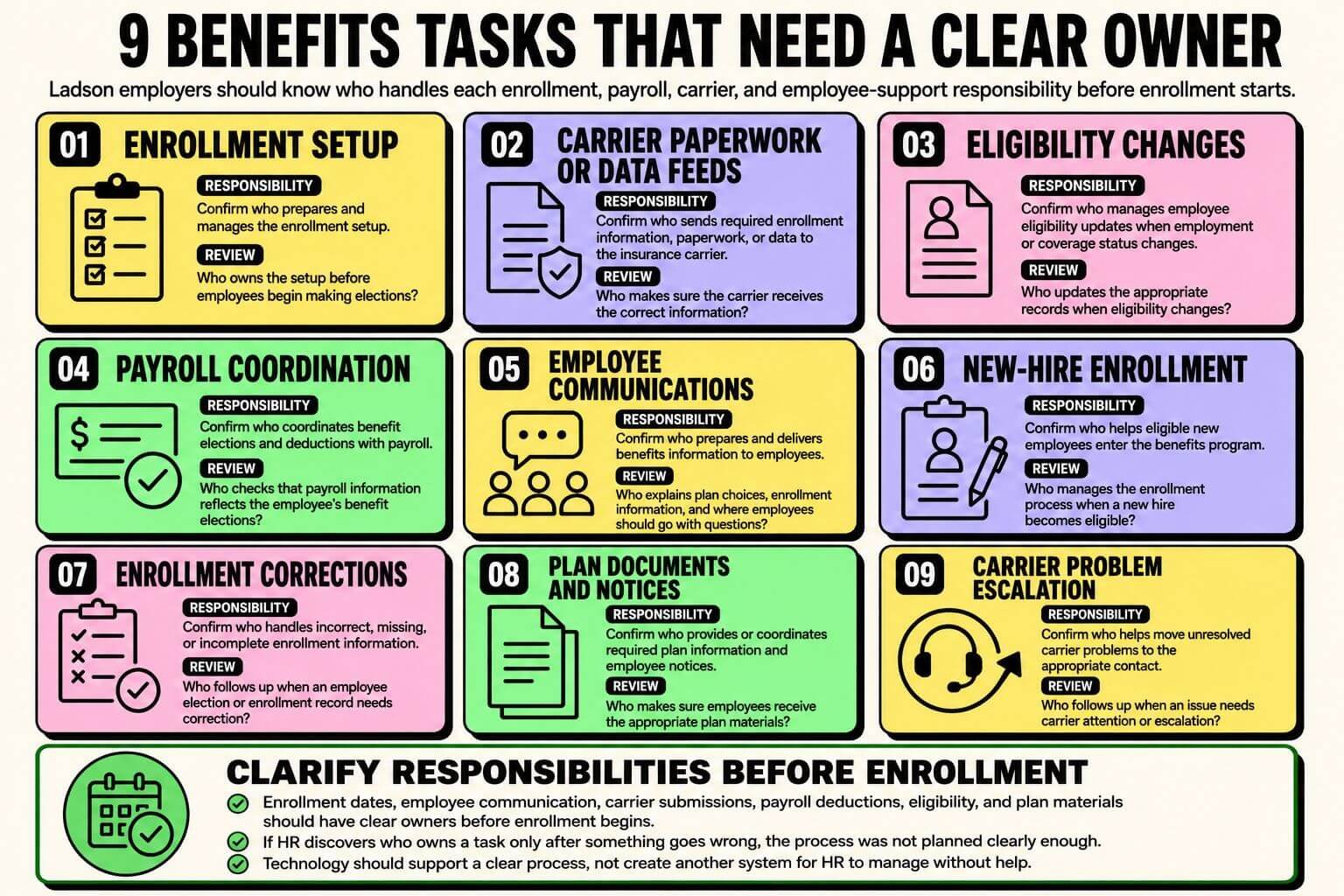
Location matters with ICHRA. The South Carolina Department of Insurance lists 2026 individual Marketplace carrier availability by county. Berkeley, Charleston, and Dorchester counties have several participating carriers, but availability is not identical across every part of the state. A useful ICHRA review should therefore look at where employees live, available plans, provider networks, and expected employer contributions rather than discussing ICHRA only in theory. ear Enrollment and Implementation Plan. Choosing a plan is only part of the broker’s job. Once the employer makes a decision, someone needs to manage enrollment dates, employee communications, carrier submissions, payroll deductions, eligibility, and plan materials. Those responsibilities should be clear before enrollment starts.
Decide Who Handles Each Task
Ask who owns each step. Your broker or account team should clearly explain who is responsible for:
- Enrollment setup
- Carrier paperwork or data feeds
- Eligibility changes
- Payroll coordination
- Employee communications
- New-hire enrollment
- Enrollment corrections
- Plan documents and notices
- Escalating carrier problems
If HR discovers these responsibilities only after something goes wrong, the process was not planned well enough. The broker should also determine whether benefits administration technology can reduce manual work around enrollment, eligibility updates, payroll coordination, and employee access to benefit information. Technology should support a clear process. It should not create another system for HR to manage without help.
Make Benefits Easier for Employees to Understand
Employees need more than a list of plan names. A useful enrollment process explains what each option covers, what comes out of the employee’s paycheck, how deductibles work, where to find providers, and where to go with questions. That could include benefit guides, enrollment meetings, simple plan comparisons, or individual support for harder questions. Clear communication also helps HR. Employees are less likely to bring every basic benefits question back to the internal team when they know where to find accurate information.
Support HR and Employees Throughout the Year
Broker support should continue after enrollment closes. Employees get married, have children, lose other coverage, move, and encounter carrier problems. HR may need help with eligibility, billing, enrollment corrections, or plan interpretation. A broker should provide a clear route for handling those issues instead of leaving the employer to work through every carrier problem alone.
Help With Coverage and Carrier Issues
A broker cannot guarantee that an insurer will approve every claim or resolve every dispute in the employee’s favor. They can still help. The account team may explain where a question should go, help an employee understand available information, check enrollment records, or escalate an appropriate issue with a carrier. That support matters because HR should not have to become the middleman for every benefits problem.
Review the Plan Before Renewal Season
Renewal planning should not begin the week quotes arrive. During the year, the broker should be paying attention to issues such as:
- Employee participation
- Contribution levels
- Administrative problems
- Workforce changes
- Employee feedback
- Upcoming plan or carrier changes
Those conversations give employers more time to make decisions. If a renewal increase arrives, the business already has context for deciding whether to adjust contributions, change plans, review funding options, or keep the current structure.
Know Who Is Actually Managing Your Account
The person who introduces the brokerage may not be the person handling your day-to-day benefits questions. Ask about that before choosing a broker. You should know:
- Who your main advisor is
- Who manages routine account service
- Who supports enrollment
- Who handles carrier escalations
- Who helps with compliance-related questions
- How issues are submitted and tracked
- Which services are included
It is also reasonable to ask how the broker is compensated. Benefits brokers may receive carrier commissions, employer-paid fees, or a combination of compensation methods. Technology or additional consulting services may also have separate costs. The important part is clarity. An employer should understand what they are paying for and what support they can expect.
Signs Your Broker Relationship May Need a Second Look
You do not need to switch brokers because of one difficult renewal or one service problem. Repeated patterns are more useful to watch. Your current relationship may deserve another look if:
- Your broker mainly contacts you near renewal.
- Recommendations arrive without clear cost comparisons.
- HR handles most enrollment and carrier problems alone.
- Employees do not know where to go for benefits help.
- No one reviews participation or employee concerns during the year.
- Roles between the broker, employer, carrier, and technology provider are unclear.
- Renewal planning consistently feels rushed.
Ask yourself a simple question: Does your broker reduce benefits work for your team, or mostly give HR more information to sort through? A strong working relationship should give the employer clearer decisions and clearer responsibilities. If employees are asking for coverage beyond core medical benefits, the broker can also review suitable voluntary benefit options based on workforce needs and the employer’s budget.
Is Your Current Broker Working This Way?
If your broker only becomes active when renewal quotes arrive, look at what happens during the other eleven months. Who handles employee questions? Who helps when eligibility or billing problems appear? Does anyone review participation, contributions, or workforce changes before renewal? When a plan is recommended, can you clearly see why it fits better than the other options? Reviewing those questions can help you determine whether the problem is the insurance plan, the administration around it, or the broker relationship itself.
Benni Agency can take a second look at an employer’s current benefits setup and help identify where the process may be creating unnecessary work or leaving questions unanswered. You do not have to change everything at once. A review of the current process can show what is working, what is not, and what deserves attention before the next renewal.