A commercial umbrella limit should reflect the liabilities your business could face, the limits already in place, and any contracts you must satisfy. There is no universal amount that fits every Mount Pleasant business. The better approach is to identify the required minimum, test it against credible severe-loss scenarios, and confirm that the umbrella is structured to sit above the right underlying policies. This guide explains that process without relying on a generic industry benchmark. Coverage depends on the issued policy, endorsements, and facts of a claim.
Key Takeaways
- Start with written insurance requirements in contracts, leases, and loan documents.
- Confirm which primary policies and limits are listed beneath the umbrella.
- Model severe but plausible claims instead of choosing an arbitrary round number.
- Compare umbrella and excess forms by their wording, not their labels.
- Revisit the limit when vehicles, locations, operations, payroll, or contracts change.
What Umbrella Limit Planning Actually Involves
Commercial umbrella insurance can add liability limits above specified underlying policies. Those may include commercial general liability, commercial auto liability, and employers liability, depending on the form. It does not replace the primary policies. Planning the limit requires more than deciding whether an extra $1 million sounds sufficient. A business should answer three questions:
- What total liability limit do our agreements require?
- What covered event could realistically exhaust our primary limit?
- Does the proposed umbrella sit above every policy and exposure we expect it to?
Travelers’ commercial umbrella overview explains that the coverage may extend over multiple liability policies and that the specific underlying coverage matters. The declarations, schedule of underlying insurance, exclusions, and endorsements still control.
Build a Limit Worksheet Before Comparing Quotes
A simple worksheet makes the discussion more precise. Use one row for each material exposure rather than combining everything into a single estimate.
| Review item | What to record | Why it matters |
| Contracts and leases | Required total limits, covered lines, and endorsement terms | Establishes the minimum promised to another party |
| General liability | Per-occurrence and aggregate limits | Shows where an additional layer may attach |
| Commercial auto | Liability limit, vehicles, drivers, and operating radius | Helps frame serious accident exposure |
| Employers liability | Each applicable limit and umbrella eligibility | Confirms whether the upper layer schedules it |
| Severe-loss scenarios | Plausible injury, property damage, or multi-claim events | Tests whether the selected limit fits the operation |
| Growth plans | New sites, contracts, vehicles, services, or payroll | Identifies near-term changes that could alter the decision |
Do not add the values in every row and call the result the correct limit. The worksheet organizes the evidence. Your broker, legal counsel, and financial team can then evaluate contractual obligations, coverage structure, risk tolerance, and available insurance options.
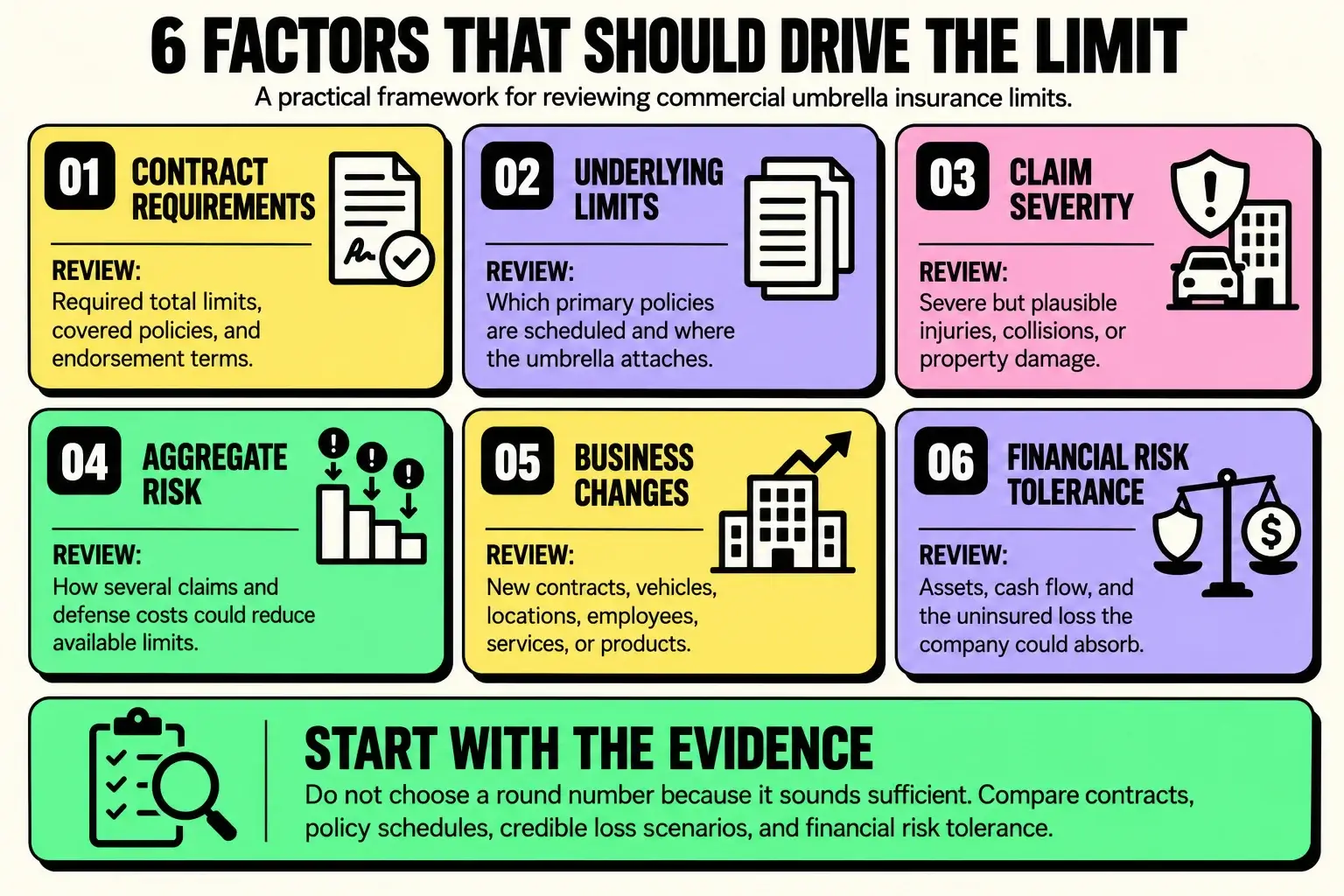
Six Factors That Should Drive the Limit
1. Contractual insurance requirements
Review signed customer agreements, vendor contracts, leases, project documents, and loan terms. Record both the required amount and the policies it must apply over. A contract may also require additional insured status or other endorsements. A higher headline limit alone does not confirm that every term has been met.
2. Existing underlying limits
The umbrella declarations or schedule identifies the insurance beneath it and the required underlying limits. If a primary policy is missing from the schedule, expires, or carries less than required, the umbrella may not respond as expected. Ask how the maintenance-of-underlying-insurance provision treats a shortfall.
3. Credible claim severity
Consider severe events connected to the actual operation: a serious visitor injury, a multi-vehicle collision, or extensive damage while employees work at a customer location. The goal is not to predict the largest imaginable lawsuit. It is to test whether current limits can absorb a plausible high-severity covered loss.
4. Aggregation risk
One occurrence is not the only concern. Several claims during the policy period may erode an aggregate limit. Review both per-occurrence and aggregate limits and ask whether defense expenses reduce the available limit under the applicable policies.
5. Business changes
Added vehicles, locations, employees, services, products, or contracts can change exposure before the next renewal. Review the umbrella when a material change occurs, not only when the policy expires.
6. Assets, cash flow, and risk tolerance
Insurance is one part of financial risk planning. Leadership should consider how much uninsured loss the organization could absorb, what assets may be exposed, and how a large claim could affect operations. These considerations inform the decision but do not replace policy analysis.
Check the Structure, Not Just the Number
Commercial umbrella and excess liability are related but are not automatically interchangeable. Excess coverage commonly adds limits over specified underlying insurance and may follow that coverage closely. An umbrella may sit over several policies and may provide broader terms in limited situations. Either form can contain its own definitions, exclusions, conditions, and notice requirements.
That distinction matters when a contract calls for umbrella coverage or when the business expects the policy to sit above more than one liability line. Benni Agency’s comparison of commercial umbrella and excess liability covers the form-level questions, while its guide to excess liability for contract work focuses on contractual wording and proof of insurance.
Common Limit-Planning Mistakes
- Selecting $1 million, $2 million, or another round amount without documenting why it fits.
- Treating a certificate of insurance as proof of all policy terms and endorsements.
- Assuming the umbrella covers every liability policy the business owns.
- Overlooking exclusions for professional, cyber, employment practices, pollution, or other specialized exposures.
- Ignoring how defense costs and aggregate erosion affect limits available for later claims.
- Renewing the same limit after the operation or contract portfolio has changed.
A commercial umbrella generally does not increase commercial property limits or workers’ compensation benefits. Specialized liability policies may need their own excess layer. Always compare the proposed schedule and exclusions with the coverage portfolio.
When to Review the Limit
Review the limit at renewal and after any meaningful change in the business. Useful triggers include signing a contract with new insurance requirements, acquiring vehicles, opening a location, entering a different type of work, or materially changing payroll or revenue. For a local planning discussion, Benni Agency’s Mount Pleasant insurance and employee benefits page provides the appropriate service-area path. Its business and commercial insurance services include commercial umbrella and excess liability coverage.
A review should use current policies and agreements rather than treating the city itself as a reason for a particular limit. South Carolina businesses can also use the South Carolina Department of Insurance to verify an insurer or producer and access state consumer resources. That verification is separate from evaluating whether a specific policy and limit fit the business.