Another difficult renewal can leave you wondering whether your benefits program is working as well as it should. A Goose Creek benefits broker can help your business compare coverage options, plan employer contributions, reduce administrative work, and give employees clearer support throughout the year.
The right broker looks beyond the initial insurance quotes and considers your budget, workforce, hiring plans, and current HR process. This guide is for Goose Creek business owners and HR leaders who want to make better benefits decisions, fix recurring problems, and know what useful broker support should include.
Key Takeaways
- A benefits broker can compare coverage and funding options based on your workforce, budget, and business goals.
- Broker support can reduce the time HR spends on enrollment, eligibility changes, payroll deductions, and employee questions.
- Fully insured, level-funded, and ICHRA options have different costs, risks, and administrative requirements.
- Core and voluntary benefits provide more value when employees understand what they cover.
- Year-round service, clear compensation, useful technology, and reliable communication matter as much as the initial plan quotes.
How a Goose Creek Benefits Broker Helps Your Business
A benefits broker helps connect your insurance choices with the way your company operates. That usually starts with reviewing your current plans, employer contributions, employee enrollment, renewal history, and the problems HR or employees are experiencing. From there, the broker may help you:
- Compare insurance carriers and plan structures
- Review employer and employee contribution amounts
- Evaluate fully insured, level-funded, or reimbursement-based options
- Coordinate enrollment and eligibility updates
- Improve employee benefits communication
- Review voluntary benefit options
- Prepare for renewals earlier
- Resolve carrier or coverage issues
- Support compliance-related processes
The exact level of service varies between brokers. Some focus mainly on placing insurance coverage, while others provide ongoing help with administration, technology, employee education, and renewal plannin. For that reason, employers should ask what services are included and who will handle each part of the benefits program. Benni provides benefits support for Goose Creek businesses that want clearer plan choices and a more manageable administration process.
A Better Benefits Strategy Starts With Your Workforce
Your benefits program should reflect the people you employ rather than follow a standard package used for every business. Berkeley County had 71,876 covered employees across 5,310 establishments in December 2025. Its average weekly wage reached $1,406 during the fourth quarter of 2025, according to the U.S. Bureau of Labor Statistics. This shows the size of the local labor market in which Goose Creek businesses hire and compete for employees. Before recommending a plan, a broker should learn about:
- The number of eligible employees
- Hourly and salaried positions
- Employee ages and family needs
- Full-time and part-time classifications
- Your employer contribution budget
- Hiring and expansion plans
- Current enrollment levels
- Employee locations
- The amount of time HR can spend on administration
A business with a small office staff may have different needs from a manufacturer employing both hourly and salaried workers. One may value simple administration and predictable monthly costs, while another may need several employee classes, stronger communication, and more flexible coverage choices. Looking at the workforce first helps the broker narrow down suitable options instead of presenting a long list of plans with little explanation.
Compare Medical Plan and Funding Options
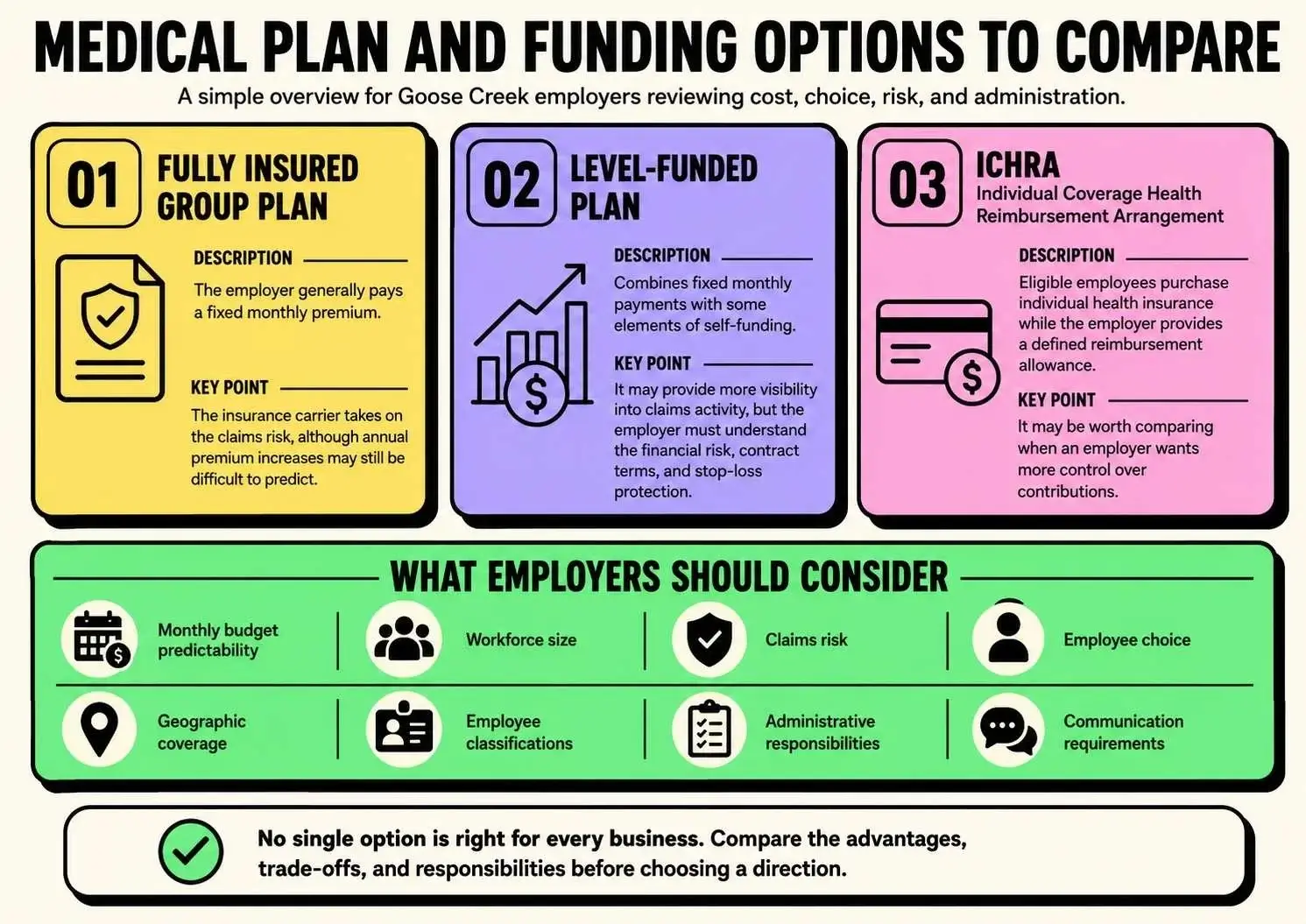
Medical coverage is often the largest part of an employer’s benefits budget. A broker should explain the main plan and funding options in plain language before recommending a direction. A fully insured group plan usually gives the employer a fixed monthly premium. The insurance carrier takes on the claims risk, although annual increases may still be difficult to predict.
A level-funded plan combines fixed monthly payments with some elements of self-funding. It may provide more visibility into claims activity, but the employer needs to understand the financial risk, contract terms, and stop-loss protection. An Individual Coverage Health Reimbursement Arrangement, or ICHRA, allows eligible employees to purchase individual health insurance while the employer provides a defined reimbursement allowance. For employers seeking more control over contributions, ICHRA options may be worth comparing with traditional group coverage.
The decision should consider:
- Monthly budget predictability
- Workforce size
- Claims risk
- Employee choice
- Geographic coverage
- Employee classifications
- Administrative responsibilities
- Communication requirements
No single option is right for every business. A useful broker comparison should explain both the advantages and the trade-offs so you know what the company and employees will be responsible for.
Choose Core and Voluntary Benefits With a Clear Purpose
Medical insurance is only one part of an employee benefits package. Employers may also consider dental, vision, life, disability, accident, critical illness, and hospital indemnity coverage. The goal should not be to add as many products as possible. Each benefit should address a real workforce need and fit the company’s contribution strategy.
For example, employer-paid group life insurance can provide employees with a basic level of financial protection. Employees may then have the option to purchase additional coverage if they need it. A broker should help answer practical questions:
- Which benefits should the employer pay for?
- Which options could be employee-paid?
- Are the costs reasonable for the workforce?
- Will employees understand how the coverage works?
- Can enrollment and payroll deductions be managed correctly?
- Is there enough employee interest to justify offering the benefit?
Participation often suffers when employees receive a long list of options without useful explanations. Clear comparisons, examples, and enrollment support help employees decide what fits their own needs.
How a Broker Reduces Work for HR
Benefits administration can take more time than expected, especially when enrollment information moves between paper forms, spreadsheets, payroll systems, and insurance carriers. A broker may help organize or support:
- New-hire enrollment
- Annual open enrollment
- Employee eligibility updates
- Qualifying life events
- Dependent changes
- Payroll deduction reviews
- Carrier submissions
- Employee self-service
- Benefits reporting
- Coverage questions
The technology used for these tasks matters, but software alone does not fix a poor process. The system needs to be configured correctly, employee information must be accurate, and someone still needs to manage exceptions and follow up when data does not match. A broker should explain how benefits administration tools can connect enrollment, eligibility, payroll, and reporting. The broker should also explain who is responsible for implementation, employee training, data checks, and ongoing support. For a business without a large HR department, that support can prevent routine benefits tasks from taking time away from hiring, payroll, employee relations, and other daily work.
What Year-Round Broker Support Should Include
Benefits work does not end when open enrollment closes. Employees may have coverage questions, new hires need to enroll, and business changes can affect eligibility or plan design. Useful year-round broker support may include:
- Starting renewal preparation before the deadline
- Reviewing available plan and funding alternatives
- Helping resolve carrier or enrollment problems
- Supporting employee benefits questions
- Reviewing eligibility procedures
- Coordinating benefit communication
- Discussing workforce or business changes
- Checking whether current plans still fit the company
- Helping organize required notices and benefit records
Ask how often the broker will meet with your team and what happens when an employee has a problem. You should also know whether support comes from one account manager, a service team, a call center, or the insurance carrier. Benefits brokers can help coordinate compliance-related processes, but they do not replace legal or tax professionals. When a decision requires formal legal or tax advice, the broker should recognize that limit and help the employer identify what needs further review. Year-round service is especially helpful when your company is hiring, opening another location, changing payroll systems, or adding new employee groups. Those changes can expose problems that may not appear during a standard annual renewal.
What to Look for in a Goose Creek Benefits Broker
A broker should be able to explain the service process before asking you to change plans or carriers. Consider asking these questions:
- How early do you begin renewal planning?
- Which insurance carriers and funding models can you evaluate?
- Who will manage implementation and enrollment?
- Who answers employee coverage questions?
- What happens when there is an eligibility or carrier issue?
- Which technology tools are included?
- Can the system connect with our payroll process?
- How often will we review the program during the year?
- How are you paid?
- Are there consulting, technology, or service fees in addition to carrier commissions?
- Have you worked with businesses of a similar size or workforce type?
Pay close attention to whether the broker asks detailed questions about your company. A broker cannot recommend a useful benefits strategy without understanding your budget, employee population, current problems, and plans for growth. Compensation should also be clear. Brokers may receive insurance carrier commissions, charge direct consulting fees, or use a combination of both. Ask for a written explanation of how the broker is paid and whether any services cost extra. The best fit is not always the broker presenting the lowest initial quote. Service responsibilities, communication, administration support, and renewal preparation can have a major effect on the employer’s experience throughout the year.
When It Makes Sense to Review Your Current Benefits Setup
A benefits review can be useful before renewal season becomes urgent. It may be time to look more closely if premiums keep rising without a clear explanation, employees struggle to compare their options, payroll deductions need frequent corrections, or HR spends too much time managing enrollment and eligibility changes. Start by gathering:
- Current plan summaries
- Employer contribution amounts
- Enrollment records
- Recent renewal information
- Payroll deduction details
- Common employee questions
- A list of recurring administrative problems
A broker should use that information to explain what is working, where the process is creating extra cost or effort, and which options deserve a closer look. Benni Agency can help Goose Creek employers review their plan structure, administration process, employee communication, and funding choices. The next step does not need to involve replacing every plan. It can begin with an honest review of the current setup and the choices available before the next renewal. Benni also supports Greenville employers with similar benefits planning and administration needs.