An office may have fewer obvious hazards than a warehouse or jobsite, but desk-based employees can still experience work-related injuries. In South Carolina, whether an employer generally needs workers’ compensation coverage depends mainly on the number of employees and statutory exceptions, not whether the work seems low risk. Mount Pleasant employers should understand the coverage threshold, classify each role by its actual duties, and maintain a reporting process that also works for remote and hybrid employees.
Key Takeaways
- South Carolina generally requires workers’ compensation coverage when a business regularly employs four or more employees in the state, subject to statutory exceptions.
- Office work is lower risk, but falls, lifting injuries, vehicle accidents, and qualifying repetitive-trauma injuries can still occur.
- Clerical Class Code 8810 may apply only when an employee’s duties meet the classification rules.
- Premium calculations commonly consider payroll, classification, carrier rates, experience, and other underwriting factors.
- Clear injury reporting, accurate job descriptions, and organized payroll records help employers manage claims and policy audits.
Does South Carolina Require Workers’ Comp for Office Employees?
South Carolina law defines covered private employment to include businesses that regularly employ four or more employees in the same business or establishment. The law also lists exemptions, including an employer that regularly has fewer than four employees or had total annual payroll below $3,000 in the previous calendar year. Other exclusions apply to certain types of work and workers. The full rule is more detailed than a simple headcount test. Employers should review the South Carolina Workers’ Compensation Law and seek guidance about their particular ownership, staffing, and employment arrangements. A professional office is not automatically exempt because its employees work at desks. Businesses that are exempt may have the option to elect coverage. Even when coverage is not mandatory, an employer may consider how an employee injury would otherwise affect the organization and its workers.
Why Office Work Can Still Lead to Claims
Workers’ compensation applies to qualifying work-related injuries, not only dramatic accidents. Potential office incidents include:
- Slips or falls in work areas, hallways, or stairs
- Strains from moving supplies, files, or equipment
- Injuries during a work-related errand or client visit
- Qualifying repetitive-trauma injuries connected to regular job duties
- Injuries that occur while an employee is performing assigned work remotely
This does not mean every injury at an office or home workspace is covered. Compensability depends on the facts and whether the injury arose out of and in the course of employment. South Carolina also has specific standards for repetitive-trauma and certain mental-injury claims.
How Clerical Employees Are Classified
Workers’ compensation classification codes group employees according to the work they actually perform. Clerical office employees are often associated with Class Code 8810, but the code is not a label that should be applied to everyone who spends some time at a desk. A role may require a different classification if it includes field visits, deliveries, equipment work, inventory handling, or other duties outside the applicable clerical definition. Job titles alone do not settle the question. An operations coordinator, for example, may have a different exposure from an employee whose work is limited to administrative duties inside an office. Employers should keep accurate job descriptions and discuss mixed-duty roles with their agent or carrier. That is especially important when an employee’s responsibilities change during the policy period.
What Determines Workers’ Comp Premiums?
There is no dependable flat price for an office team in Mount Pleasant. A workers’ compensation premium commonly reflects:
- Payroll assigned to each classification
- The applicable rate for each class code
- The employer’s claims experience, when experience rating applies
- Carrier underwriting rules, policy charges, and available credits or debits
- Changes identified during the policy audit
The basic rating concept is often expressed as payroll divided by $100, multiplied by the rate for the applicable classification. That is only a framework, not a quote. Using a generic online rate can mislead an employer because rates, eligibility, and final charges depend on the policy and business. At the end of a policy term, an audit may compare estimated payroll and classifications with actual records. If payroll increased or employees were placed in the wrong class, the final premium can change. Maintaining payroll by role throughout the year is easier than reconstructing duties at audit time.
What Should Happen After an Office Injury?
A written response process helps supervisors act consistently without deciding for themselves whether a claim will ultimately qualify. A practical process should tell employees to:
- Obtain emergency help when needed.
- Report the incident to a supervisor or designated contact promptly.
- Record when, where, and how the incident occurred.
- Follow instructions for authorized medical care.
- Provide updated work-status information and restrictions when requested.
South Carolina law says an injured employee should notify the employer immediately or as soon as practicable. Subject to stated exceptions, compensation may be unavailable if notice is not given within 90 days. The law also sets separate deadlines for filing a claim with the Commission. Employers can review the state’s notice, claim, and medical-treatment provisions, then coordinate reporting and forms with their carrier. Managers should avoid promising that an injury will be covered or telling an employee that it will not be. The carrier and, when necessary, the South Carolina Workers’ Compensation Commission evaluate compensability under the applicable facts and law.
Workers’ Comp for Remote and Hybrid Employees
Remote work changes the location of an exposure, not automatically the workers’ compensation analysis. An injury at home may be compensable when it arises out of and occurs in the course of employment, but the line between work activity and personal activity can be fact-specific. Employers can reduce uncertainty by defining working hours, expected duties, designated work areas, and incident-reporting steps. Remote employees should know whom to contact and what information to document. Employers with staff working in other states should also review where coverage must be arranged because workers’ compensation obligations can vary by state.
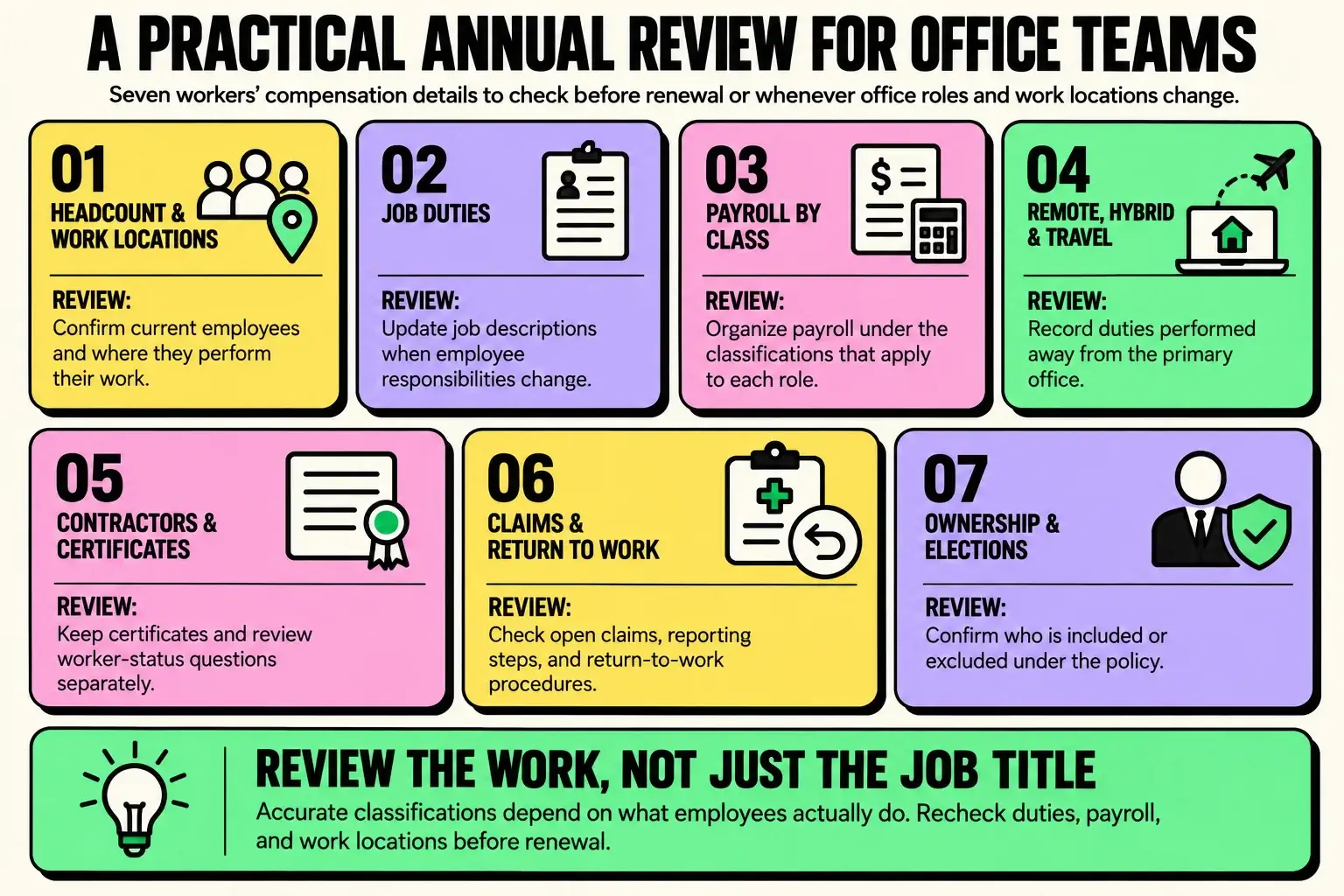
A Practical Annual Review for Office Teams
Before renewal, an office-based employer should review:
- Current headcount and work locations
- Job descriptions and changes in employee duties
- Payroll allocated to each classification
- Remote, hybrid, travel, and errand responsibilities
- Contractors and certificates of insurance, without assuming a certificate alone resolves worker-status questions
- Open claims and return-to-work procedures
- Ownership changes and elections affecting who is included
This review should connect workers’ compensation with the wider insurance program without treating policies as interchangeable. General liability, cyber, property, professional liability, and workers’ compensation address different exposures and remain subject to their terms. Benni Agency’s business and commercial insurance overview explains the broader coverage categories employers may need to evaluate. Mount Pleasant organizations can also use the local Benni Agency overview when considering how an insurance review fits their operations.