Your renewal is approaching, employee questions keep landing on your desk, and every broker seems to promise better rates and service. How do you tell which one can actually help?
A Summerville employee benefits broker should understand your business before recommending a plan. Look at how the broker evaluates costs, explains options, handles enrollment, supports employees, and stays involved after renewal. This guide is for Summerville business owners and HR leaders who want to compare brokers carefully and avoid choosing one based only on price or presentation.
Key Takeaways
- Start with the problems you need to solve. Know whether cost, enrollment, employee communication, plan choice, or broker service needs attention.
- Look for relevant experience. The broker should understand businesses of your size and what a small HR team can manage.
- Review the process, not just the quote. A useful proposal explains costs, trade-offs, and why the recommendation fits your workforce.
- Ask who handles the work after enrollment. Confirm who manages employee questions, carrier issues, payroll coordination, and renewal planning.
- Verify the details. Check licensing, request references, and ask how the broker is paid.
Start With the Problems Your Broker Needs to Solve
Before comparing brokers, write down what is not working now.
A broker cannot build a useful recommendation from your employee count and renewal date alone. They need to understand why you are reviewing your benefits program and what you want to improve.
Ask:
- Are renewal increases arriving without a clear explanation?
- Are employees confused about their coverage?
- Does your team spend too much time fixing enrollment or eligibility problems?
- Is participation lower than expected?
- Does your current broker become difficult to reach after open enrollment?
- Is the business adding employees, locations, or new employee classes?
Gather your current plan information, employer contributions, recent renewal documents, and common employee questions. This gives each broker the same starting point and makes the recommendations easier to compare.
Summerville employers recruit from a wider regional workforce. The U.S. Bureau of Labor Statistics reported a civilian labor force of about 475,200 people in the Charleston-North Charleston-Summerville metro area in May 2026. A broker should understand who you hire and what those employees value.
Look for Experience With Businesses Like Yours
A broker may have years of insurance experience without regularly serving companies like yours.
Ask about clients with a similar employee count, industry, budget, workforce structure, and HR capacity. Small employers often need more hands-on help because they may not have an internal benefits team handling eligibility, employee education, payroll coordination, and reporting.
The size of the brokerage does not settle the question. A national firm may offer broad resources but limited attention to smaller accounts. A local agency may be easier to reach but still lack the technology or plan knowledge you need.
Ask for Proof, Not General Claims
Almost every broker says they provide personal service and strategic guidance. Ask them to show what that means.
Useful proof may include:
- A case study involving a similar-sized employer
- A reference from a company with comparable needs
- A sample implementation timeline
- An example employee communication
- A clear list of the people serving your account
You are checking whether the broker can describe real work beyond shopping the market and presenting rates.
Compare the Broker’s Planning and Cost Approach
Most employers want to control benefit costs, but a lower premium does not always produce a better result.
A plan may reduce the monthly rate by increasing deductibles, limiting provider networks, or shifting more of the cost to employees. Those changes may be reasonable, but the broker should explain them clearly.
A proper review should consider:
- Employer and employee contributions
- Deductibles and out-of-pocket limits
- Provider and hospital networks
- Prescription coverage
- Participation
- Administrative requirements
Ask how the broker balances employer cost with employee affordability. The answer should go beyond finding the least expensive carrier.
The discussion should also cover whether core coverage and voluntary benefits can address employee needs without adding options people do not understand or use.
Make Sure the Broker Can Compare Different Plan Models
A broker should be able to explain more than one way to provide health benefits, including fully insured coverage, level-funded plans, and Individual Coverage Health Reimbursement Arrangements.
There is no model that works best for every small business. The broker should explain why an option may fit, what trade-offs it creates, and what the employer and employees will need to manage.
ICHRA options may give an employer more control over contributions while allowing eligible employees to buy individual coverage. That does not make ICHRA the automatic answer. Employee needs, local plan choices, affordability, administration, and communication all affect whether it fits.
Be cautious if a broker recommends a funding model before learning much about your company.
Find Out Who Handles Enrollment and Ongoing Service
The person making the presentation may not be the person who handles your account after you sign.
Before choosing a broker, ask who will manage:
- Enrollment setup
- Payroll coordination
- New hires and terminations
- Employee questions
- Carrier errors
- Renewal preparation
You should also know how often the broker expects to communicate during the year.
Useful support may include resolving carrier issues, preparing for workforce changes, and discussing renewal strategy before rates arrive. The relationship should include more than a renewal presentation and open enrollment.
Judge the Workflow, Not Just the Technology Demo
A polished portal does not prove the process will be easier.
Ask the broker to walk through a real task, such as adding a new employee, sending elections to payroll, or correcting an enrollment error. That will show who owns each step and whether information must be entered in more than one system.
A useful benefits administration process should reduce manual work, not give your team another login while leaving the same tasks in place.
Check Licensing, References, and Compensation
Confirm that the broker and the people serving your account have the appropriate authority to conduct insurance business in South Carolina. The South Carolina Department of Insurance provides an online tool for locating licensed insurance companies and producers.
Ask for references from employers that are reasonably similar to your company. A large national corporation may not tell you much about how the broker supports a 30-person Summerville business with one person managing HR.
Compensation should also be easy to discuss. Ask whether the broker receives carrier commissions, service fees, technology charges, or implementation fees. Then confirm which services are included.
One model is not automatically better than another. The goal is to understand how the broker is paid and whether costs change depending on the plan or services selected.
Use the Same Scorecard to Compare Each Broker
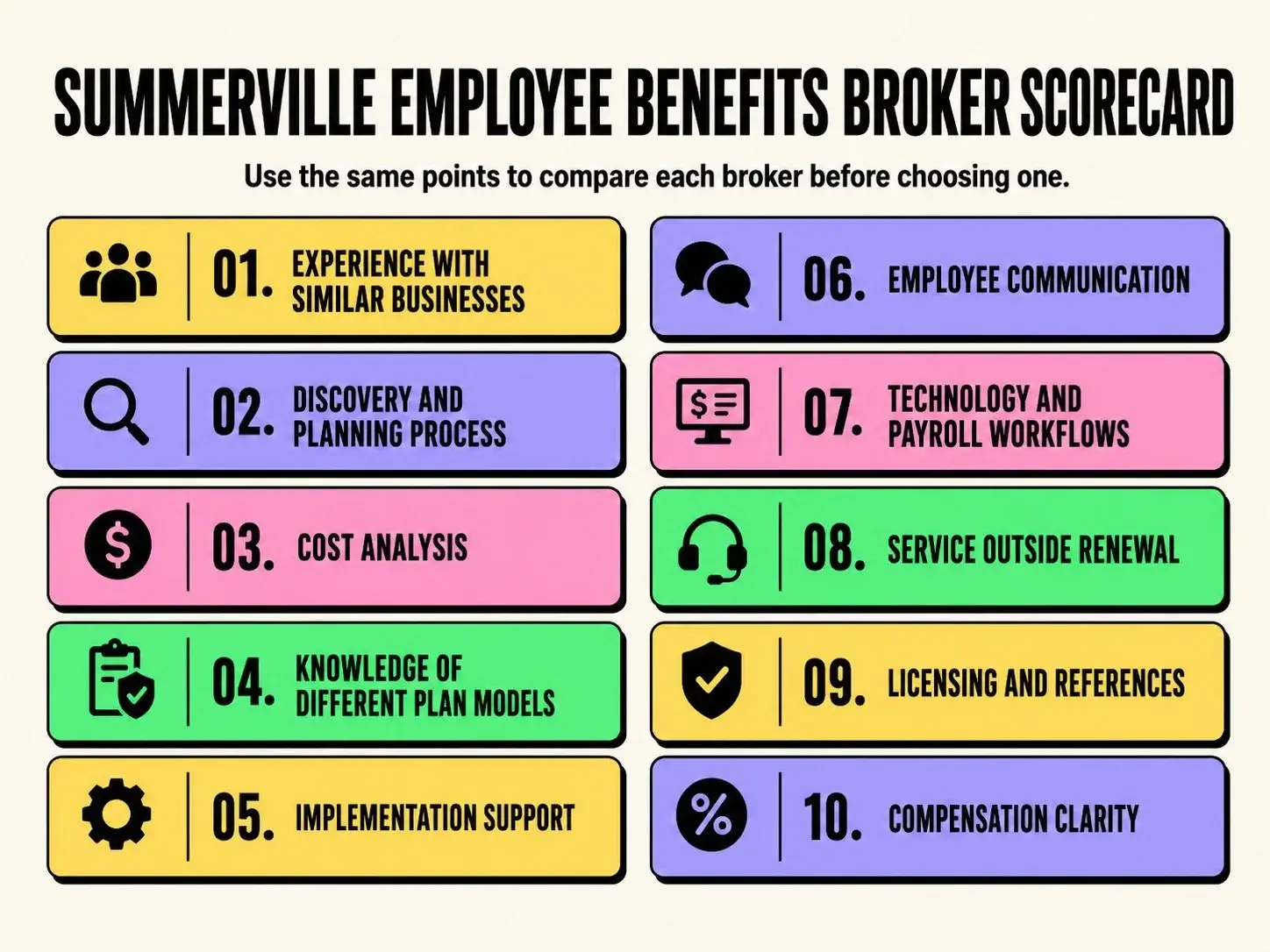
Broker proposals are easier to compare when every candidate is judged on the same points:
- Experience with similar businesses
- Discovery and planning process
- Cost analysis
- Knowledge of different plan models
- Implementation support
- Employee communication
- Technology and payroll workflows
- Service outside renewal
- Licensing and references
- Compensation clarity
A simple one-to-five rating with a few notes under each category is enough. It keeps the decision from coming down to the lowest quote or the most polished presenter.
Red Flags That Deserve a Closer Look
Ask more questions if a broker:
- Recommends a plan before reviewing your needs
- Talks only about the lowest premium
- Cannot explain who will manage the account
- Has no clear implementation timeline
- Cannot provide a relevant reference
- Is unclear about charges
- Promises guaranteed savings
Strong answers should be specific. Instead of saying, “We handle enrollment,” the broker should explain who builds it, how payroll is updated, and who fixes errors.
Need a Clearer View of Your Current Benefits Setup?
You may not need to replace your current broker. The first step is finding out where the problem sits.
It could be the plan design, employer contribution, enrollment process, employee communication, or the support you receive during the year. Bring your current plan information, latest renewal, contribution amounts, common employee questions, and a list of the tasks causing the most trouble.
Benni works with employers seeking practical Summerville benefits support, including help reviewing coverage options, administration, and ongoing service.
A second look should leave you with clearer choices, even when the right decision is to keep part of your current setup.