If you received a level-funded quote and the monthly cost looks better than your fully insured renewal, the first question is simple: what are you actually paying for? A level-funded health plan generally uses one predictable monthly payment to cover expected employee claims, plan administration, and stop-loss insurance. Claims still matter because the employer’s own group experience can affect surplus and future pricing.
This article is for business owners, HR leaders, and benefits decision-makers who want to understand the funding mechanics, compare the risks, and know what to review before signing a contract.
Key Takeaways
- A level-funded plan uses a predictable monthly payment that generally covers expected claims, administration, and stop-loss insurance.
- Employee claims are tied to the employer’s plan, so claims experience can influence surplus and future pricing.
- Stop-loss insurance limits covered financial exposure once individual or total claims cross the thresholds in the contract.
- Lower claims may create a refund or credit, but surplus treatment depends on the plan terms and is not guaranteed.
- Higher claims can affect renewal costs, even when stop-loss limits the employer’s current-year exposure.
- The contract matters as much as the monthly quote, especially when reviewing maximum exposure, surplus rules, and renewal conditions.
What Is a Level-Funded Health Plan?
A level-funded health plan is generally a form of self-funded coverage that gives the employer a steady monthly funding amount. Instead of paying one traditional insurance premium, that payment is divided among expected claims, administration, and stop-loss coverage. This gives employers more visibility into how plan dollars are used while keeping monthly budgeting more predictable than traditional self-funding. Level funding has become common among smaller employers.
How Do Level-Funded Health Plans Work?
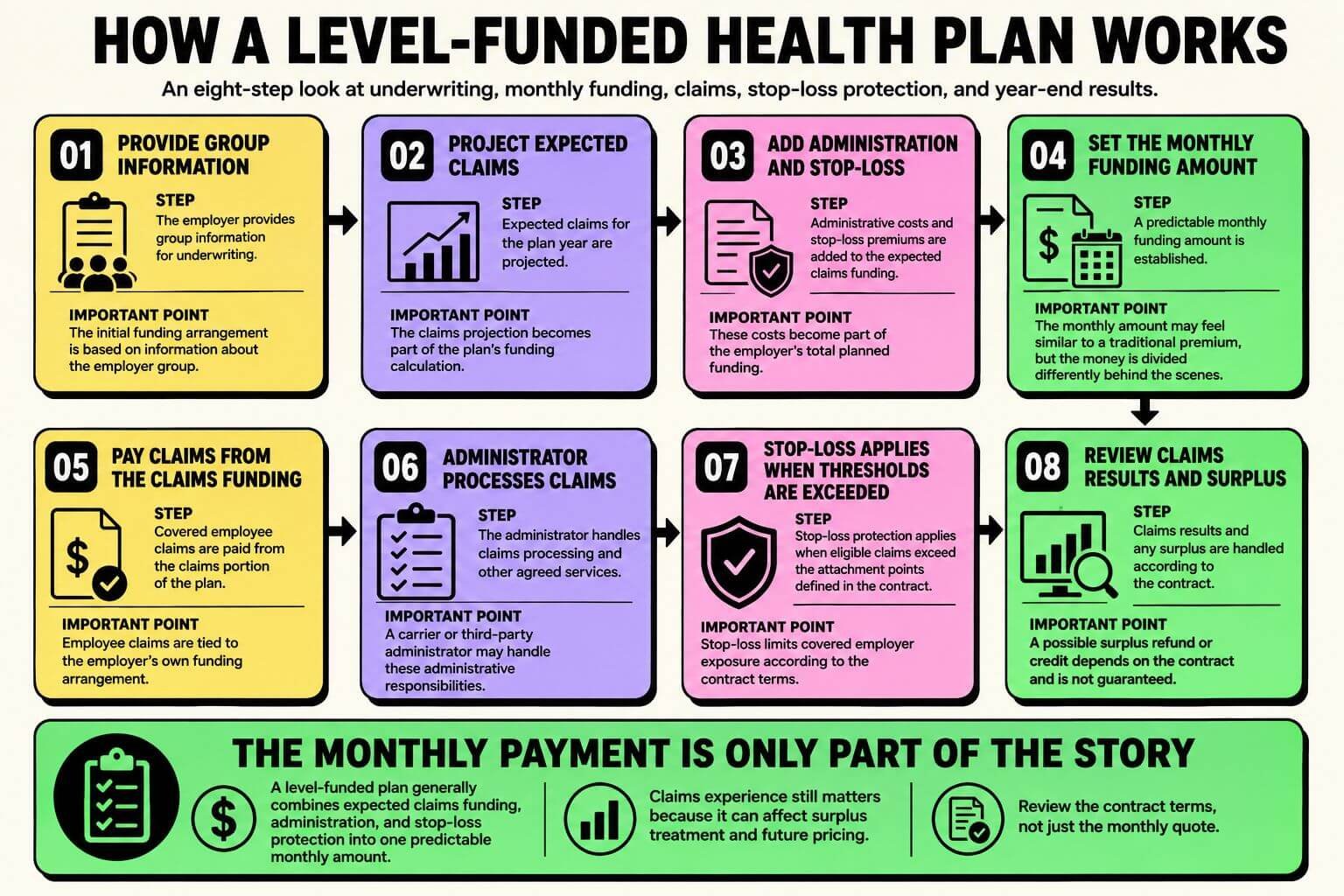
The basic process usually looks like this:
- The employer provides group information for underwriting.
- Expected claims for the plan year are projected.
- Administrative costs and stop-loss premiums are added.
- A set monthly funding amount is established.
- Claims are paid from the claims portion of the plan.
- The administrator handles claims processing and other agreed services.
- Stop-loss applies when eligible claims exceed the contract’s attachment points.
- Claims results and any surplus are handled according to the contract.
The monthly payment may feel similar to a fully insured premium, but the money works differently behind the scenes.
What Does the Monthly Payment Cover?
Most level-funded plans have three main cost components:
- Expected claims funding: Money set aside for covered medical and pharmacy claims.
- Administrative costs: Fees for claims processing, network access, reporting, and plan administration.
- Stop-loss premium: The cost of protecting the employer against covered claims above defined thresholds.
The exact breakdown varies by plan. Employers should ask to see each component rather than comparing proposals by monthly price alone.
How Are Employee Claims Paid?
Employees generally use the plan much like other employer medical coverage. They visit providers, present their insurance card, and covered claims are processed according to the plan’s benefits. Behind the scenes, those claims are paid from the employer’s claims funding. A carrier or third-party administrator may process them, but the funding arrangement is different from traditional fully insured coverage.
How Does Stop-Loss Insurance Protect the Employer?
Stop-loss insurance is one of the main protections built into level funding. It covers eligible claim costs above contractually defined attachment points. The U.S. Department of Labor explains that stop-loss protection can apply either to unusually high claims from one covered person or to total claims across the group. It generally protects the employer rather than serving as health insurance for employees.
Specific Stop-Loss
Specific stop-loss addresses unusually high eligible claims involving one covered person. If that person’s claims exceed the specific attachment point, stop-loss coverage responds according to the policy terms. Check the attachment point, exclusions, covered expenses, and reimbursement rules carefully. A competitive monthly quote can lose some of its appeal if the stop-loss contract leaves the employer carrying more risk than expected.
Aggregate Stop-Loss
Aggregate stop-loss looks at total eligible claims across the covered group. Protection generally begins once total claims cross the threshold defined by the contract. Employers should understand how that threshold is calculated and which claims count toward it.
What Happens When Claims Are Lower or Higher Than Expected?
This is where level funding becomes especially important to understand. The result can look very different depending on the group’s claims experience.
When Claims Are Lower Than Expected
If claims are below the funded amount, the plan may have a surplus. Depending on the contract, some of that surplus may come back to the employer as a refund or credit.
Do not assume every unused claims dollar will be returned.
Plans can have different surplus-sharing formulas, renewal requirements, run-out provisions, and other conditions. Ask how unused claims funding is handled before treating a possible refund as part of the savings.
When Claims Are Higher Than Expected
If claims run above projections, stop-loss protection may apply once covered claims cross the agreed thresholds.
That protection helps limit current-year exposure, but it does not erase the claims experience. A high-claims year can still affect underwriting and renewal pricing.
Employers should therefore review both maximum current-year exposure and how the next renewal will be calculated.
Level-Funded vs. Fully Insured vs. Self-Funded Plans
A short comparison makes the differences easier to see –
Plan Type | Monthly Cost | Claims Risk | Claims Visibility | Possible Surplus |
Fully insured | Fixed premium | Primarily carrier | Usually limited | Generally no |
Level funded | Fixed planned funding | Employer, limited by stop-loss terms | Often greater | Possible, based on contract |
Traditional self-funded | Claims can vary more directly | Employer, often with stop-loss | Typically greater | Unused claims funds may remain with the plan or employer, depending on structure |
Level funding sits between these approaches in how employers experience budgeting and claims risk. Employers who want a deeper comparison can review these funding model differences before deciding where level funding fits.
What Are the Benefits and Risks of Level Funding?
A level-funded plan can solve real problems, but the value depends on the employer, workforce, and contract.
Potential Benefits
Employers may value:
- Predictable monthly funding
- Better claims reporting
- A possible surplus when claims are favorable
- More information for renewal discussions
- Greater visibility into where plan dollars are going
Claims data can also help identify issues such as rising prescription costs or changes in how employees are using care.
Potential Trade-Offs
Employers also need to consider:
- Underwriting requirements
- Renewal sensitivity after a high-claims year
- Stop-loss contract details
- Surplus restrictions
- Run-out claims
- Added administration and compliance responsibilities
Level funding is not a guaranteed savings strategy. A lower first-year quote only tells part of the story.
Who Is a Level-Funded Health Plan a Good Fit For?
There is no single employee count that makes level funding the right choice. It may deserve consideration when an employer wants predictable monthly budgeting, better claims information, and the possibility of benefiting when claims are favorable. The group must also meet the carrier’s underwriting and participation requirements. Fully insured coverage may still make more sense for an employer that values simplicity, has limited benefits resources, or receives a stronger fully insured offer. The decision should come from the numbers and contract, not simply from the plan label.
What Should Employers Review Before Choosing a Level-Funded Plan?
Before signing, look beyond the monthly amount. Ask for clear answers on:
- Expected claims funding
- Maximum annual claim exposure
- Specific stop-loss attachment point
- Aggregate stop-loss attachment point
- Surplus or refund rules
- Run-out claims
- Renewal conditions
- Provider network
- Prescription drug arrangement
- Claims reporting
- Administrative fees
- Employee contribution requirements
- Compliance and enrollment support
Administration deserves attention too. If enrollment, eligibility changes, payroll deductions, and reporting already take too much HR time, consider whether your benefits administration technology can support the new plan.
What Should South Carolina Employers Know About Level Funding?
South Carolina employers should know that the regulatory setup can differ from traditional fully insured coverage. The South Carolina Department of Insurance says many self-funded employer plans do not fall under the department’s jurisdiction and instead fall under federal Department of Labor oversight.
That difference matters because changing funding arrangements can also change which rules and administrative responsibilities apply. Employers should confirm the requirements for their specific plan rather than assuming a level-funded contract works exactly like fully insured coverage.
Compare the Full Cost Before You Decide
A level-funded quote can look attractive when its monthly cost comes in below a fully insured renewal, but the monthly payment does not tell you everything. Review maximum annual exposure, specific and aggregate stop-loss terms, claims funding, administrative fees, surplus provisions, provider network, prescription drug arrangements, reporting access, and renewal rules. Ask what happens to unused claims funding and how outstanding claims are handled if the plan ends.
It also makes sense to compare more than one health plan approach. Level funding may fit one employer while traditional group coverage or an ICHRA option makes more sense for another. Benni Agency can help employers compare those details side by side without treating the lowest monthly quote as the only deciding factor. If you already have a level-funded proposal, comparing its total exposure and contract terms against your current plan is a sensible next step.