A failed compressor, electrical panel, or refrigeration system can create more than a repair bill. It can stop production, spoil inventory, interrupt customer service, and force a temporary closure. Equipment breakdown insurance is designed for certain sudden mechanical, electrical, and pressure-system failures that commercial property coverage may not address. For Charleston businesses, the important question is not simply whether the coverage appears on a policy. Owners should confirm which equipment qualifies, what indirect losses are included, and where limits or exclusions could leave a gap.
Key Takeaways
- Equipment breakdown insurance generally addresses covered mechanical, electrical, and pressure-system failures.
- Covered property may include HVAC, refrigeration, electrical systems, computers, boilers, and production machinery.
- Business income, extra expense, utility interruption, spoilage, and data restoration may require separate limits or provisions.
- Wear, deterioration, corrosion, and many external causes of loss are generally outside the coverage.
- The policy language, limits, deductibles, waiting periods, and endorsements determine how a specific claim is handled.
What Does Equipment Breakdown Insurance Cover?
Equipment breakdown insurance, historically called boiler and machinery insurance, can cover direct physical damage resulting from a covered breakdown. The modern name reflects the wider range of equipment businesses now use. Covered causes may include mechanical failure, electrical arcing, motor burnout, short circuits, and failures involving certain pressure systems. The precise definition of “breakdown” matters. A machine that stops working has not necessarily experienced a covered event.
Depending on the form, covered equipment may include:
- Heating and air-conditioning systems
- Refrigerators, freezers, and compressors
- Electrical panels, transformers, and wiring
- Boilers and other pressure equipment
- Motors, pumps, and production machinery
- Computers and communication systems
- Elevators and other building systems
Nationwide’s equipment breakdown overview also identifies repair costs, business-income losses, spoiled stock, and expenses incurred to speed restoration as potential coverage areas. These protections vary by policy and should not be assumed from the coverage name alone.
Direct Damage Is Only Part of the Exposure
The damaged equipment may be only one part of a loss. A Charleston restaurant could face spoiled inventory after a refrigeration breakdown. A professional office could lose access to essential systems after an electrical failure. A production business could miss orders while machinery is repaired.
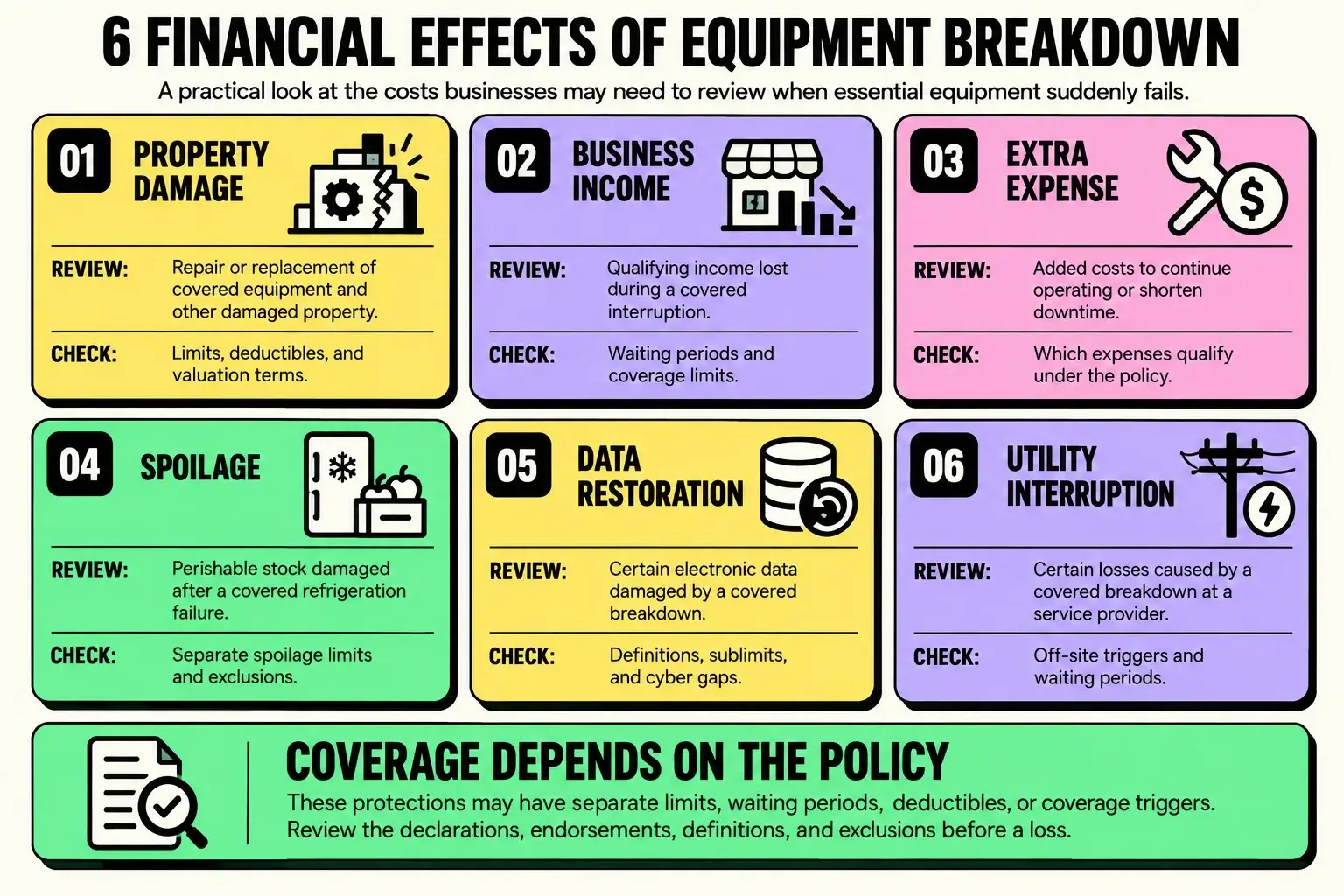
Equipment breakdown forms may offer protection for:
- Property damage: Repairing or replacing covered equipment and other property damaged by the breakdown
- Business income: Addressing qualifying income loss during a covered interruption
- Extra expense: Paying certain additional costs incurred to continue operating or shorten the interruption
- Spoilage: Covering qualifying perishable stock damaged by a covered refrigeration failure
- Data restoration: Restoring certain damaged electronic data, subject to the form’s definition and limits
- Utility interruption: Addressing certain losses caused by a covered breakdown at a utility or service provider
These provisions may have sublimits, waiting periods, separate deductibles, or specific triggers. Businesses should verify each one rather than treating them as automatic extensions.
Equipment Breakdown vs. Commercial Property Insurance
Commercial property insurance and equipment breakdown coverage address different causes of loss. A property policy may cover equipment damaged by a listed or otherwise covered external cause, such as fire or wind. Equipment breakdown coverage focuses on qualifying internal mechanical, electrical, or pressure-system failures. The distinction depends on what caused the damage. For example, an air-conditioning unit damaged by a covered wind event may fall under commercial property coverage. An internal electrical failure inside that unit may point toward equipment breakdown coverage. If both policies could be involved, their wording and loss-coordination provisions become important. Equipment breakdown coverage may be added to a Business Owners Policy (BOP), included within a Commercial Package Policy (CPP), or arranged through another commercial property structure. Businesses comparing broader coverage options can review Benni Agency’s business and commercial insurance services.
What Equipment Breakdown Insurance Usually Does Not Cover
Common exclusions or limitations may include:
- Ordinary wear and tear
- Gradual deterioration, rust, erosion, or corrosion
- Defects or conditions known before the policy began
- Certain maintenance-related problems
- Fire, flood, wind, and other causes handled or excluded elsewhere
- Software problems that do not result from covered physical damage
- Failure to meet the policy’s definition of a covered breakdown
A coastal environment can expose outdoor equipment to heat, humidity, salt, and severe weather, but those conditions do not automatically create an equipment breakdown claim. Gradual corrosion remains different from a sudden covered failure. Likewise, storm damage, flooding, and an internally generated electrical failure may involve different policies or exclusions. The cause of loss must therefore be investigated before coverage can be evaluated. The declarations, endorsements, exclusions, and definitions in the issued policy control.
Four Questions to Ask Before Choosing a Limit
1. Which systems could interrupt operations?
List equipment whose loss would stop or materially reduce operations. Include building systems, leased equipment, production machinery, refrigeration, electrical infrastructure, and essential technology.
2. What would replacement actually involve?
Consider repair or replacement cost, labor, shipping, installation, calibration, and the availability of replacement parts. Older equipment may require updates to surrounding systems or additional work before a replacement can operate.
3. What losses could continue during repairs?
Estimate how a shutdown could affect income, payroll, temporary relocation, equipment rental, spoiled stock, and expedited repairs. Then compare those exposures with applicable limits, sublimits, and waiting periods.
4. Does another party own the equipment?
A landlord, utility, or vendor may own the equipment that fails, but the business can still suffer lost income. Policyholders should confirm whether dependent property, service interruption, or equipment owned by others is addressed.
How Premiums and Coverage Terms Are Determined
There is no dependable flat price for equipment breakdown insurance. Underwriters may consider the equipment’s type, age, value, use, location, condition, loss history, and importance to operations. Selected limits, deductibles, optional extensions, and the structure of the underlying property program also affect the quote. Instead of relying on a general cost estimate, compare proposals using the same equipment values and interruption assumptions. A lower premium may reflect a higher deductible, narrower definition, shorter list of covered property, or reduced indirect-loss protection.
Reviewing Coverage Before Renewal
Before renewal, update the equipment inventory and identify any new machinery, electrical upgrades, refrigeration units, or technology. Confirm whether the current policy uses blanket or scheduled limits and whether property at every relevant location is included.
The review should also address:
- Equipment-breakdown and property deductibles
- Business-income limits and waiting periods
- Spoilage and utility-interruption sublimits
- Treatment of leased or landlord-owned equipment
- Data-restoration provisions
- Valuation and replacement terms
- Duties after a loss
- Coordination with warranties or service agreements
A warranty and an insurance policy serve different purposes. A warranty may address specific defects or repairs under its contract. Equipment breakdown coverage may address insured property damage and related losses, but only when the policy’s requirements are met. Charleston businesses that want to review equipment breakdown alongside property, liability, and other commercial policies can use Benni Agency’s Charleston insurance and benefits page as the next step.