A fire, burst pipe, severe storm, or other covered loss can damage more than a company’s physical space. It can also damage the inventory, furniture, tools, equipment, and technology that keep daily operations moving. Those items are commonly insured as business personal property, but payment after a covered loss depends on the policy wording, limits, valuation method, deductible, and applicable conditions. This guide is for Summerville business owners who want a clearer way to review business personal property values before a loss.
Key Takeaways
- Business personal property can include inventory, furniture, equipment, tools, technology, and other movable assets, but the policy definition ultimately controls what qualifies.
- Actual cash value, replacement cost, functional replacement cost, and agreed value can work differently, so businesses should confirm both the valuation basis and payment conditions.
- Coinsurance can affect a covered partial-loss payment when the property limit does not meet the required insurance-to-value percentage.
- Tenant improvements, property belonging to others, mobile equipment, and peak inventory may need separate consideration rather than being grouped into a basic contents total.
- Contents values should be reviewed at renewal and after major purchases, renovations, expansions, moves, inventory growth, or meaningful replacement-cost changes.
What Counts as “Contents” in a Commercial Property Policy
In commercial property insurance, “contents” usually means business personal property, or BPP. It is separate from the building itself. The exact definition comes from the policy, but BPP often includes movable property a business owns and uses at a covered location. That can include:
- Inventory, stock, display fixtures, and point-of-sale equipment
- Furniture, computers, electronics, and office equipment
- Tools, machinery, and equipment that are not part of the building
- Restaurant furnishings, kitchen equipment, and smallwares
- Tenant-funded improvements and betterments, depending on the policy and lease
Property belonging to customers, vendors, or others deserves separate attention. Some policies provide limited coverage, while others may require an endorsement or use different limits. Tools or equipment that regularly leave the premises may also need coverage designed for mobile or off-premises property.
How Commercial Property Policies May Value Contents
The declarations page, coverage form, and endorsements determine how a policy settles a covered loss. The common approaches below are useful starting points, but availability and claim requirements vary by carrier and policy. The National Association of Insurance Commissioners provides additional guidance on actual cash value and replacement cost and how the two approaches generally differ.
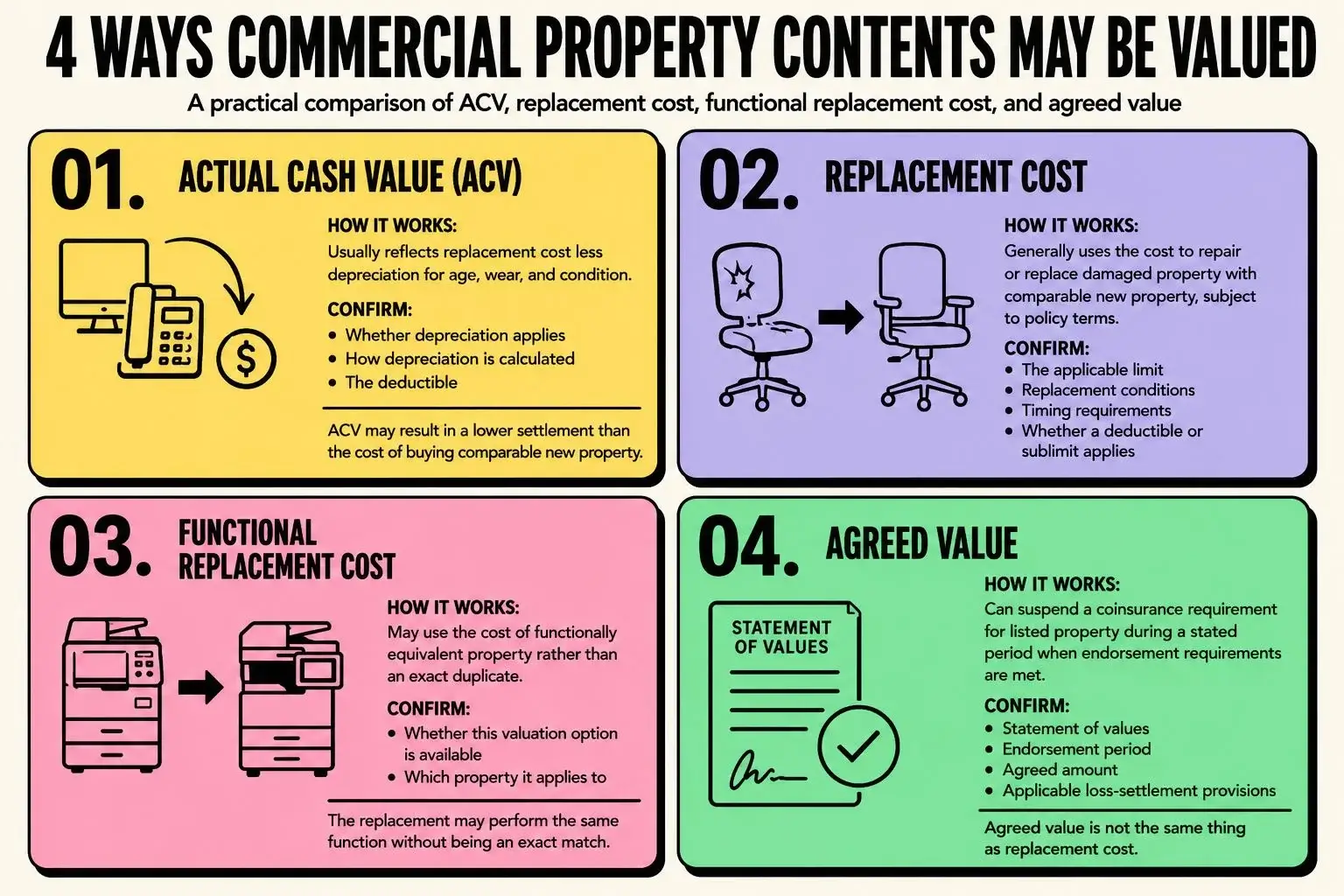
Replacement cost and agreed value are not interchangeable. Replacement cost is generally a loss-settlement approach, while agreed value is typically an endorsement tied to a statement of values that may affect coinsurance. The policy controls the details.
Why Insurance-to-Value and Coinsurance Matter
Many commercial property policies include a coinsurance condition. It generally requires a stated percentage of the property’s value, often 80%, 90%, or 100%, using the policy’s valuation basis.If the limit is too low, the insurer may reduce a covered partial-loss payment. Some policies may use a margin clause or agreed-value endorsement instead. Here is a simplified coinsurance example. Assume:
- The policy requires 80% insurance-to-value
- The applicable contents value is $200,000
- The policy limit is $120,000
- A covered loss is $40,000
The required amount of insurance would be $160,000. Before the deductible and any other applicable policy terms, the calculation could be: $120,000 ÷ $160,000 × $40,000 = $30,000
The actual claim result depends on the policy wording, cause of loss, limits, deductible, endorsements, and all applicable conditions. The value used for insurance should also match the policy’s settlement basis. Tax depreciation schedules and older purchase-price lists can help identify assets, but they may not show what the policy requires or what those items would cost to replace today.
How to Build a More Reliable Contents Valuation
A useful valuation is more than a single dollar figure. It should be an organized record that can be reviewed with an agent or insurer and updated as the business changes.
1. Make an Inventory
List business property by category and location. Photos, serial numbers, invoices, equipment descriptions, and current quantities can help support future updates and provide documentation after a loss.
2. Separate the Property Types
Distinguish building items, movable contents, inventory, tenant improvements, and property belonging to others. Separating these categories can make it easier to compare the inventory with the way the policy actually structures coverage.
3. Use Current Replacement Information
For major equipment and other high-value property, use current vendor pricing or a comparable replacement estimate where possible. Do not rely on book value as the only basis for setting a replacement-cost limit.
4. Review Special Property Needs
Ask about mobile tools, equipment used away from the premises, peak-season inventory, customer property, and other items that may need an endorsement, separate limit, or different coverage.
5. Compare the Policy at Renewal
Match the current inventory to the declarations, endorsements, deductibles, limits, and sublimits after major purchases, renovations, inventory growth, relocation, or a material price change.
Summerville Questions to Review Before a Loss
A contents valuation does not determine whether a particular cause of loss is covered. That answer depends on the policy. For a Summerville location, it is sensible to review the property declarations and endorsements for wind, named-storm, and flood provisions that apply to that address. Flood insurance is generally separate from a standard commercial property policy. Businesses can review FEMA flood insurance guidance for additional information about flood insurance and available coverage. FEMA also explains that business property flood coverage may apply to a business building, its contents, or both, depending on the policy purchased. Also check for separate wind or named-storm deductibles, water-damage exclusions, or sublimits. These terms depend on the carrier, coverage form, endorsements, and insured location.
Common Gaps That Can Affect a Claim
Property values and business operations can change gradually, which makes coverage gaps easy to overlook. Common issues to review include:
- Using a contents limit that has not changed since the business opened
- Valuing replacement-cost property from depreciated tax records alone
- Leaving out tenant improvements, new technology, or additional inventory
- Assuming a landlord’s policy insures the tenant’s business property
- Overlooking property belonging to others or equipment that regularly travels off premises
- Ignoring a coinsurance condition, margin clause, deductible, endorsement, or coverage sublimit
These are issues to identify during a policy review before a loss, not while a claim is already being adjusted.
When to Update Your Contents Limit
Review the contents limit at each renewal and sooner when the business:
- Buys or leases significant equipment, technology, furniture, or tools
- Increases inventory or adds storage capacity
- Renovates, expands, or funds a leased-space build-out
- Moves, opens another location, or changes how property is used
- Experiences a material change in the replacement cost of important equipment or supplies
Keep the review documented with an updated inventory, current estimates for major items, and a comparison with existing policy limits.
A Better Renewal Conversation
Compare a current inventory with the policy’s valuation provision, coinsurance or margin terms, deductibles, limits, and endorsements. For a broader review of property, liability, and other business risks, explore commercial insurance options through Benni Agency. Businesses looking for information about commercial coverage resources in the local area can also review business insurance in Summerville. If property coverage is part of a business owners policy, the Summerville BOP guide explains how property and liability coverage can fit within a broader insurance package. A licensed insurance professional can help compare policy terms, valuation provisions, and current limits.