Employee benefits can get expensive quickly, but cutting costs without a plan can create problems with hiring, retention, and employee satisfaction. Building an employee benefits strategy starts with knowing what your business needs, what employees value, what you can afford, and how you will measure whether the plan is working.
You do not need to add every benefit available. You need a package your employees can use and your business can support. This guide is for employers, business owners, and HR teams who want to make those decisions with a clear process instead of starting with insurance quotes.
Key Takeaways
- Start with business goals before comparing plans. Decide whether benefits need to improve affordability, recruiting, retention, cost stability, or HR efficiency.
- Audit your current benefits first. Review costs, enrollment, waivers, employee questions, administrative issues, and feedback before changing coverage.
- Ask employees what they actually value. Surveys and enrollment behavior can show where the current package helps and where employees struggle.
- Set a budget that works for both sides. Look at employer contributions, payroll deductions, deductibles, and expected workforce growth.
- Choose plans after the strategy is clear. Funding, coverage, administration, and communication should support the goals you already defined.
- Measure results every year. Participation, costs, employee feedback, recruiting signals, and HR workload can show what should stay and what needs attention.
What Is an Employee Benefits Strategy?
An employee benefits strategy is the plan behind the benefits your company offers. It explains what you offer, why you offer it, how much the company contributes, how employees access the benefits, and how you judge whether the program is working. That is different from simply having a benefits package. Medical, dental, vision, life, disability, and voluntary plans are products. The strategy is the reasoning that connects those products to your workforce, budget, hiring goals, and day-to-day HR needs. A good strategy should answer a basic question: What does our company need its benefits program to accomplish?
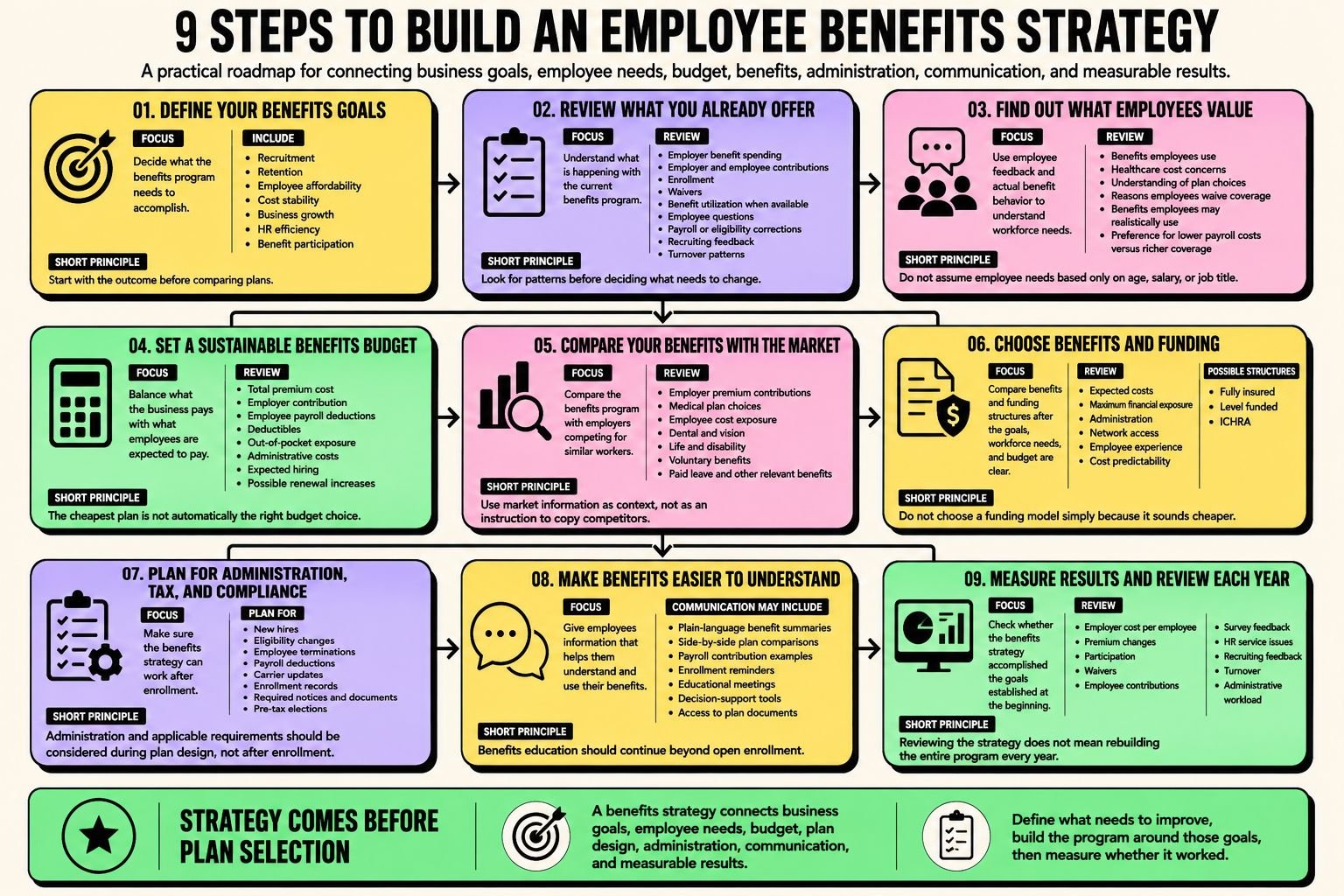
1. Define What Your Benefits Need to Accomplish
Before looking at carriers or plan designs, decide what problem you are trying to solve. For one employer, the priority may be keeping employee payroll deductions manageable. Another business may be losing candidates because its benefits are weaker than competitors. A growing company may care more about creating a program that can support new locations and a larger workforce. Common goals include:
- Improving recruitment
- Reducing employee turnover
- Keeping employee costs manageable
- Controlling renewal increases
- Supporting business growth
- Reducing HR administration
- Improving benefit participation
Try to connect each goal to something you can measure. If recruiting is the problem, look at candidate feedback and offer acceptance. If affordability is the concern, review employee contributions and waiver rates. If HR workload is the issue, track how much time is spent fixing enrollment, eligibility, and payroll problems. Start with the outcome, then look at the plan options.
2. Review What You Already Offer
You may not need a completely different benefits package. First, find out what is happening with the one you already have. Review information such as:
- Total employer benefit spending
- Employer and employee premium contributions
- Enrollment rates
- Coverage waiver rates
- Plan utilization, when available
- Benefits employees rarely choose
- Questions HR receives repeatedly
- Payroll or eligibility corrections
- Recruiting feedback
- Turnover patterns
Look for patterns rather than isolated complaints. For example, a high waiver rate could mean employees have coverage elsewhere. It could also mean your employee contribution is too high for part of the workforce. You need to know which problem you have before trying to fix it. The same applies to low enrollment in an optional benefit. Employees may not want it, or they may simply not understand what it covers.
3. Find Out What Employees Actually Value
Your employees should have a voice in the benefits strategy, but asking, “What benefits do you want?” usually does not give you enough information. Ask more useful questions. You might want to know:
- Which current benefits employees use most
- Where healthcare costs create the most concern
- Whether employees understand their plan choices
- Why people waive coverage
- Which additional benefits they would realistically use
- Whether employees value lower payroll deductions or richer coverage more
A short anonymous survey can help. Enrollment data, HR questions, recruiting feedback, and waiver reasons can add more context. Do not assume that age, salary, or job title tells you exactly what someone wants. Two employees in the same age group may have completely different priorities because of family coverage, prescriptions, doctors, financial circumstances, or coverage available through a spouse.
4. Set a Benefits Budget You Can Maintain
Cost control should not mean automatically choosing the cheapest plan. A benefits budget needs to account for what the company pays and what employees are expected to pay. Review:
- Total premium cost
- Employer contribution
- Employee payroll deductions
- Deductibles
- Out-of-pocket exposure
- Administrative costs
- Expected hiring
- Possible renewal increases
This matters because a plan can look affordable to the business while still being difficult for employees to use. For some South Carolina context, KFF reported that the average annual premium for employer-sponsored family coverage in the state was $24,280 in 2024. Employees contributed an average of $7,832, while employers paid an average of $16,448. Those numbers will not match every company, but they show why contribution strategy deserves careful attention. Premium cost is only one part of the decision. An employer also needs to consider how much employees pay from each paycheck and what they may owe when they actually receive care.
5. Compare Your Benefits With the Market
Your benefits do not have to beat every competitor. They should make sense for the people you are trying to hire and keep. Compare your program with employers competing for similar workers. Useful areas to review include:
- Employer premium contributions
- Medical plan choices
- Deductibles and other employee costs
- Dental and vision availability
- Life and disability coverage
- Voluntary benefits
- Paid leave and other relevant benefits
Industry and regional benchmarks can tell you whether your benefits are far behind, roughly in line, or unusually rich. Use that information as context, not as an instruction to copy other companies. If another employer pays a larger share of medical premiums, for example, your answer does not automatically need to be a higher contribution. You may decide that a different plan option, funding model, or benefit is more useful to your workforce.
6. Choose the Right Benefits and Funding Structure
Once you understand your goals, employees, and budget, you can start comparing plan structures. Employers may look at fully insured coverage, level-funded plans, or an ICHRA option, depending on group size, eligibility, budget, state rules, and what insurers make available. Do not choose a funding model simply because it sounds cheaper. Compare expected costs, maximum financial exposure, administrative requirements, network access, employee experience, and how predictable the arrangement will be for the business.
Build the Core Coverage First
Start with the benefits employees depend on most. For many businesses, medical coverage gets the most attention. Dental, vision, life insurance, and disability coverage may also form part of the core package based on employee needs and the employer’s budget. The point is not to offer the longest benefits list. A smaller package that employees understand and can afford may work better than a larger package filled with options that receive little use.
Use Voluntary Benefits Where They Solve a Clear Need
Voluntary benefits can give employees more choice without requiring the employer to pay the full premium for every option. They can be useful when employees want additional protection, but the employer has limited room in the benefits budget. Still, every option should have a reason for being there. Before adding another benefit, ask: What employee problem does this solve, and are enough people likely to use it? If there is no clear answer, adding another product may only make enrollment more confusing.
7. Plan for Administration, Tax, and Compliance
A benefits strategy also has to work after open enrollment ends. Think about how your team will handle:
- New hires
- Eligibility changes
- Employee terminations
- Payroll deductions
- Carrier updates
- Enrollment records
- Required notices and documents
- Pre-tax elections
If HR is entering the same information into several systems or regularly fixing enrollment errors, benefits administration technology may reduce some of that manual work. Tax design also deserves attention early. Depending on the benefits offered and how contributions are structured, tax-advantaged accounts may help employees pay eligible healthcare expenses with tax advantages. Compliance requirements can vary based on employer size, plan type, funding arrangement, and other factors. Review those requirements while designing the program instead of trying to fix them after enrollment.
8. Make Benefits Easier for Employees to Understand
A good plan loses value when employees cannot tell how it works. Think about the questions employees are likely to ask:
- What will come out of my paycheck?
- Which doctors can I use?
- What is my deductible?
- What happens if I need a prescription?
- Which plan is better for my family?
- When can I change my coverage?
Give employees information that helps them answer those questions. Useful communication can include:
- Plain-language benefit summaries
- Side-by-side plan comparisons
- Payroll contribution examples
- Enrollment reminders
- Short educational meetings
- Decision-support tools
- Easy access to plan documents after enrollment
Do not limit benefits education to one presentation during open enrollment. Employees make healthcare and financial decisions throughout the year. They should be able to find basic information when they actually need it.
9. Measure Results and Review the Strategy Each Year
Once the plan is running, check whether it is doing what you expected. Your annual review might include:
- Employer cost per employee
- Total premium changes
- Participation rates
- Waiver rates
- Employee contributions
- Survey feedback
- HR service issues
- Recruiting feedback
- Turnover patterns
- Administrative workload
Compare those results with the goals you set at the beginning. Suppose you wanted to reduce HR workload, but enrollment corrections are still taking hours every month. That tells you something needs attention even if the insurance rates are competitive. Or perhaps your goal was better employee affordability, but waiver rates increased after payroll deductions went up. That deserves a closer look. Reviewing the strategy every year does not mean rebuilding it every year. If most of the program is working, you may only need to adjust a contribution, replace one plan option, improve employee education, or fix an administrative problem.
When Your Benefits Strategy Needs Another Look
A benefits strategy does not need to be rebuilt every year, but some signs deserve a closer look. Maybe renewal costs keep rising without a clear reason. Employees may be waiving coverage because payroll deductions feel too high. HR could be spending hours correcting enrollment or eligibility issues. Your company may also be adding employees, locations, or different types of workers that the current plan was never designed to support.
Those situations do not automatically mean you need a new carrier or a completely different benefits package. Sometimes the better answer is changing employer contributions, adjusting plan choices, improving administration, or giving employees clearer information. Benni Agency can help employers review their current benefits against business goals, employee needs, costs, and administrative demands before deciding what should actually change. A benefits review can help you see what is working, what is costing too much, and what may be worth changing before the next renewal.