A high renewal, confused employees, and too many benefit admin tasks can make broker choice feel more stressful than it should. To choose a Goose Creek insurance broker for employers, look for more than plan quotes. The right broker should help you compare costs, explain trade-offs, support employees, manage enrollment, and guide benefits decisions throughout the year.
This guide is for Goose Creek business owners and HR teams who want to choose a broker with the right strategy and support and know what to review before the next renewal deadline.
Key Takeaways
- A Goose Creek insurance broker should help with more than annual quotes.
- The right broker looks at your workforce, budget, renewal timing, employee questions, and HR workload.
- Employers should ask about strategy, service, technology, compliance support, and post-enrollment help.
- A lower premium is not always better if the plan creates confusion, weak access, or higher employee costs.
- Growing Goose Creek employers may need flexible benefits options, clearer communication, and cleaner administration.
What a Goose Creek Insurance Broker Should Actually Do
A strong broker should not just bring you a few plan options and wait until renewal season. For employers, the broker’s job should include strategy, education, support, and administration guidance. That means looking at your budget, your workforce, your contribution strategy, and how employees actually use their benefits.
A good broker should help you answer questions like:
- Are employees using the plan?
- Are deductibles, copays, and networks creating problems?
- Is the company paying too much for benefits employees do not understand?
- Does HR have a clean process for enrollment, changes, and employee questions?
- Are there better plan designs worth reviewing?
For local companies that need practical benefits help, Benni provides support for Goose Creek businesses that want clearer choices and better benefits guidance.
Why Rate Shopping Is Not Enough for Employers
Shopping rates matters, but it should not be the whole strategy. A lower premium can look good at first. But if the plan has a weaker network, higher deductibles, poor employee understanding, or more admin work for HR, it may not solve the real problem.
Health coverage is already a major cost for employers. KFF reported that average annual employer-sponsored health insurance premiums in 2025 were $9,325 for single coverage and $26,993 for family coverage, with family premiums rising 6% from 2024. That is why employers need a broker who can explain the trade-offs, not just the price.
A useful broker should help you compare:
- Monthly premiums
- Deductibles and out-of-pocket costs
- Employee contributions
- Network access
- Prescription coverage
- Payroll and enrollment impact
- Employee communication needs
The goal is not always the cheapest plan. The goal is a benefits setup your business can afford and your employees can understand.
The Right Broker Fit Depends on Your Workforce
There is no one best benefits plan for every employer. A small office team may need a simple group plan with clean enrollment. A growing company may need better admin tools, clearer contribution planning, and stronger employee communication. A younger workforce may care more about affordability, while employees with families may focus on networks, dependent coverage, and predictable costs.
Goose Creek is also a growing market. U.S. Census Bureau QuickFacts shows the city reached an estimated 52,010 residents in July 2025, up 12.9% from its April 2020 estimate base. That growth matters because local employers may be competing harder for talent across the Charleston-area labor market. A broker should understand how your workforce affects your benefits strategy. For example:
- Hourly teams may need affordability and simple enrollment support.
- Professional teams may compare benefit quality closely when choosing jobs.
- Growing teams may need systems that can handle new hires and changes.
- Mixed-age teams may need more careful plan education.
- Budget-sensitive teams may benefit from reviewing voluntary benefits such as accident, critical illness, or hospital indemnity coverage.
A good broker should ask about your people before recommending a plan.
Questions to Ask Before You Choose a Broker
Before choosing a broker, ask direct questions. The answers will tell you whether the broker is focused on your business or only focused on the next renewal.
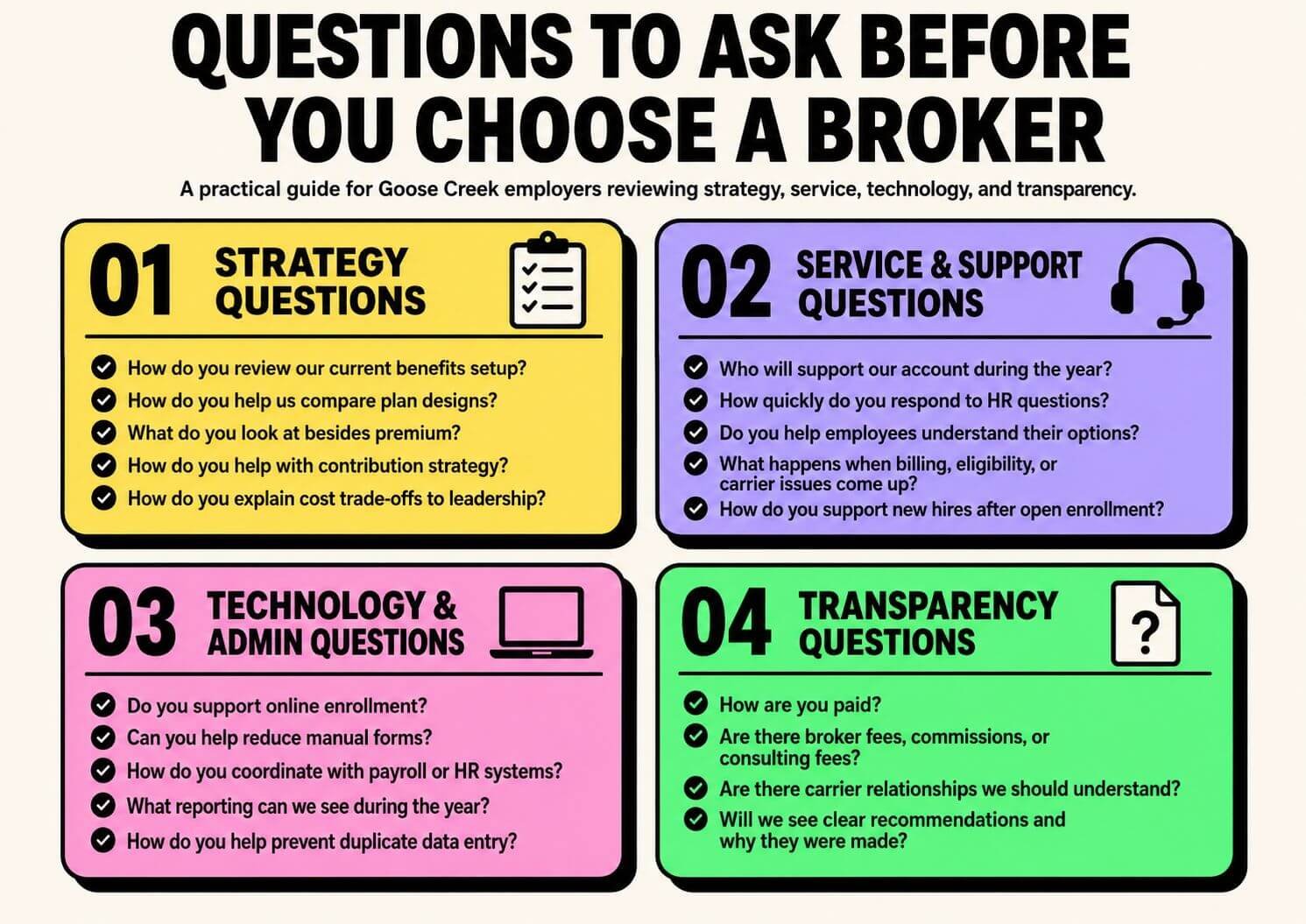
Strategy Questions
Ask:
- How do you review our current benefits setup?
- How do you help us compare plan designs?
- What do you look at besides premium?
- How do you help with contribution strategy?
- How do you explain cost trade-offs to leadership?
These questions help you see whether the broker thinks beyond quotes.
Service and Support Questions
Ask:
- Who will support our account during the year?
- How quickly do you respond to HR questions?
- Do you help employees understand their options?
- What happens when billing, eligibility, or carrier issues come up?
- How do you support new hires after open enrollment?
This matters because broker service is often tested after enrollment, not during the sales meeting.
Technology and Admin Questions
Ask:
- Do you support online enrollment?
- Can you help reduce manual forms?
- How do you coordinate with payroll or HR systems?
- What reporting can we see during the year?
- How do you help prevent duplicate data entry?
Strong benefits administration support can save HR time and reduce employee confusion.
Transparency Questions
Ask:
- How are you paid?
- Are there broker fees, commissions, or consulting fees?
- Are there carrier relationships we should understand?
- Will we see clear recommendations and why they were made?
A trustworthy broker should be comfortable explaining compensation and recommendations in plain English.
What Strong Support Looks Like After Enrollment
Open enrollment is only one part of the benefits year. After employees make selections, real issues still come up. Someone gets married. A new hire needs coverage. An employee has a billing question. Payroll deductions need to match elections. A carrier file does not process correctly. This is where broker support matters. Strong post-enrollment support should include:
- Helping HR manage eligibility changes
- Answering employee benefit questions
- Supporting billing or carrier issues
- Helping with payroll deduction problems
- Reviewing plan performance during the year
- Preparing early for renewal
If a broker disappears after enrollment, HR is left carrying the full weight of the benefits program. A better broker relationship should make the year feel more organized, not more confusing.
Where ICHRA and Flexible Plan Design May Fit
Some Goose Creek employers may need more than a traditional group plan. An Individual Coverage Health Reimbursement Arrangement, often called an ICHRA, can give certain employers a way to set a defined benefits budget while employees choose individual health coverage. It can be useful for companies with mixed employee groups, remote workers, multiple locations, or budget pressure.
But ICHRA is not automatically the best answer. A broker should help you compare the full picture:
- Does your team understand individual plan shopping?
- Are good individual plans available in your area?
- How would reimbursements be handled?
- Would employees need extra education?
- How would this compare with a group plan?
For some employers, ICHRA options can be worth reviewing. For others, a traditional group plan with better communication and cleaner admin may still make more sense. The broker’s role is to explain the choice clearly, not push one model every time.
When It Makes Sense to Review Your Broker Options
You do not need to change brokers every time premiums rise. But if each renewal feels rushed, employees ask the same questions every year, or your HR team is still chasing forms, invoices, eligibility updates, and carrier answers, it may be time to step back and review the relationship. A good broker review should not start with a sales pitch. It should start with your current plans, your workforce, your contribution strategy, your admin process, and what is not working for employees or leadership.
For Goose Creek employers, this can be helpful if the business is growing, hiring in a competitive market, or trying to offer better benefits without losing control of costs. Benni can help employers look at the full benefits setup and see where the plan, process, or support model may need to improve. If the current setup feels harder than it should, a broker review can help you see what needs to change before the next renewal.