Fleet insurance can coordinate multiple company vehicles under one commercial auto program, but it does not automatically provide every coverage a logistics operation may need. Liability, physical damage, customer cargo, rented vehicles, non-owned trailers, operating authority, and federal or state filings can each create separate questions.
For North Charleston logistics firms, a useful fleet review starts with the actual operation: which vehicles are used, who drives them, what freight they carry, where they operate, and which contracts or regulatory rules apply.
Key Takeaways
- Fleet insurance is a way to coordinate multiple commercial vehicles, not a guarantee that every vehicle or exposure receives identical coverage.
- Federal minimum public-liability requirements can vary by vehicle weight, cargo type, and operating authority.
- South Carolina generally requires at least 25/50/25 auto liability and minimum uninsured motorist coverage; underinsured motorist coverage is optional.
- Motor truck cargo, hired and non-owned auto, trailer-related coverage, and umbrella or excess liability may need separate review.
- Quotes are easier to compare when vehicle schedules, limits, deductibles, cargo assumptions, and operating details are kept consistent.
Why Fleet Coverage Matters for North Charleston Logistics Operations
North Charleston has genuine freight and transportation activity rather than simply being a city name added to a fleet-insurance article. The South Carolina Ports Authority says North Charleston Terminal handles roughly 22% of the Port of Charleston’s container volume. SC Ports also uses motor carriers in its Rapid Rail program to move containers between marine terminals and nearby rail yards. That makes vehicle, cargo, trailer, and operating-authority questions particularly relevant to transportation businesses working around North Charleston. It does not, however, mean every local logistics company faces the same routes, accident frequency, cargo values, or insurance premiums. Companies should base coverage on their own operations rather than on general assumptions about the local market.
What Fleet Insurance Actually Covers
Fleet insurance usually describes how several commercial vehicles are placed within a coordinated commercial auto program. The policy forms, declarations, covered-auto symbols, endorsements, vehicle schedule, and individual coverage selections determine what is actually insured. Benni Agency’s current Business & Commercial Insurance page includes both commercial auto and fleet insurance among its South Carolina commercial coverage offerings.
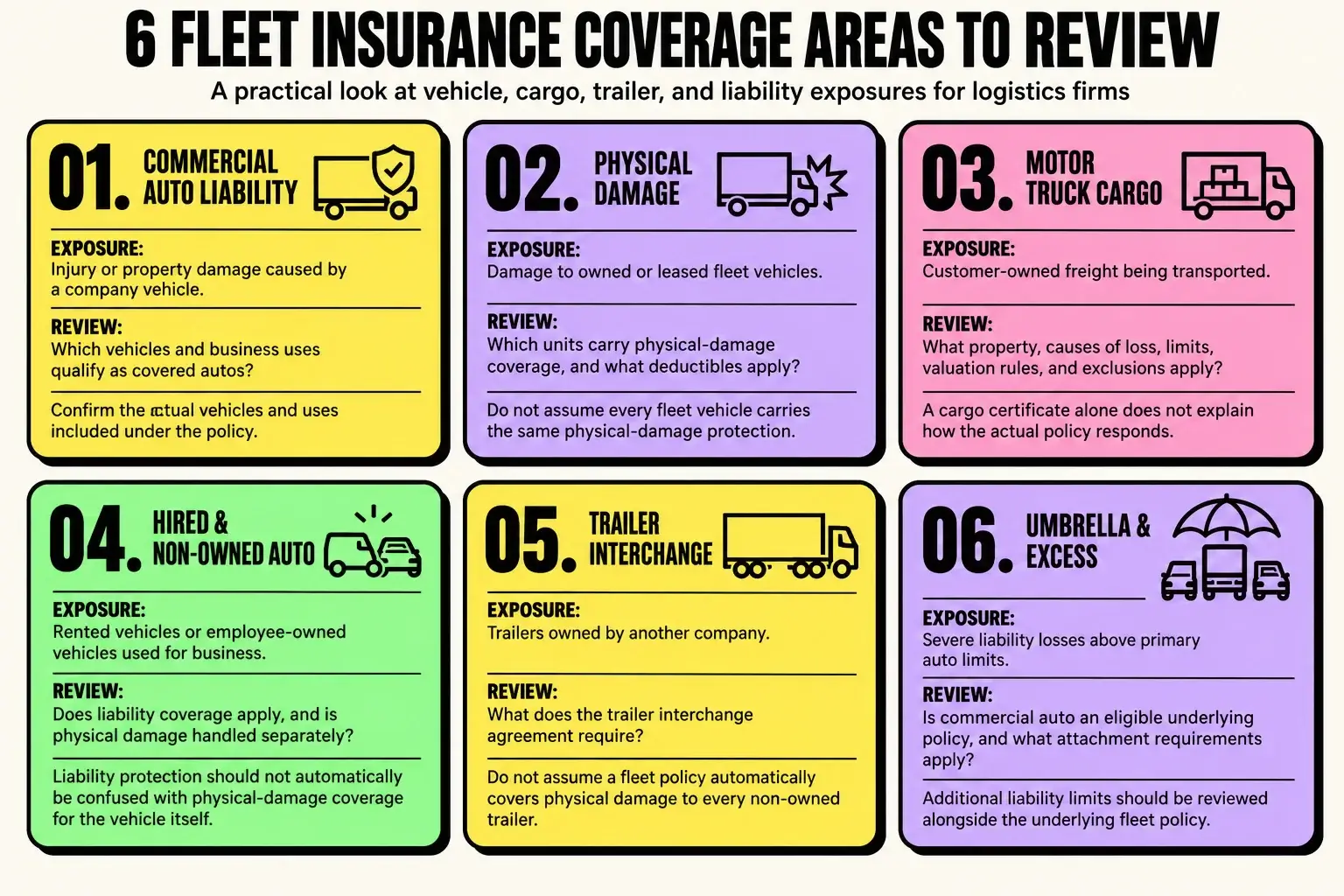
For a logistics company, the review may involve several different coverage areas:
| Operational Exposure | Coverage to Review | Main Question |
| Injury or property damage caused by a company vehicle | Commercial auto liability | Which vehicles and uses qualify as covered autos? |
| Damage to owned or leased fleet vehicles | Collision and comprehensive/other-than-collision coverage | Which units carry physical damage and what deductibles apply? |
| Customer-owned freight | Motor truck cargo | What property, causes of loss, limits, valuation rules, and exclusions apply? |
| Rented vehicles or employee-owned vehicles used for business | Hired and non-owned auto liability | Does liability coverage apply, and is physical damage handled separately? |
| Trailers owned by another company | Trailer interchange or other applicable physical-damage coverage | What does the interchange agreement require? |
| Severe liability losses above primary auto limits | Commercial umbrella or excess liability | Is commercial auto an eligible underlying policy and what attachment requirements apply? |
Workers’ compensation and general liability are separate policies. They should not be assumed to be part of a fleet policy merely because the exposures arise during transportation operations.
Commercial Auto Liability
Commercial auto liability can respond when a covered business vehicle causes bodily injury or property damage to another party, subject to the policy’s terms, exclusions, and limits. A logistics company should verify more than the limit shown on the declarations page. Covered-auto symbols, vehicle ownership, scheduled units, business use, and endorsements can determine how coverage applies.
Physical Damage
Collision and comprehensive or other-than-collision coverage can protect covered fleet vehicles against specified causes of loss. A company should review which vehicles have physical-damage coverage, the stated or actual values used by the policy, deductibles, leased-vehicle requirements, and any limitations affecting specialized equipment.
Motor Truck Cargo
Motor truck cargo insurance is designed to address certain loss or damage to property being transported for others. Coverage varies significantly by policy.
Important questions can include:
- Which commodities are eligible?
- What is the per-vehicle or per-load limit?
- How is damaged cargo valued?
- Does coverage apply during loading, unloading, or temporary storage?
- Are theft, unattended-vehicle losses, refrigeration breakdown, or particular commodities restricted?
A certificate showing cargo insurance exists does not answer those policy-specific questions.
Hired and Non-Owned Auto
Hired and non-owned auto coverage can address certain liability exposures when a business uses vehicles it does not own, such as rented vehicles or an employee’s personal vehicle used for company business. Liability coverage should not be confused with physical-damage coverage for the rented or employee-owned vehicle itself. The policy and rental or contractual arrangements should be reviewed separately.
Trailer Interchange
A logistics company pulling trailers owned by another party may have obligations under a trailer interchange agreement. Do not assume the fleet policy automatically covers physical damage to every non-owned trailer. The agreement, vehicle arrangement, and applicable endorsements should be compared.
Federal and South Carolina Minimum Insurance Requirements
A logistics fleet can be subject to more than one set of requirements. Federal rules can apply based on interstate operations, operating authority, vehicle weight, and cargo. South Carolina has separate insurance requirements for vehicles and certain intrastate for-hire carriers.
Federal Financial Responsibility for Property Carriers
FMCSA’s current insurance-filing guidance lists the following minimum bodily injury and property damage liability amounts for relevant property carriers:
| Operation | Federal Minimum Public Liability |
| For-hire, nonhazardous property carrier with GVWR under 10,001 pounds, when subject to the applicable federal requirement | $300,000 |
| For-hire, nonhazardous property carrier with GVWR of 10,001 pounds or more | $750,000 |
| Certain hazardous-material operations | $1,000,000 |
| Specified higher-hazard materials and operations | $5,000,000 |
These are minimum financial-responsibility amounts, not recommended limits for every company. Contracts, leases, shipper requirements, cargo, vehicle ownership, and the company’s own risk tolerance can lead to different insurance decisions. FMCSA also treats household-goods carriers differently for cargo filing purposes. General property carriers should not assume a federal cargo filing requirement applies simply because they carry freight.
BMC-91, BMC-91X, and MCS-90 Are Different Documents
When FMCSA proof-of-financial-responsibility filings are required, registered insurance filers generally submit forms such as BMC-91 or BMC-91X electronically to FMCSA. The MCS-90 serves a different function. It is an endorsement attached to the motor carrier’s liability policy when the federal financial-responsibility rules require it. It should not be described as simply another form filed with FMCSA in the same manner as a BMC-91 or BMC-91X. A logistics firm should verify both its active insurance and any required regulatory filings rather than assuming that purchasing a commercial auto policy completes every registration step.
South Carolina Auto Insurance Minimums
South Carolina’s minimum automobile liability limits are:
- $25,000 for bodily injury to one person
- $50,000 for bodily injury to two or more people
- $25,000 for property damage
South Carolina also requires uninsured motorist coverage at the statutory minimum. Underinsured motorist coverage is not mandatory, although insurers must offer it. These state minimums should not be confused with the higher financial-responsibility requirements that can apply to regulated motor carriers.
Intrastate For-Hire Operations
The South Carolina Department of Motor Vehicles maintains a Certificate of Compliance process for certain intrastate for-hire motor carriers. Its current motor-carrier guidance distinguishes Class E-L and Class E-LC property carriers and includes insurance requirements tied to carrier classification, vehicle weight, and cargo. A company operating only within South Carolina should therefore not assume that federal interstate rules are the only requirements worth checking.
What Affects Fleet Insurance Pricing?
There is no reliable “North Charleston fleet insurance price” that applies across logistics firms. Underwriting depends on the actual fleet and policy. Common factors can include:
Vehicle types and values. Cargo vans, box trucks, tractors, specialized vehicles, and trailers present different physical-damage and liability exposures.
Driver information. License class, driving history, experience, and motor vehicle records can affect underwriting.
Operating radius and territory. Local delivery, regional routes, interstate transportation, and long-haul operations are not necessarily rated the same way.
Cargo and commodities. What a company transports, how much is carried, and the maximum value at risk can affect cargo coverage and underwriting.
Limits and deductibles. Higher liability or physical-damage limits, lower deductibles, and additional coverages can change premium.
Loss history. Prior auto, cargo, and related claims may affect eligibility, pricing, or deductibles.
Operating authority and filings. For-hire status, federal filings, and South Carolina motor-carrier requirements can affect which insurance markets or policy structures are suitable.
Safety programs and telematics may also be considered by individual insurers, but their effect on pricing or eligibility depends on the carrier and program. Detailed driver-risk controls are better addressed separately from this fleet-policy guide.
Common Fleet Insurance Gaps to Review
1. The Vehicle Schedule Is Out of Date
Vehicles can be bought, sold, leased, replaced, or temporarily added during the policy year. At renewal, reconcile the policy schedule against the company’s actual fleet rather than assuming every operational vehicle was added correctly.
2. Cargo Coverage Does Not Match the Freight
A logistics company may carry customer property with values, commodities, or handling requirements that exceed what the current cargo policy contemplated. Review contracts and realistic maximum cargo values rather than relying only on a generic certificate of insurance.
3. Hired and Non-Owned Autos Are Overlooked
Employees may rent vehicles or occasionally use personal vehicles for business tasks. A fleet composed mainly of company-owned trucks can still have hired or non-owned auto exposure.
4. Non-Owned Trailers Are Assumed to Be Covered
Trailer interchange agreements can create physical-damage responsibilities for trailers belonging to another company. Verify the agreement and the actual policy response instead of treating every trailer as though it were company-owned equipment.
5. Owner-Operator Arrangements Are Treated Like Employee-Driven Fleet Vehicles
Independent contractors and owner-operators can create different insurance questions involving leases, operating authority, vehicle ownership, non-trucking liability, and scheduling. Whether a particular driver or vehicle is covered depends on the actual arrangement and policy language.
6. Workers’ Compensation Is Treated as an Auto Coverage Issue
A work-related injury involving a driver may raise workers’ compensation questions even when no third-party auto claim exists. South Carolina’s general rule requires workers’ compensation coverage for businesses regularly employing four or more people, but the statute contains exceptions and special classifications. Transportation companies using owner-operators should review their specific status rather than applying the employee-count rule without qualification.
7. A Specialized Operation Is Folded Into a General Fleet Assumption
A company transporting automobiles has different cargo, loading, securement, trailer, and contractual questions from a general freight operation. Businesses that haul vehicles can use Benni Agency’s North Charleston Auto Hauler Insurance Risk Checklist for that more specialized exposure instead of stretching a general fleet policy discussion into auto-hauler guidance.
Fleet Insurance Review Checklist for Logistics Firms
Before requesting quotes or reviewing a renewal, gather the information that allows insurers to evaluate the same operation.
- Build a complete vehicle schedule. Include year, make, model, VIN, ownership or lease status, garaging location, use, and vehicle value where relevant.
- Reconcile the driver list. Identify employees, owner-operators, occasional drivers, license classes, and other information requested by the insurer.
- Document the operating profile. Note typical territory, maximum radius, interstate or intrastate operations, and applicable operating authority.
- Describe the freight accurately. Include normal commodities, maximum cargo values, unusual loads, and any contractual cargo requirements.
- Identify non-owned exposures. List rented vehicles, employee-owned vehicles used for business, leased equipment, and non-owned trailers.
- Compare proposals on matching terms. Use the same vehicle schedule, limits, deductibles, cargo assumptions, and requested coverages whenever possible.
- Verify filings separately. Confirm required FMCSA or SCDMV filings rather than assuming the policy itself completes the regulatory process.
- Repeat the review after operational changes. Adding vehicles, changing routes, hauling different commodities, entering new contracts, or changing operating authority can justify a midterm review.
Coordinating Fleet Insurance With the Rest of the Business
Commercial auto is only one part of a transportation company’s insurance program. Depending on the operation, a logistics firm may also need to review motor truck cargo, workers’ compensation, general liability, commercial property, umbrella or excess liability, cyber coverage, or other policies. The goal is not to purchase every available coverage. It is to understand which policy is intended to respond to each major exposure and where a contract, exclusion, sublimit, or uninsured activity could leave a gap. For broader insurance options available to businesses in the area, see Benni Agency’s North Charleston insurance and benefits page.
One thought on “North Charleston Fleet Insurance for Logistics Firms”
Comments are closed.