When employees drive for work, insurance involves more than vehicles and limits. Driver selection, motor vehicle record reviews, written rules, training, maintenance, and accident follow-up show how a business manages road risk. This guide explains practical controls for Charleston employers with company cars, vans, pickups, or trucks and separates general safety practices from rules for regulated motor carriers.
Key Takeaways
- There is no universal legal vehicle count that turns commercial auto coverage into a fleet policy; carrier eligibility rules vary.
- South Carolina’s required auto liability limits are a legal minimum, not a recommendation for every business operation.
- Driver authorization should be based on a written standard, a valid license, an appropriate driving record, and the vehicle being operated.
- MVR reviews, coaching, maintenance records, and accident reviews are most useful when findings lead to documented action.
- Safety controls do not guarantee lower premiums, but they can give underwriters clearer evidence of how the business manages risk.
What Counts as a Fleet for Insurance Purposes?
“Fleet” is commonly used for a group of vehicles insured or managed together, but there is no single legal threshold that applies to every policy. One insurer may offer a fleet or mini-fleet program at a vehicle count another insurer handles differently. Vehicle type, ownership, use, garaging, drivers, operating radius, and loss history can all affect eligibility.
Build an accurate schedule of owned, leased, rented, and regularly used vehicles. Identify who drives each vehicle and why. This helps determine whether a fleet structure is available and whether hired or non-owned auto exposures need attention.
South Carolina Auto Requirements Are Only a Starting Point
The South Carolina Department of Insurance lists minimum limits of $25,000 for bodily injury to one person, $50,000 for bodily injury to all people in one accident, and $25,000 for property damage. South Carolina also requires uninsured motorist coverage at the 25/50/25 minimum level.
Those amounts establish a legal floor. They do not determine the right limits for a particular company. Contracts, leases, vehicle financing, cargo, passenger transportation, operating authority, and umbrella or excess policies may create other requirements. Businesses should compare those obligations with the actual policy rather than assuming registration minimums settle the coverage question.
Why Driver Controls Matter During Underwriting
Commercial auto underwriting can consider driver records, vehicle use, loss history, territory, limits, deductibles, and other operational characteristics. A documented safety process helps explain how the business responds to unsafe driving or accidents.
That documentation should be specific enough to verify. A statement that the company “takes safety seriously” is less useful than dated MVR reviews, signed policies, training records, maintenance logs, and completed accident-review forms. Controls may influence eligibility, terms, or pricing in some programs, but no individual practice guarantees a discount or renewal offer.
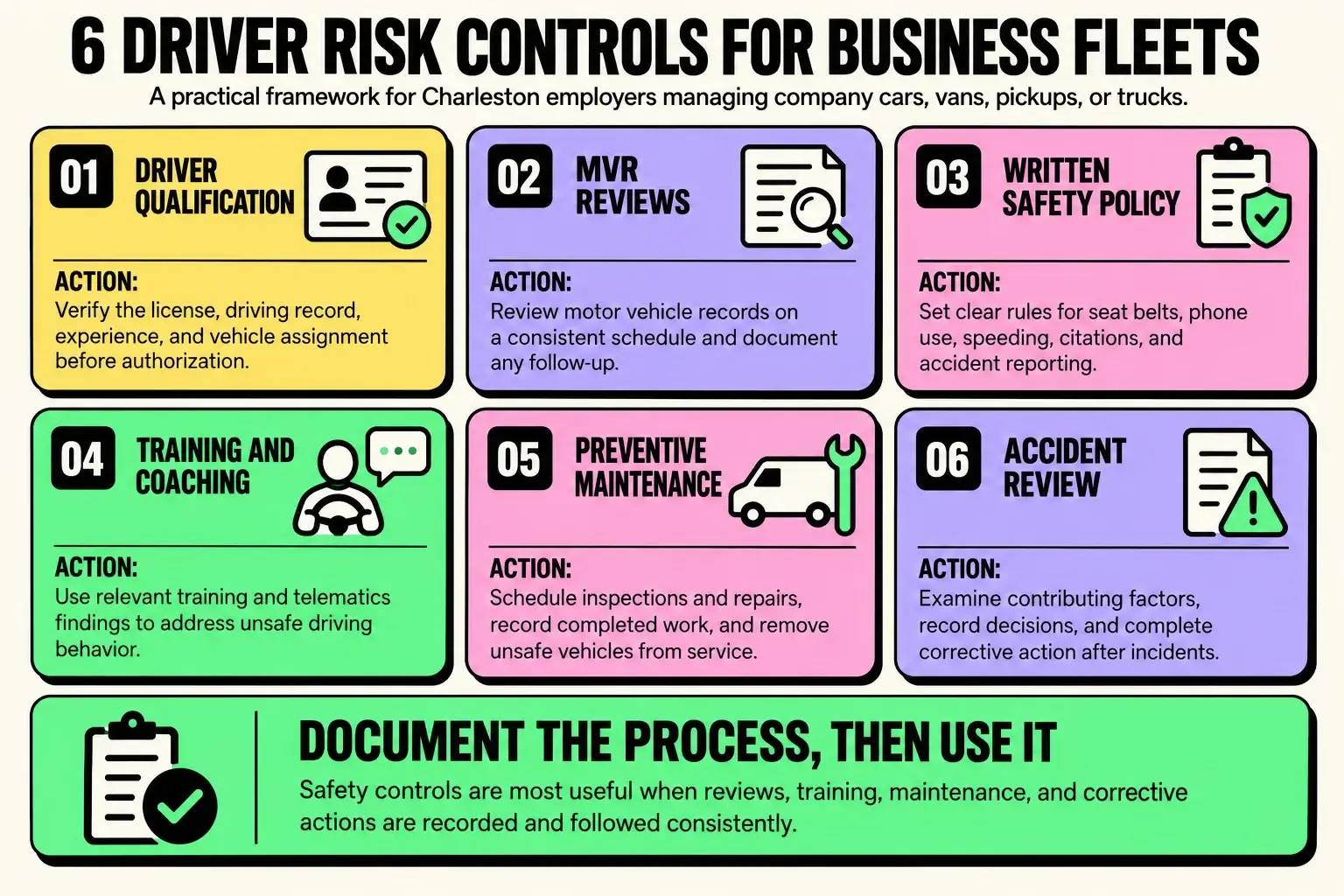
Six Driver Risk Controls to Put in Writing
1. Driver Qualification and Authorization
Set minimum standards before anyone drives on company business. Confirm that the person has a valid license appropriate for the vehicle and assignment. Define how the company evaluates serious violations, recent accidents, required experience, and exceptions. Apply the process to occasional and temporary drivers as well as regular drivers.
Maintain an authorized-driver list and remove access promptly when a license expires, a role changes, or the driver no longer meets company standards. Employment decisions should also follow applicable employment and privacy rules.
2. Motor Vehicle Record Reviews
Obtain an MVR before authorizing a driver when permitted and appropriate, then establish a recurring review schedule. The policy should identify who orders the record, who reviews it, what criteria apply, how results are documented, and what happens when new violations appear.
For drivers subject to 49 CFR Part 391, 49 CFR § 391.25 generally requires the motor carrier to obtain and review each employed driver’s MVR at least once every 12 months, subject to stated exceptions. The record and review note must be kept in the driver qualification file. Businesses should first confirm whether the rule applies to their operation and drivers.
3. A Practical Fleet Safety Policy
Write rules employees can follow during a normal workday. Address seat belts, speeding, distracted driving, phone use, passengers, personal use, vehicle security, impaired driving, accident reporting, citations, and required inspections. Explain consequences and apply them consistently.
Each driver should acknowledge the policy. Review it when vehicles, routes, technology, or duties change.
4. Training, Telematics, and Coaching
Training should reflect actual vehicles and tasks. New-driver orientation, defensive-driving refreshers, backing procedures, relevant load securement, and post-incident retraining may all have a place.
Telematics and cameras can provide information about speeding, harsh braking, seat-belt use, or other events, depending on the system. Decide in advance what will be measured, who may access the data, how long it is retained, and which events trigger coaching. Technology produces little value when alerts are collected but never reviewed.
5. Preventive Maintenance and Inspection Records
Use a maintenance schedule based on manufacturer guidance, mileage, time, duty cycle, and any rules applicable to the vehicle. Give drivers a simple way to report tire, brake, light, windshield, or other safety concerns and a clear process for taking an unsafe vehicle out of service.
Retain inspection, repair, and maintenance records. They help managers confirm that reported defects were addressed and provide useful documentation after an accident or during a regulatory review.
6. Accident Reporting and Corrective Action
Drivers need a clear accident-response procedure before a collision occurs. It should cover immediate safety, emergency assistance, internal notification, required information, photographs when safe, and instructions against admitting fault at the scene.
Afterward, review what happened without assuming every crash was preventable. Look for contributing factors, policy gaps, training needs, vehicle issues, and recurring patterns. Record the decision and follow-up action so lessons are not lost between incidents.
Match the Controls to the Insurance Program
Risk controls cannot repair a coverage gap. Review them alongside vehicle and driver schedules, liability limits, physical damage, deductibles, hired and non-owned auto, contractual requirements, and any umbrella or excess coverage. Benni Agency’s business and commercial insurance resources provide the broader service context, while the Charleston insurance and benefits page connects local employers with the appropriate review path.
Companies with transportation-specific exposures can also compare their program against Benni Agency’s fleet insurance guide for North Charleston logistics firms. That article focuses on policy structure and coverage gaps; this guide remains focused on driver controls. Bring the current policies, loss runs, vehicle schedule, driver list, safety policy, MVR process, maintenance records, and relevant contracts to the review. A licensed insurance professional can then evaluate the operation against available carrier requirements and policy language. Legal or regulatory questions should be addressed with qualified counsel or the responsible agency.