North Charleston auto hauler insurance needs a separate review from ordinary commercial auto coverage. Vehicle transport businesses face a mix of liability, cargo, equipment, filing, securement, workforce, and contract-related risks that standard trucking policies may not address in the same way.
Federal financial-responsibility rules can require higher liability limits for auto haulers, and the right coverage structure depends on the vehicles being transported, the equipment used, operating authority, routes, and customer requirements.
This guide is for North Charleston auto haulers preparing for a quote or renewal and looking to identify important coverage and compliance issues before choosing or updating a policy.
Key Takeaways
- PHMSA states that motor carriers transporting motor vehicles in commerce must maintain at least $1 million in public liability coverage under 49 CFR Part 387.
- FMCSA does not require a federal cargo filing for property carriers other than household-goods carriers, but contracts and South Carolina requirements can create separate cargo obligations.
- Federal operating authority, financial-responsibility filings, South Carolina intrastate requirements, and commercial driver licensing are separate compliance questions that should not be treated as one rule.
- Cargo limits should reflect the highest realistic vehicle value carried on one trailer and be reviewed alongside valuation terms, deductibles, exclusions, loading provisions, and contracts.
- North Charleston has a genuine vehicle-logistics connection through South Carolina Ports, but location alone does not determine premiums, limits, carrier eligibility, or policy terms.
Why Auto Hauler Insurance Needs a Separate Review
The main distinction is the vehicle cargo. PHMSA Interpretation 09-0074 explains that motor vehicles transported in commerce can qualify for the hazardous-material exception in 49 CFR 173.220(g), while still meeting the hazardous-material definition for Part 387 financial-responsibility purposes.
PHMSA states that a carrier transporting motor vehicles in commerce must maintain at least $1 million in public liability coverage. That federal liability minimum is not a complete auto-hauler insurance program. A carrier still needs to review:
- Trucks
- Owned and non-owned trailers
- Customer vehicles in transit
- Employees and drivers
- Owner-operator relationships
- Contracts
- Loading and unloading practices
- Storage or terminal exposure
- Actual policy terms
The FMCSA insurance filing requirements establish federal financial-responsibility requirements, while the insurance policy itself determines what losses, vehicles, drivers, and operations the insurer agrees to cover.
Why North Charleston Is Relevant to Vehicle Transport
North Charleston has a verified connection to vehicle logistics through South Carolina Ports. In May 2026, SC Ports announced plans to expand roll-on/roll-off operations to North Charleston Terminal, with construction planned to begin in 2027 and completion planned for 2028. The Columbus Street Terminal currently handles vehicles, rolling stock, and other roll-on/roll-off cargo. Those facts make vehicle transportation a legitimate North Charleston topic.
They do not prove that North Charleston auto haulers:
- Pay higher insurance premiums
- Need identical limits
- Use certain insurers
- Have the same contracts
- Operate the same routes
- Face one universal local insurance requirement
Insurance should instead be reviewed using the hauling business’s actual vehicles, routes, equipment, workforce, contracts, and customer-vehicle values.
The Auto Hauler Insurance Risk Checklist
Use this checklist to organize a first quote or renewal review. Coverage names can vary between insurers, so the policy label alone does not tell you everything that is covered. Review the:
- Declarations
- Coverage forms
- Endorsements
- Exclusions
- Limits
- Sublimits
- Deductibles
1. Primary Auto Liability
Primary commercial auto liability addresses covered bodily injury and property-damage claims arising from operation of insured commercial vehicles. For motor carriers transporting motor vehicles in commerce, PHMSA states that Part 387 requires at least $1 million in public liability coverage. Contracts may require higher limits.
Compare:
- Policy liability limit
- Contract requirements
- Vehicles shown on the policy
- Drivers
- Operations
- Required federal filings
Do not assume that meeting the federal minimum automatically satisfies every customer or facility contract.
2. Motor Truck Cargo or Vehicle-in-Transit Coverage
Cargo coverage addresses certain covered loss or damage to customer vehicles being transported, subject to the policy’s terms. FMCSA does not require a federal cargo insurance filing for motor carriers of property other than household-goods carriers. That does not eliminate possible:
- Customer contract requirements
- Broker requirements
- Dealer requirements
- South Carolina filing requirements
- Lender requirements
Start by calculating the highest realistic total value of customer vehicles that could be loaded on one trailer. Then review:
- Per-vehicle limits
- Per-occurrence limits
- Total cargo limit
- Valuation method
- Deductibles
- Excluded causes of loss
- Loading coverage
- Unloading coverage
- Temporary storage provisions
- Vehicle-type restrictions
- High-value vehicle limitations
The number shown as a cargo limit is only useful when it matches the actual vehicles being transported.
3. Physical Damage for the Truck and Owned Trailer
Physical damage coverage can address covered collision and other insured physical losses involving the hauling company’s own truck or scheduled trailer. It is separate from:
- Liability coverage for damage caused to others
- Cargo coverage for customer vehicles
Review:
- Tractor value
- Trailer value
- Stated or agreed values where applicable
- Comprehensive coverage
- Collision coverage
- Deductibles
- Scheduled equipment
- Permanently attached equipment
Financing or lease agreements may also require specific physical-damage terms.
4. Non-Owned Trailer and Trailer Interchange Exposure
A hauler that pulls trailers it does not own should confirm how damage to those trailers is insured. Trailer interchange coverage may apply when the business has possession of a non-owned trailer under an interchange agreement. Other arrangements involving borrowed, leased, rented, or otherwise non-owned trailers may require a different coverage structure. Match the insurance to:
- Trailer ownership
- Written agreement
- Who has custody
- Who is responsible for physical damage
- Trailer values
- Deductibles
Do not rely on “trailer interchange” as a catch-all label for every non-owned trailer arrangement.
5. Non-Trucking and Off-Dispatch Use
Leased owner-operators may have liability exposures when a tractor is not operating on behalf of the motor carrier. Terms such as:
- Non-trucking liability
- Bobtail insurance
They are sometimes used differently. Review the actual coverage form instead of assuming every insurer uses these terms to describe the same protection. Pay attention to:
- Dispatch status
- Personal use
- Deadheading
- Lease terms
- Motor-carrier responsibilities
- Exclusions
6. General Liability and Premises Exposure
Commercial general liability can address certain covered third-party claims occurring outside the use of a commercial auto. An auto-hauling operation may have exposures involving:
- Office premises
- Loading areas
- Terminals
- Customer visits
- Contractual activities
- Other non-auto operations
Commercial auto and general liability are separate coverage parts. Review both rather than assuming commercial auto covers every liability exposure connected with the hauling business.
7. Workers’ Compensation and Driver Status
The South Carolina Workers’ Compensation Commission employer FAQs explain that the general rule requires employers with four or more employees to carry workers’ compensation coverage. Part-time employees and family members count toward that general rule. Exemptions exist, including a specific owner-operator provision when the applicable conditions are met.
The Commission’s coverage and compliance FAQs also explain that receiving a 1099 does not determine independent-contractor status by itself. Driver relationships should therefore be reviewed using:
- Actual job duties
- Control over work
- Contractual relationship
- Current workforce
- Applicable South Carolina requirements
Rather than job titles alone.
8. Excess Liability and Contract Requirements
Customers, brokers, lenders, lessors, terminals, and facilities may require:
- Higher liability limits
- Additional insured status
- Waivers
- Specific endorsements
- Certificates of insurance
- Contract-specific wording
An umbrella or excess liability policy may provide additional limits over eligible underlying policies, subject to its own terms and underlying insurance requirements. Compare the actual contract with the actual policy endorsements. A certificate of insurance alone does not change the underlying policy.
Federal Financial Responsibility and South Carolina Filing Rules
Start by separating operating authority from insurance filings. A for-hire carrier transporting regulated property in interstate commerce may need FMCSA operating authority when no exemption applies. Review the FMCSA types of operating authority before assuming that registration and insurance filings are the same requirement. FMCSA then requires proof of financial responsibility tied to the authority. For public liability, registered insurers may electronically file forms such as:
- BMC-91
- BMC-91X
The FMCSA insurance filing requirements explain the federal filing process.
What Is the MCS-90?
The FMCSA MCS-90 guidance explains that the MCS-90 is an endorsement attached to a motor carrier’s liability insurance policy to satisfy federal public-liability requirements. It is not a separate insurance policy. It also should not be treated as a substitute for reading the actual underlying liability coverage.
South Carolina Intrastate Filing Requirements
Intrastate for-hire operations may fall under South Carolina Department of Motor Vehicles Certificate of Compliance requirements. The SCDMV Certificate of Compliance program uses certificate classes and insurer filings.
Depending on the certificate class, SCDMV may require:
- Form E for liability
- Form H for cargo when applicable
Current requirements may depend on:
- Vehicle weight
- Commodity classification
- Certificate type
- Type of operation
Confirm the applicable SCDMV class and form before relying on a general insurance checklist.
Driver Licensing Is a Separate Requirement
Insurance limits and operating authority do not determine which commercial driver’s license a driver needs. The South Carolina Commercial Driver’s License manual defines Class A using vehicle weight ratings. The current definition generally involves a combination vehicle with a gross combination weight rating of at least 26,001 pounds when the towed unit has a gross vehicle weight rating above 10,000 pounds. Actual vehicle ratings and use determine the required license class. Check the truck and trailer ratings instead of assuming every auto-hauler combination requires the same CDL classification.
Cargo Securement Is Part of the Risk Review
Insurance does not replace required cargo securement. The FMCSA cargo securement rules include vehicle-specific requirements. For automobiles, light trucks, and vans weighing 10,000 pounds or less individually, 49 CFR 393.128 applies. Each vehicle must be restrained at the front and rear using at least two tiedowns designed to prevent:
- Lateral movement
- Forward movement
- Rearward movement
- Vertical movement
Vehicles weighing more than 10,000 pounds fall under the heavy-vehicle rule in 49 CFR 393.130. Use the securement rule that matches the vehicle being transported and use tiedowns and attachment points that meet the applicable requirements.
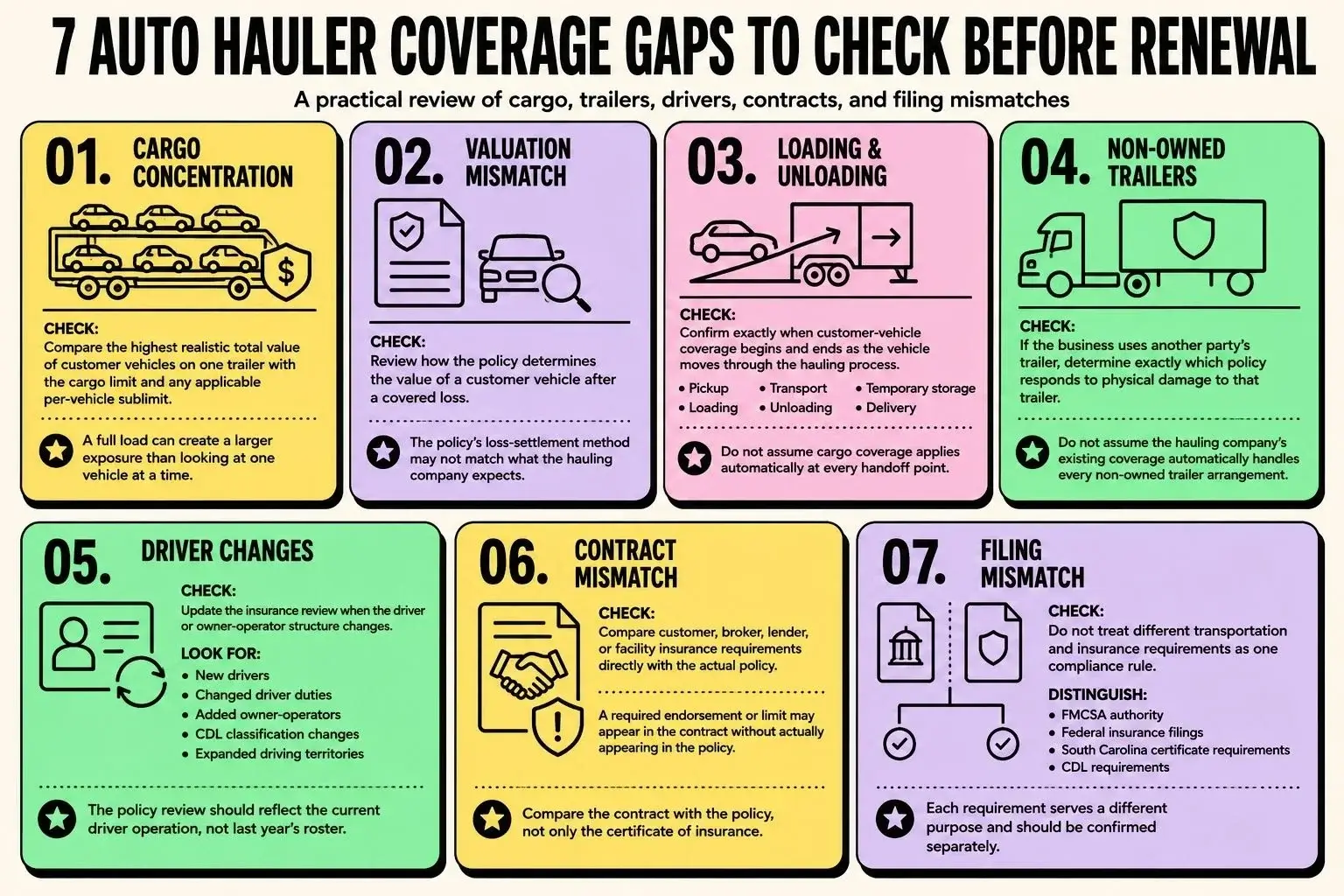
Common Coverage Gaps to Check Before Renewal
Cargo Concentration
The total value of customer vehicles on one trailer may exceed the cargo limit or an applicable per-vehicle sublimit. Compare maximum realistic load values with the policy.
Valuation Mismatch
The policy’s loss-settlement method may differ from what the hauling company expects after a covered loss. Review valuation wording before a claim.
Loading or Unloading Assumptions
Do not assume cargo coverage applies at every handoff point. Confirm when coverage begins and ends during:
- Pickup
- Loading
- Transport
- Unloading
- Temporary storage
- Delivery
Non-Owned Trailer Exposure
If the company uses another party’s trailer, determine exactly which policy responds to physical damage.
Driver Changes
Update the insurance review when:
- New drivers are hired
- Driver duties change
- Owner-operators are added
- CDL classifications change
- Driving territories expand
Contract Mismatch
A customer, broker, lender, or facility may require an endorsement or limit that is not actually shown in the policy. Compare the contract with the policy, not just the certificate.
Filing Mismatch
Do not treat:
- FMCSA authority
- Federal insurance filings
- South Carolina certificate requirements
- CDL requirements
As one compliance rule. Each serves a different purpose.
Prepare for a More Useful Auto Hauler Quote
A clean insurance submission gives an insurer or broker a clearer picture of the operation. Prepare current information before comparing proposals.
Truck and Trailer Schedule
Include:
- Year
- Make
- Model
- VIN
- GVWR
- GCWR where relevant
- Stated value
- Ownership
- Financing details
- Lease information
Driver Information
Prepare:
- Current driver list
- License class
- Motor vehicle records when requested
- Driver experience
- Owner-operator relationships
- Recent driver changes
Cargo Profile
Document:
- Number of vehicles hauled
- Types of vehicles transported
- Typical vehicle value
- Maximum individual vehicle value
- Maximum total value on one trailer
- Specialty or high-value vehicles
Operations
Document:
- Operating radius
- Interstate activity
- Intrastate activity
- Operating authority
- Terminals
- Storage locations
- Loading practices
- Unloading practices
Contracts
Gather insurance provisions from:
- Brokers
- Dealers
- Shippers
- Lenders
- Leases
- Terminals
- Facilities
- Major customers
Include requested certificates and endorsements.
Insurance History
Prepare:
- Current declarations
- Policy endorsements
- Loss runs or loss history
- Prior claims
- Known operational changes since the last policy term
Using consistent information makes it easier to compare quotes fairly.
What Affects Auto Hauler Insurance Cost?
There is no dependable flat North Charleston price for auto hauler insurance. Premiums can change based on:
- Trucks and trailers
- Equipment values
- Driver records
- Loss history
- Operating radius
- Interstate or intrastate operations
- Cargo values
- Liability limits
- Cargo limits
- Deductibles
- Ownership and lease arrangements
- Insurer underwriting
A lower quote may reflect different:
- Limits
- Deductibles
- Exclusions
- Drivers
- Equipment schedules
- Cargo provisions
- Valuation terms
Compare proposals using the same operating information and coverage assumptions before treating price as the deciding factor.
Auto Hauling Is Different From Tow Truck Operations
Auto hauling and towing can physically overlap, but their insurance questions are not identical. A towing company that performs roadside recovery, stores customer vehicles, or participates in a South Carolina Highway Patrol rotation list may need to review:
- On-hook coverage
- Garage keepers coverage
- Storage-lot exposure
- Rotation-list requirements
Those issues do not define a standard scheduled auto-hauler operation. If the business performs towing or recovery in addition to vehicle transport, review Benni Agency’s North Charleston Tow Truck Insurance Coverage Guide for those separate exposures.
Reviewing Auto Hauler Coverage With Benni Agency
Benni Agency’s Business & Commercial Insurance services include commercial auto and related business coverages. For an auto-hauling review, the most useful starting point is the actual operation:
- Trucks
- Trailers
- Drivers
- Cargo values
- Routes
- Filings
- Contracts
- Current policy forms
Businesses serving the area can also use Benni Agency’s North Charleston service-area page for the local contact path and broader business insurance and employee benefits information. A coverage review should compare available policy terms with the business’s stated exposures. Coverage remains subject to insurer underwriting and the terms, conditions, exclusions, limits, and endorsements of the issued policy.
One thought on “North Charleston Auto Hauler Insurance Risk Checklist”
Comments are closed.