Seeing an unexpectedly high price at the pharmacy can leave you wondering whether you can afford the medication at all. To save on prescription medications in Charleston without insurance, start by comparing cash prices, checking legitimate discount programs, asking about generic options, and reviewing assistance programs available in South Carolina.
The lowest price can vary by pharmacy, quantity, and medication. This guide is for Charleston residents, employers, and HR teams looking for practical ways to reduce costs and help people find reliable support.
Key Takeaways
- Ask for the pharmacy’s cash price before using a coupon or discount card.
- Compare the same medication, strength, and quantity at more than one pharmacy.
- Ask a pharmacist or prescriber whether an approved generic or lower-cost option is available.
- Check whether a 90-day supply lowers the total cost, but do not assume it always will.
- Eligible uninsured South Carolina residents may qualify for help through Welvista, community clinics, or manufacturer programs.
- Prescription discount cards may lower some prices, but they are not insurance and do not guarantee the lowest cost.
Why Prescription Prices Can Be So Different Without Insurance
Without insurance, you may be asked to pay the pharmacy’s full cash price. That price can be affected by the pharmacy, medication strength, quantity, dosage form, and whether a generic version is available. Two pharmacies can charge different amounts for the same prescription. A coupon or discount card may also produce a different price at each location because pharmacies participate in different pricing agreements. That is why it helps to compare the exact prescription rather than searching only by medication name. Make sure each quote covers the same:
- Medication
- Strength
- Dosage form
- Quantity
- Brand or generic version
This issue affects a meaningful share of the local community. The U.S. Census Bureau estimates that 10% of Charleston County residents under age 65 lacked health insurance during the 2020–2024 reporting period. For uninsured residents, checking prices and assistance options can make necessary medications easier to afford.
Compare the Actual Price Before You Pay
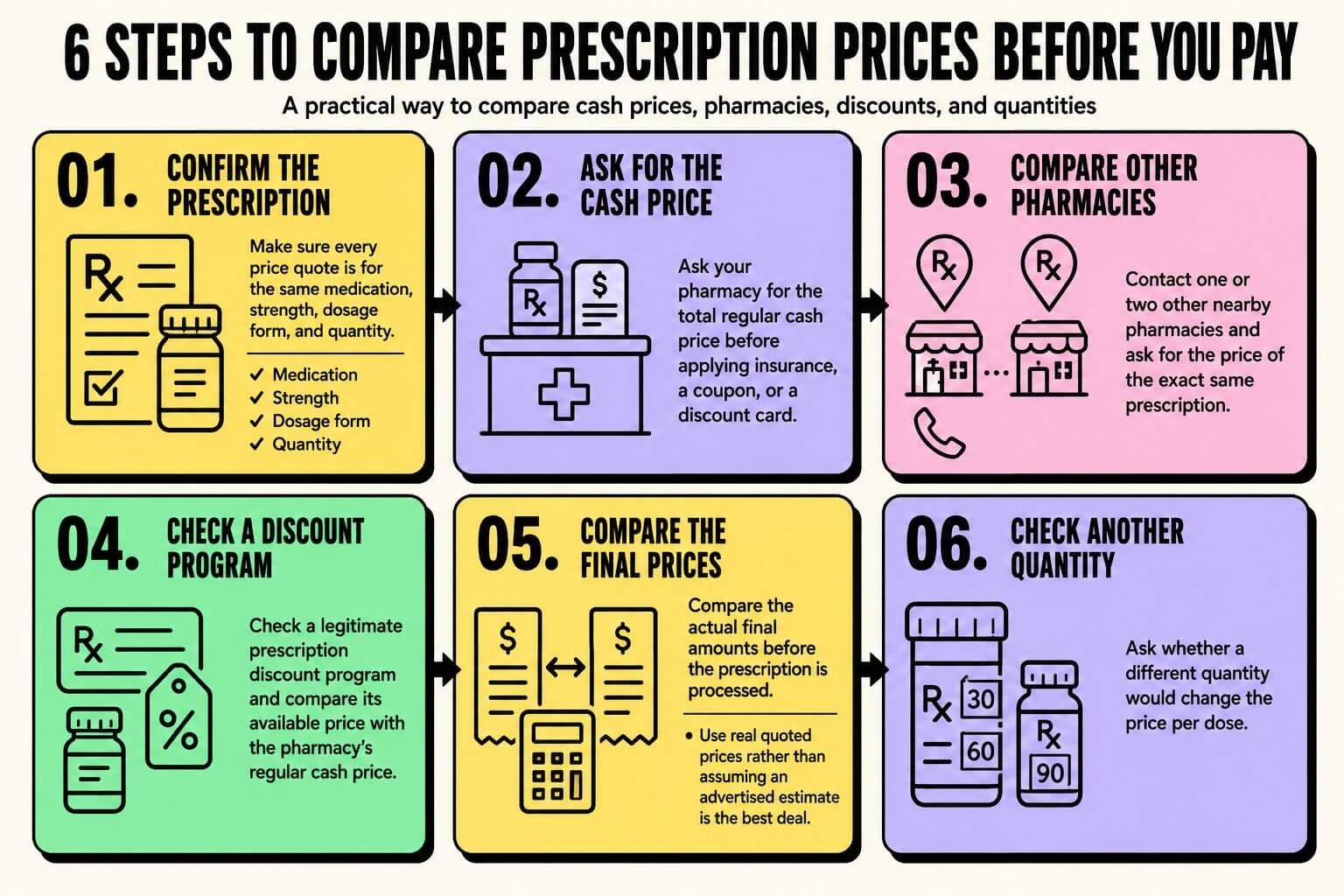
Price comparison is one of the simplest ways to lower prescription costs, but you need to compare the right numbers. Do not assume that the first coupon you find is automatically the best deal. Ask the pharmacy for its regular cash price first, then compare that amount with any available discount price. You can follow this process:
- Confirm the medication name, strength, form, and quantity.
- Ask your pharmacy for the total cash price.
- Contact one or two other nearby pharmacies.
- Check a legitimate prescription discount program.
- Compare the final amounts before the prescription is processed.
- Ask whether another quantity would change the per-dose price.
Prices can change, so a pharmacy that was less expensive for one refill may not have the lowest price for the next.
Ask for the Pharmacy’s Cash Price
A discount card may lower the listed price, but that does not always make it the cheapest option. Ask the pharmacist or pharmacy technician: “What is the regular cash price for this prescription, without insurance or a discount card?” Then ask what the price would be with the discount program you are considering. This gives you two real numbers to compare instead of relying on an advertised estimate. You should also confirm whether the quoted amount includes the full prescribed quantity.
Check More Than One Pharmacy
Chain pharmacies, grocery-store pharmacies, hospital-affiliated pharmacies, and independent pharmacies may all use different pricing structures. An independent pharmacy is not always cheaper, and a large chain does not always have the lowest price. Compare the actual cost rather than choosing based on pharmacy type. Ask whether the pharmacy:
- Has the medication in stock
- Accepts the discount program
- Can provide the full prescribed quantity
- Charges the same price for a refill
- Offers a lower price for a larger supply
A few phone calls can save you from driving across Charleston only to learn that an online estimate was inaccurate.
Use Prescription Coupons and Discount Cards Carefully
Prescription coupons and discount cards can reduce the cash price of some medications. They are especially useful when you do not have insurance or when the discounted cash price is lower than another available payment option. However, a discount card is not health insurance. It does not provide medical coverage, count toward an insurance deductible, or guarantee that every pharmacy will offer the same price. Before using one, check:
- Whether the pharmacy participates
- Whether the price applies to the correct quantity
- Whether the price is current
- Whether there are membership fees
- How the company handles personal information
- Whether the pharmacy’s regular cash price is lower
The South Carolina Drug Card is one state-specific discount resource residents can review. Its website states that the program is not insurance, and the available price can depend on the medication and participating pharmacy. Use discount tools as comparison options, not as automatic proof that you have found the lowest possible price.
Ask About Generic or Lower-Cost Medication Options
If a brand-name medication is too expensive, ask the pharmacist or prescriber whether an approved generic version is available. You can also ask whether:
- Another dosage form costs less
- A different strength could be prescribed appropriately
- A medically suitable alternative is available
- The manufacturer offers financial assistance
- A lower-cost medication in the same treatment category may be appropriate
Do not switch medications, change the dosage, split pills, or delay treatment without speaking with a qualified medical professional. A cheaper option is only useful when it is safe and appropriate for your condition. Be direct about the problem. You can say: “This medication is more than I can afford. Is there a generic or another appropriate option that may cost less?” Pharmacists and prescribers deal with cost questions regularly. Asking early gives them a chance to review your options before you skip a refill.
Check Whether a 90-Day Supply Costs Less
A 90-day supply may have a lower cost per dose than three separate 30-day fills, especially for maintenance medications taken on a regular schedule. Before requesting a larger supply, compare the total price, not only the price per tablet. A 90-day supply may not be the right choice when:
- You are starting a new medication
- Your dosage may change
- The medication is intended for short-term use
- The medication has dispensing restrictions
- The upfront cost is too high
- You may experience side effects
- The medication could expire before you use it
Ask the pharmacy for both the 30-day and 90-day cash prices. Your prescriber may need to issue a new prescription if you decide that a larger quantity makes sense.
Look Into Patient Assistance Programs
If comparing pharmacies and asking about generics does not lower the price enough, you may qualify for a patient assistance program. These programs can be offered by:
- Drug manufacturers
- Charitable pharmacies
- Nonprofit organizations
- Community health centers
- Free clinics
- Hospital assistance programs
Eligibility rules vary. An application may ask for proof of income, South Carolina residency, insurance status, and a valid prescription. Some programs also require information or signatures from the prescribing provider. Do not wait until you are completely out of medication before applying. Reviews and provider paperwork can take time.
Welvista for Eligible South Carolina Residents
Welvista operates a medication assistance pharmacy for qualifying uninsured South Carolina residents. Its current eligibility information says applicants must live in South Carolina and cannot have Medicaid, Medicare, VA health benefits, Affordable Care Act coverage, or private health insurance. Eligible medications may be filled and delivered to approved patients at no cost. The program does not cover every medication, and approval is not automatic. Applicants must submit the required paperwork and supporting documents. Check Welvista’s current medication list and eligibility rules before applying.
Charleston-Area Medication and Clinic Support
MUSC Health lists prescription-assistance information at Rutledge Tower in Charleston. This may be a useful starting point for residents who need help locating available medication resources. Confirm the current location, contact details, and eligibility requirements directly with MUSC before visiting. Community health centers and free clinics may also help uninsured residents access medical care, prescriptions, or assistance applications. The support available can depend on income, residency, clinic capacity, and the medication involved. When contacting a local program, ask:
- Does the program help with my specific medication?
- Do I need an appointment?
- What income documents should I bring?
- Is provider paperwork required?
- How long does the application usually take?
- What should I do while the application is being reviewed?
What to Ask When a Prescription Is Too Expensive
A high prescription price can be stressful, and it is easy to leave the pharmacy without asking the right questions. Use this short checklist before you pay:
- What is the regular cash price?
- Is there an approved generic version?
- Would another quantity cost less per dose?
- Is there a manufacturer assistance program?
- Does the pharmacy accept a legitimate discount card?
- Is another nearby pharmacy charging less?
- Could the prescriber review a lower-cost alternative?
- Is there a local clinic or charitable pharmacy that can help?
You do not need to ask every question at once. Start with the cash price and generic options, then move to assistance programs if the cost is still out of reach. Do not be afraid to explain that cost is affecting your ability to fill the prescription. That information can help the pharmacist or prescriber understand why another option needs to be considered.
How Charleston Employers Can Support Employees With Prescription Costs
Employers cannot recommend medications or make treatment decisions for employees. They can still make prescription-cost information easier to understand and easier to find. This may help employees who are:
- Waiting for health benefits to begin
- Working part-time or seasonally
- Supporting an uninsured dependent
- Facing a high deductible
- Unsure how to use an HSA, FSA, or HRA
- Confused about pharmacy and prescription benefits
HR teams can provide a short, verified resource list that explains where employees can compare prices, find community clinics, or learn about assistance programs. Employers should also review whether their benefits materials clearly explain prescription deductibles, pharmacy networks, formularies, account-based benefits, and enrollment waiting periods. Companies seeing repeated questions about prescription affordability may want to review their broader Charleston benefits support and employee education process. The goal is not to promise that one pharmacy or coupon will always be cheapest. It is to help employees understand what to check and who to ask before cost causes them to delay a necessary refill.
A Practical Next Step for Charleston Employers
Employees do not always bring prescription-cost concerns directly to HR. They may skip a refill, try an unfamiliar discount card, or wait until the issue becomes urgent. Employers cannot choose medications for employees, but they can make reliable resources easier to find. Start by reviewing how your company explains prescription coverage, deductibles, benefit waiting periods, and the use of HSA, FSA, or HRA funds. It may also help to provide a short list of verified community clinics, assistance programs, and pharmacy questions employees can use when a prescription is unaffordable.
Benni Agency can help Charleston employers look at whether their current benefits communication and plan structure leave avoidable gaps. The aim is not to guarantee the lowest prescription price. It is to give employees clearer information before cost becomes a reason to delay medication. A focused benefits review can show where clearer prescription-cost guidance may help your workforce.