A contract can require more liability protection than a business’s current policies provide. When that happens, excess liability insurance may supply an additional layer above scheduled underlying coverage. The limit alone, however, does not prove the requirement has been met. Business owners and operations teams also need to compare the contract with the underlying policies, excess policy, and endorsements. This guide explains what North Charleston contractors and vendors should review before bidding, signing, or submitting proof of insurance. It provides general information, not legal advice or a determination of coverage.
Key Takeaways
- Excess liability adds limits above specified underlying policies; it does not replace them.
- A contract may require additional insured, primary and noncontributory, waiver of subrogation, or completed-operations terms.
- A certificate of insurance does not change the coverage provided by a policy or endorsement.
- “Umbrella” and “excess” labels do not establish the policy’s scope; the actual wording controls.
- Review insurance requirements early enough to address gaps before bidding or signing.
What Excess Liability for Contract Work Means
Excess liability insurance is designed to respond after the applicable underlying insurance reaches the attachment point stated in the excess policy. Depending on the form, the scheduled underlying coverage may include commercial general liability, business auto liability, or employers liability. For contract work, the required limit usually comes from the agreement between the parties. A customer, property owner, general contractor, or other contracting party may require a vendor to maintain a stated amount of liability insurance as a condition of the work.
If the vendor’s existing limit is lower, an excess layer may help reach the required total. That does not mean every excess policy will satisfy every contract. The policy must sit above the correct underlying coverage, and its terms must align with the agreement closely enough for the intended purpose. Licensing rules, public contracts, and particular projects may impose separate requirements, so a business should not rely on a general checklist as a substitute for reviewing its own documents.
How Excess Coverage Connects to the Underlying Policies
Three concepts help explain how an excess layer works:
- Scheduled underlying insurance: The excess declarations or schedule identifies the policies beneath the excess layer. Coverage not listed may not receive the added limit.
- Attachment point: This is the level at which the excess policy may begin responding, subject to its terms and the exhaustion language.
- Follow-form wording: An excess policy may follow parts of an underlying policy, but it can still have separate definitions, conditions, exclusions, and notice requirements.
The last point is easy to miss. IRMI’s discussion of commercial umbrella and excess policies explains why buyers should review the complete form instead of assuming the upper layer duplicates everything below it.
Underlying limits must also satisfy the excess carrier’s requirements. If a business agrees to maintain an underlying limit but carries less, the excess policy may not simply fill the missing amount. The maintenance-of-underlying-insurance and loss-payable provisions need to be reviewed for the specific result.
Excess Liability vs. Commercial Umbrella
The terms are sometimes used loosely in contracts, but they should not be treated as interchangeable. Excess liability generally adds limits over scheduled underlying coverage. A commercial umbrella may sit over several liability policies and may include some broader provisions, but that depends entirely on the form. Policy names are not enough. Some products called “umbrella” function mainly as follow-form excess coverage, while some forms have distinct insuring agreements and exclusions. When an agreement says “umbrella or excess,” confirm what underlying policies must be scheduled, whether the proposed form meets the requested limit, and whether any required endorsements apply at the excess layer. Benni Agency’s commercial umbrella and excess liability comparison explores that distinction in more detail.
Contract Requirements to Check Beyond the Limit
A contract may combine the excess limit with other risk-transfer requirements. Review the agreement for:
- Additional insured status: The other party may request insured status for certain claims connected with the named insured’s work, subject to the endorsement.
- Primary and noncontributory wording: The agreement may specify the intended order of coverage and whether the providing insurer will seek contribution from the additional insured’s own insurance.
- Waiver of subrogation: This can restrict an insurer’s recovery rights against a stated party, subject to the policy and endorsement.
- Completed operations: Construction agreements may require additional insured protection for covered liability arising after the work is completed.
- Per-project or per-location aggregates: The contract may specify how an aggregate limit should apply, but the policy must actually contain compatible terms.
- Notice and evidence requirements: The agreement may set deadlines for certificates, endorsements, or other proof.
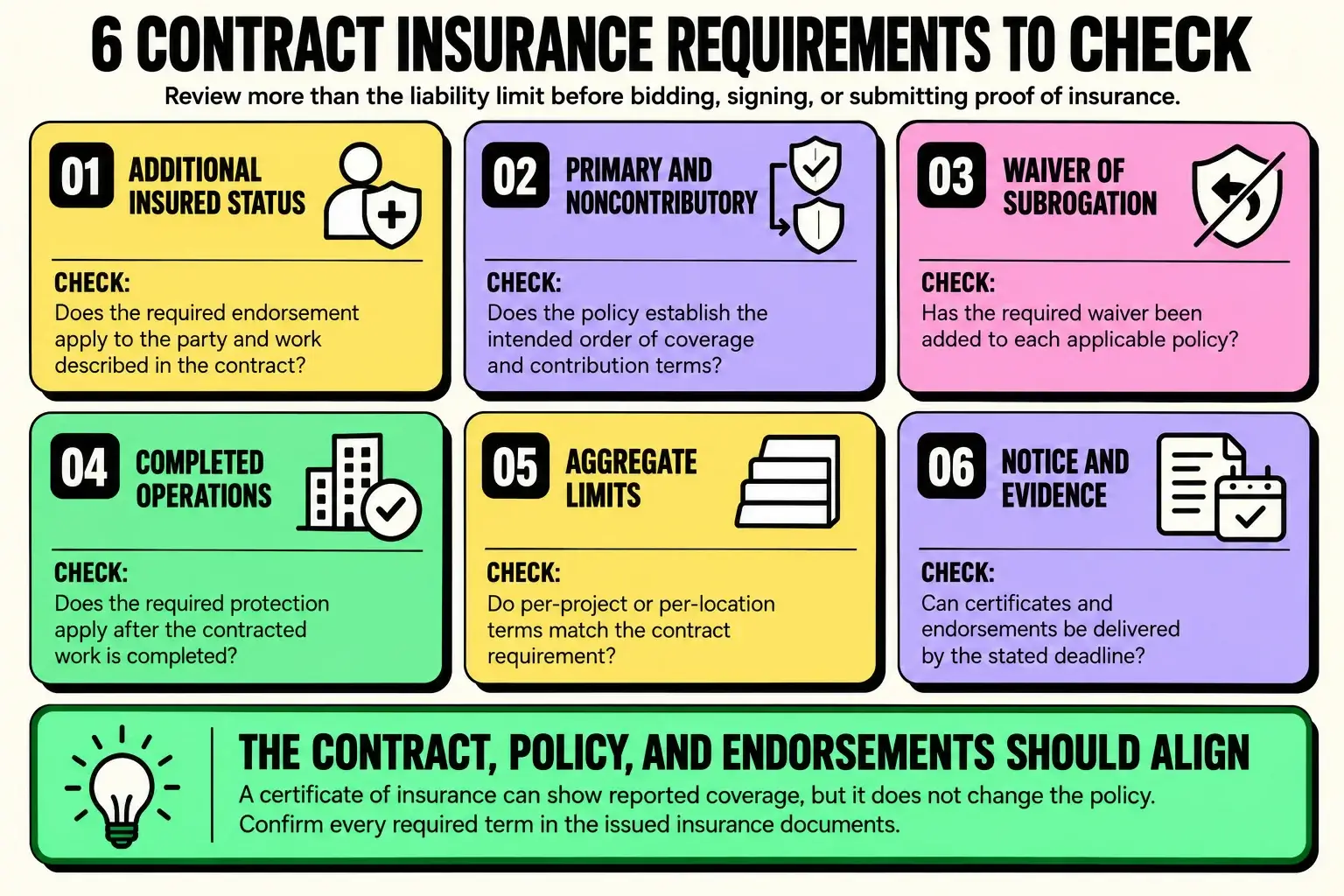
Do not assume an endorsement on the primary policy automatically carries into the excess policy. Confirm additional insured status and the intended order of coverage at each relevant layer.
Why a Certificate of Insurance Is Not the Final Check
A certificate of insurance, often called a COI, summarizes reported policy information. It is useful for evidence, but it is not the policy and does not create rights or coverage by itself. A state insurance regulator’s explanation of the ACORD certificate confirms that it is a summary rather than a contract and cannot independently modify policy terms. If the contract requires an additional insured endorsement, primary and noncontributory treatment, or a waiver of subrogation, ask whether the applicable endorsement has been issued. The certificate, policy schedule, and endorsements should tell a consistent story. A note in a certificate’s description box cannot substitute for policy language.
A Practical Review Before You Bid or Sign
Start with the complete insurance section and any exhibit attached to the contract. Then:
- List every required policy, limit, endorsement, and deadline.
- Compare those requirements with current declarations and endorsements.
- Identify which policies must appear on the excess schedule.
- Check the attachment point, aggregates, exclusions, and defense provisions.
- Confirm whether subcontractor requirements create additional obligations.
- Resolve unclear contract language with qualified legal counsel and coverage questions with a licensed insurance professional.
Reviewing these items before signing matters because some requirements may need underwriting approval or may not be available on the requested terms. For broader protection planning, the North Charleston insurance and benefits page explains how Benni Agency supports businesses in the area, while its Business & Commercial Insurance service covers the wider insurance program.
What Affects the Quote
Pricing and availability vary by business, operations, claims history, underlying insurance, requested limit, contract terms, and carrier underwriting. A generic online average is not a reliable North Charleston quote. Prepare the contract or insurance exhibit, current declarations, loss runs if requested, a description of the work, and details about vehicles, subcontractors, and specialized operations. Compare more than premium. The scheduled underlying policies, exclusions, attachment language, aggregates, defense terms, and endorsements can determine whether a proposal addresses the contract’s actual requirement.
One thought on “North Charleston Excess Liability for Contract Work”
Comments are closed.