A serious liability claim can exceed a business’s primary policy limit. Commercial umbrella and excess liability insurance can provide another layer of protection, but the terms are often used loosely. That creates a practical problem: two policies with similar names may not respond in the same way.
For a Charleston business, the better choice depends on the policies underneath the additional layer, the actual form offered by the insurer, and any limits or wording required by a client, landlord, lender, or project owner. This guide explains what to compare before accepting a quote, signing a contract, or requesting a certificate of insurance.
Key Takeaways
- Commercial umbrella and excess liability both add limits above underlying liability insurance, but their names alone do not tell you how broad the coverage is.
- Follow-form excess generally tracks scheduled underlying coverage, but the excess policy can still contain its own exclusions, definitions, conditions, and reporting requirements.
- A commercial umbrella may sit above several liability policies and sometimes provide broader terms, but only when the actual policy wording does so.
- Contract wording, attachment points, required underlying limits, exclusions, defense provisions, and retained limits matter more than the umbrella-versus-excess label.
- The safest comparison uses the actual quote, declarations, forms, endorsements, underlying-policy schedule, and contract requirements side by side.
Commercial Umbrella vs. Excess Liability: The Short Answer
Both coverages can provide additional limits after covered underlying insurance reaches the applicable limit. The traditional distinction is that follow-form excess liability increases limits while generally tracking underlying coverage, whereas a commercial umbrella may sit over several underlying policies and may provide broader terms for certain claims.
That distinction is useful, but it is not a guarantee. An excess policy can be scheduled over more than one underlying policy. An umbrella can contain exclusions that make it no broader than the coverage underneath it. Even a policy described as follow form can contain conditions or exclusions that differ from the primary insurance. Resources discussing commercial umbrella policy considerations reinforce why the actual policy form matters more than the product name. The reliable answer is in the policy documents.
What Is Excess Liability Insurance?
Excess liability insurance provides an additional limit above one or more scheduled underlying liability policies. It generally responds only after the applicable underlying limit or attachment point has been reached in the manner required by the excess policy. Many excess policies are described as follows. In general, that means the upper layer is designed to follow certain coverage terms from the underlying policy.
However, follow-form excess coverage can still contain its own exclusions, definitions, notice requirements, conditions, and coverage territory. A business should not assume that every provision of the primary policy carries upward unchanged. Excess liability may be appropriate when the goal is to add capacity over a clearly defined exposure, such as commercial general liability or commercial auto liability. It does not automatically fix an exclusion in the underlying policy unless the excess form expressly provides broader coverage.
What Is Commercial Umbrella Insurance?
Commercial umbrella insurance is also a form of excess liability coverage. It commonly sits above several scheduled policies, such as commercial general liability, commercial auto liability, and employers liability. The schedule of underlying insurance and required minimum limits determine which policies qualify beneath the umbrella. Some umbrella forms may provide coverage for a claim that is not covered by an underlying policy but is covered by the umbrella’s own terms. This is sometimes described as the umbrella dropping down.
When that happens, a self-insured retention may apply. Other umbrella forms provide little or no broader coverage than the policies underneath them. An umbrella should therefore not be assumed to cover professional liability, cyber liability, employment practices liability, directors and officers liability, pollution liability, or other specialized exposures unless the policy specifically provides that protection.
Side-by-Side Comparison
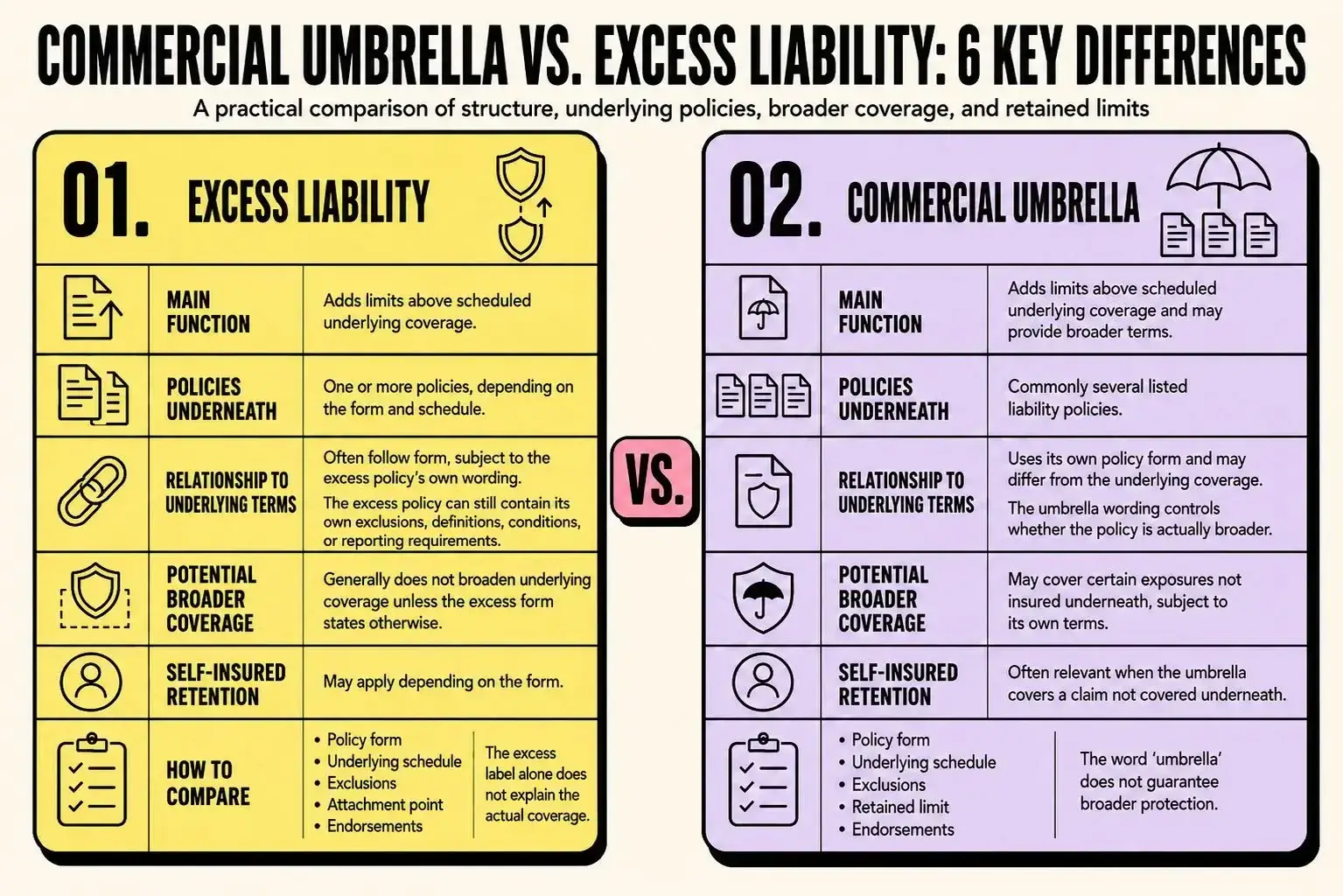
| Feature | Excess Liability | Commercial Umbrella |
| Main function | Adds limits above scheduled underlying coverage | Adds limits above scheduled underlying coverage and may provide broader terms |
| Policies underneath | One or more policies, depending on the form and schedule | Commonly several listed liability policies |
| Relationship to underlying terms | Often follow form, subject to the excess policy’s own wording | Uses its own form and may differ from underlying coverage |
| Potential broader coverage | Generally does not broaden underlying coverage unless stated | May cover certain exposures not insured underneath, subject to its terms |
| Self-insured retention | May apply depending on the form | Often relevant when the umbrella covers a claim not covered underneath |
| Best comparison method | Review form, schedule, exclusions, attachment point, and endorsements | Review form, schedule, exclusions, retained limit, and endorsements |
These are common market distinctions, not universal rules. Policy forms and endorsements control.
Why the Underlying Insurance Matters
An umbrella or excess policy is only one part of a layered liability program. The declarations and schedule usually identify which underlying policies must be maintained and the minimum limits required. If a business fails to maintain those limits, the upper layer may not begin paying where the business expects. Depending on the wording, the business may have to absorb the difference. That is why the review should include commercial general liability limits and aggregates, commercial auto liability, employers liability, and any specialized liability policy required by contract. It is equally important to confirm that the upper-layer policy actually lists and recognizes each underlying policy. Benni Agency’s business and commercial insurance resources explain how liability, auto, property, and other commercial policies can fit into a coordinated insurance program.
Contract Requirements Can Change the Decision
Charleston businesses may encounter umbrella or excess liability requirements in leases, vendor agreements, construction contracts, loan documents, and client agreements. Do not rely only on a certificate request or a short email summary when the signed contract contains more detailed insurance requirements. The contract may specify per-occurrence and aggregate limits, which underlying policies must be included, whether umbrella or excess coverage is acceptable, and whether additional insured or primary and noncontributory wording is required.
It may also contain waiver-of-subrogation requirements, completed-operations obligations, or deadlines for providing proof of insurance. An additional limit alone may not satisfy an endorsement requirement. A certificate of insurance provides evidence of reported coverage. It does not rewrite the policy or create rights that the policy and endorsements do not provide. If a contract requires only a higher limit over one specific policy, a targeted excess form may be appropriate. If it calls for one additional layer above several liability policies, an umbrella may be easier to structure. Either conclusion must be confirmed against the signed contract and actual policy wording.
Six Policy Details to Compare Before Choosing
1. Scheduled Underlying Policies
Confirm every policy the upper layer is intended to cover.
Do not assume commercial auto, hired and non-owned auto, employers liability, or another exposure is included simply because that coverage exists elsewhere in the insurance program.
2. Attachment Points and Required Underlying Limits
The attachment point is where the umbrella or excess layer is intended to begin.
Compare that point with the underlying per-occurrence, aggregate, and other applicable limits.
Also check what happens if an underlying aggregate has already been reduced by earlier claims.
3. Follow-Form Language and Separate Exclusions
Read the follow-form provision together with the upper-layer policy’s exclusions and endorsements.
A policy can broadly follow the primary form while still narrowing coverage in important ways.
4. Defense Costs
Determine whether defense expenses reduce the available limit and when the upper-layer insurer assumes or participates in the defense.
The answer can affect how much coverage remains available for a covered settlement or judgment.
5. Self-Insured Retention
If an umbrella may cover certain claims not insured underneath, identify the self-insured retention and the conditions for satisfying it.
A self-insured retention should not automatically be treated as the same thing as a deductible.
6. Notice, Reporting, and Consent Requirements
Upper-layer insurers may require notice before an underlying claim reaches the attachment point.
Review reporting requirements, settlement-consent provisions, and which party is responsible for notifying each insurer.
Which Coverage May Fit Your Business?
Excess liability may be worth considering when the primary goal is simply to add a defined limit over scheduled insurance and the existing underlying terms already address the exposure. It can also fit a contract that clearly calls for a higher limit over one liability line. A commercial umbrella may be useful when several liability policies need one additional shared layer or when the proposed umbrella form provides meaningful protection not available underneath. The benefit depends on the actual form, not the word umbrella printed on the quote. Some businesses use both umbrella and excess layers when they need higher total limits. That structure requires careful alignment so each layer attaches properly and does not introduce an unexpected exclusion or gap.
What These Policies Commonly Do Not Replace
Commercial umbrella and excess liability policies should not be treated as substitutes for a complete business insurance program. Depending on the form, they may not extend over workers’ compensation benefits, professional errors and omissions, employment practices claims, cyber liability, directors and officers liability, pollution liability, intentional acts, or damage to the business’s own property.
Some specialized liability policies can have their own excess layers. Confirm the actual structure rather than assuming a general commercial umbrella sits above every policy the company carries. For a related review of primary liability exposures, see Charleston general liability gaps businesses can miss.
What Affects the Cost?
There is no reliable flat Charleston price for commercial umbrella or excess liability insurance. Pricing can vary based on the insurer, operations, revenue or payroll measures, vehicle exposure, locations, claims history, underlying limits, requested excess limit, contract requirements, and loss-control practices. The number of policies beneath an umbrella and the breadth of the policy form can also affect the quote. Avoid using a generic online average as a Charleston price estimate.A better comparison places proposals side by side and accounts for meaningful differences in exclusions, attachment points, retained limits, defense provisions, scheduled underlying policies, and total limits.
A Practical Quote-Review Checklist
Before accepting commercial umbrella or excess liability coverage, gather the current declarations, relevant policy forms, available loss runs requested by the insurer, vehicle and driver information when commercial auto is involved, and signed contracts or insurance exhibits. Also collect information about locations, operations, recent business changes, and the proposed umbrella or excess quote, including its forms, endorsements, and schedule of underlying insurance.
Then ask the broker to show where the proposal addresses each contractual or operational requirement and where any exclusion or limitation remains. For a broader local review, Charleston businesses can visit Benni Agency’s Charleston insurance and employee benefits page. The South Carolina Department of Insurance can also be used to verify insurer and producer information or locate state insurance resources.
2 thoughts on “Charleston Commercial Umbrella vs Excess Liability”
Comments are closed.