A Business Owners Policy, commonly called a BOP, can be a practical starting point for eligible small businesses. It commonly packages commercial property and general liability coverage, and many forms also include business-income protection for a covered loss. But a BOP is not a complete insurance program. Its terms, exclusions, sublimits, deductibles, and available endorsements all depend on the carrier and policy form.
For a Charleston business, the review should cover ordinary operating exposures as well as separate questions involving wind, flood, power interruption, and storm-related closures. This guide is for Charleston business owners and operations leaders who want to compare a BOP with how the business actually operates before renewal, a lease signing, or hurricane season.
Key Takeaways
- A BOP is a foundation, not a blanket solution. It may package core property, liability, and business-income coverage, but availability and scope vary by policy.
- Review operations before choosing add-ons. Equipment, data, cash handling, employee driving, lease obligations, and inventory can change which coverage questions deserve attention.
- Some exposures may require separate policies. Flood, commercial auto, workers’ compensation, professional liability, liquor liability, and some employment-practices risks may fall outside a standard BOP.
- Charleston storm planning requires cause-of-loss clarity. Wind, storm surge, flood, and off-premises utility damage may be treated differently under different policies.
- The declarations page and endorsements matter. Confirm actual limits, sublimits, deductibles, exclusions, and endorsements instead of relying only on a coverage label.
What a Standard BOP May Cover, and Where It Can Stop
A BOP is generally designed for eligible businesses with relatively straightforward risks. According to Triple-I’s BOP overview, BOPs commonly combine property, liability, and business-income coverage in one package. The exact covered property, causes of loss, exclusions, limits, and business-income triggers still come from the policy itself, not from the BOP label. A BOP often needs to be coordinated with other insurance. Common areas for a separate review include:
- Commercial auto
- Workers’ compensation
- Professional liability
- Flood
- Liquor liability
- Employment practices liability
For a closer look at third-party claims and other exposures a BOP may not resolve by itself, review general liability gaps businesses can miss. Before adding an endorsement, identify whether the issue involves:
- A limit or sublimit
- An exclusion
- A missing type of coverage
- A contractual requirement
- A separate policy exposure
An endorsement may broaden or modify limited coverage, but it may not replace a separate policy designed for a fundamentally different exposure.
BOP Add-Ons Worth Discussing With Your Agent or Broker
Equipment Breakdown
Equipment breakdown coverage may help with certain direct losses caused by a covered sudden and accidental mechanical or electrical breakdown. It can be relevant for:
- HVAC systems
- Refrigeration equipment
- Point-of-sale systems
- Electrical panels
- Other essential machinery or equipment
Read the policy wording carefully. Normal wear, gradual deterioration, poor maintenance, and a covered equipment breakdown are not the same thing. The important questions are what equipment qualifies, what causes of loss are covered, what limits apply, and whether resulting business-income or spoilage losses receive separate treatment.
Cyber and Data-Breach Coverage
A standard BOP should not be assumed to respond to every data breach, ransomware event, payment-card incident, or privacy claim. Some insurers may offer a limited cyber endorsement, while broader cyber insurance may need to be purchased separately. Instead of asking only whether “cyber coverage” exists, review:
- First-party expenses
- Third-party liability claims
- Incident-response services
- Data restoration
- Business interruption
- Ransomware provisions
- Policy exclusions
- Deductibles
- Coverage limits
Insurance does not replace basic security controls. CISA small-business cyber guidance can help businesses review practical steps for reducing common cyber risks.
Employee Dishonesty and Crime
Crime coverage may address defined losses involving employee dishonesty, theft, forgery, or alteration, depending on the policy form. Businesses handling cash, checks, inventory, securities, or client funds should review:
- The policy definition of an employee
- Covered property
- Covered causes of loss
- Discovery periods
- Exclusions
- Coverage limits
The business’s actual cash-handling and inventory controls should guide the discussion rather than assuming a basic BOP automatically covers every theft-related loss.
Spoilage, Utility Services, and Off-Premises Power Interruption
Food service businesses, retailers, and other operations that depend heavily on refrigeration or power should review how spoilage, utility-services coverage, and business-income protection interact. A loss caused by damage to an off-premises utility may have different coverage requirements than damage that begins at the insured location.
Important questions include:
- Which utilities are covered?
- Does the outage need to result from a covered cause of loss?
- Is transmission-line damage included or excluded?
- Does a waiting period apply?
- Is spoilage subject to a separate sublimit?
- Does business-income coverage respond to the same event?
These details are policy-specific and should be confirmed before relying on the coverage.
Ordinance or Law Coverage
After a covered property loss, building codes can increase the cost of repairing or rebuilding property. Ordinance or law coverage may address specified additional costs associated with code enforcement, depending on the policy terms and limits.
Review this coverage alongside:
- Building replacement values
- Tenant improvements
- Lease responsibilities
- Demolition requirements
- Increased construction costs caused by code compliance
The need can differ significantly between an owner-occupied building and a tenant responsible for only certain improvements.
Hired and Non-Owned Auto Liability
If employees drive personal, rented, or borrowed vehicles for business errands, deliveries, client visits, or job-site travel, hired and non-owned auto liability deserves a separate review. It may help address certain liability claims involving vehicles the business does not own, subject to policy terms. However, it does not replace commercial auto coverage for vehicles the business owns, leases, or needs to insure for physical damage. Businesses should document how employees use vehicles for work rather than assuming an occasional business trip is automatically covered.
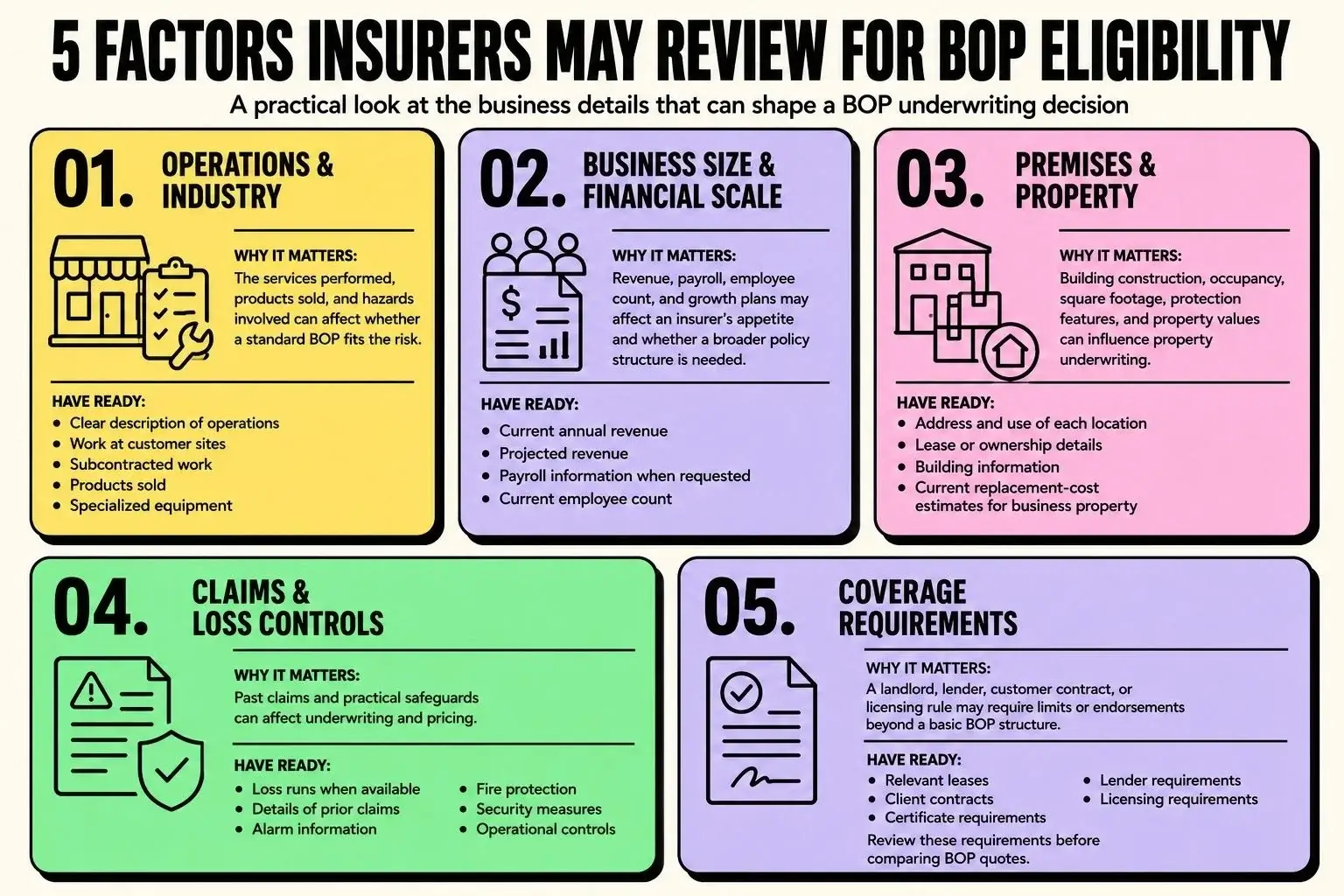
Coverage Questions That May Call for a Separate Policy
Some exposures do not fit neatly into a BOP endorsement. The following are review points, not automatic recommendations.
- Workers’ compensation: Employee work injuries and occupational illnesses are generally addressed through workers’ compensation rather than general liability.
- Professional liability or E&O: Advice, design work, technology services, consulting, or other professional errors can create financial-loss exposures a general liability policy may not address.
- Commercial auto: Company-owned vehicles and many business-use driving situations require a separate commercial auto review.
- Flood insurance: Flood damage, including storm surge, is commonly treated separately from standard commercial property coverage.
- Liquor liability and EPLI: Depending on operations and carrier offerings, these may require separate policies or specific endorsements.
The key is to determine whether the exposure belongs inside the BOP, can be addressed by endorsement, or requires another policy entirely.
Why Charleston Adds a Coastal Coverage Review
Charleston’s coastal setting makes it especially important to distinguish one cause of loss from another. The South Carolina Department of Insurance hurricane preparedness guidance separates wind, storm surge, rainfall, and flood concerns. A commercial property policy may treat these events differently, so a business should not assume one policy answers every storm-related question.
Wind and hail may be:
- Included
- Limited
- Excluded
- Subject to a separate deductible
- Placed under a separate policy
The South Carolina Wind and Hail Underwriting Association, commonly called the Wind Pool, is South Carolina’s residual market for wind and hail coverage in eligible coastal territory. Eligibility and policy terms depend on the property and location. Flood and storm surge are generally separate from wind. FEMA flood insurance guidance explains that NFIP flood policies typically have a 30-day waiting period before becoming effective, subject to exceptions. The South Carolina Department of Insurance also cautions that insurers may impose moratoriums on new policies or coverage changes when a named storm is likely to affect an area.
That is why wind and flood questions should be reviewed well before a storm approaches. A storm or named-storm deductible may also differ from the regular commercial property deductible. Depending on the policy, it may be a fixed dollar amount or a percentage. For a fuller pre-season review, see Benni Agency’s Charleston commercial property storm coverage guide.
A Practical Add-On Review by Business Operation
Use this table as a conversation starter. It does not replace an individualized coverage analysis or the actual policy wording.
| Business Operation | Coverage Questions to Raise | Documents or Facts to Bring |
| Restaurant, cafe, or food retailer | Refrigeration, spoilage, equipment breakdown, utility interruption, liquor liability | Equipment list, inventory values, alcohol sales details, lease terms |
| Retailer | Crime, signs, inventory, payment-card exposure, customer data, utility interruption | Inventory records, sign values, POS details, cash-handling controls |
| Professional or office service | Cyber, professional liability, employee driving, client contract requirements | Service agreements, data-handling practices, employee driving uses |
| Contractor or trade business | Commercial auto, tools and equipment, professional liability, subcontractor requirements | Vehicle schedule, tool values, contracts, certificates, job descriptions |
The goal is not to purchase every available endorsement. It is to identify which exposures actually exist and determine how the policy addresses them.
How to Decide What Belongs on Your Policy
Start With Operations
Document material changes involving:
- Equipment
- Locations
- Services
- Employees
- Vehicles
- Inventory
- Customer data
- Contractors
- Property values
Coverage discussions are more useful when they start with what the business actually does.
Read the Actual Policy Documents
Compare current operations with:
- Declarations pages
- Endorsement schedules
- Coverage limits
- Sublimits
- Deductibles
- Exclusions
- Covered property
- Covered causes of loss
Do not rely only on a coverage name shown on a summary or certificate.
Check Outside Obligations
Leases, lenders, customers, landlords, and vendors may require specific insurance limits, additional insured wording, or other evidence of coverage.
Review these documents before renewal so contractual requirements can be compared with the policy.
Plan for Continuity as Well as Insurance
Keep secure off-site or cloud copies of:
- Policies
- Property inventories
- Vendor contacts
- Equipment records
- Important contracts
- Claim-reporting information
Ready.gov business continuity planning provides additional guidance for maintaining essential operations after a disruption.
Review After a Material Change
Do not wait only for annual renewal if the business:
- Moves
- Adds a location
- Buys significant equipment
- Adds a new service
- Changes employee driving
- Expands inventory
- Signs a major contract
- Begins storing new types of customer data
A significant operational change can create a coverage question before the next scheduled renewal. Benni Agency can help business owners organize policy documents and identify questions for a commercial insurance review. For local information, explore Charleston business insurance resources or review Benni Agency’s business and commercial insurance services for a broader commercial coverage discussion. Any recommendation should be based on current policy terms, operations, property, contracts, exposures, and insurer requirements.
One thought on “Charleston BOP Add-Ons Small Businesses Often Need”
Comments are closed.