Choosing between high- and low-deductible health insurance can feel like deciding whether to pay more now or risk paying more later. A low-deductible plan usually comes with higher monthly premiums but may reduce what you pay when you need medical care. A high-deductible plan often has lower premiums but can leave you responsible for more upfront costs.
Neither option automatically saves more money. The better choice depends on your expected healthcare use, monthly budget, prescriptions, employer contributions, and ability to handle unexpected medical bills. This guide is for individuals, families, employers, and HR teams comparing health plan costs.
Key Takeaways
- Low-deductible health insurance usually has higher monthly premiums but can reduce how much you pay when you need covered medical care.
- High-deductible plans may save more for people who rarely use healthcare, especially when the premium difference is large.
- The deductible alone does not determine which plan is cheaper. Compare premiums, copays, coinsurance, prescriptions, and the out-of-pocket maximum.
- Employer HSA contributions can change the overall cost comparison and may make an eligible high-deductible plan more attractive.
- The best plan depends on expected healthcare use and financial comfort with risk, so compare both normal-year costs and worst-case expenses before choosing.
What Is Low Deductible Health Insurance?
Low deductible health insurance is a plan that requires you to pay a relatively smaller amount toward covered medical services before the plan begins applying its deductible-based cost sharing. There is no single federal dollar amount that automatically makes a deductible “low,” so the term usually describes how one plan compares with other available options. HealthCare.gov defines a health insurance deductible as the amount you pay for certain covered healthcare services before your plan begins paying according to its terms. Some plans cover certain services before the deductible is reached, and qualifying preventive services may be available without cost sharing under applicable plan rules.
Some plans can go even further, including $0 deductible health insurance, where certain covered services may not require you to satisfy a deductible before applicable plan benefits begin. These plans often have higher monthly premiums because you are paying more throughout the year in exchange for potentially lower costs when you receive care. A lower deductible can feel reassuring because the amount you may need to pay before insurance contributes appears smaller. However, the deductible should still be considered alongside premiums and other cost-sharing expenses.
High vs. Low Deductible Health Insurance: What Is the Difference?
The biggest difference between high- and low-deductible health insurance is how healthcare costs are divided between monthly premiums and what you pay when you receive care. A low-deductible plan usually charges a higher monthly premium but requires less spending before deductible-based coverage begins. A high-deductible plan generally has lower premiums but can require more out-of-pocket spending when medical care is needed.
A lower deductible may feel more predictable for someone who expects regular care. A higher deductible can be attractive to someone who wants lower monthly costs and rarely uses healthcare. However, the deductible should never be the only number you compare. Premiums, copays, coinsurance, prescriptions, employer contributions, and the out-of-pocket maximum can all affect which plan costs less over the year.
Which Saves More Money: High or Low Deductible Health Insurance?
Neither option always saves more money. The better financial choice depends on how much healthcare you expect to use and how much you would save or spend through premiums and other out-of-pocket costs. A low-deductible plan may cost more each month but become less expensive overall if you need frequent or costly medical care. A high-deductible plan may save money when lower premiums outweigh the additional amount you spend on healthcare. The key is to compare total expected yearly costs, not simply the deductible printed on the plan.
If You Rarely Need Medical Care
A high-deductible plan may save more if you rarely visit doctors beyond preventive care and do not expect major medical expenses. Lower monthly premiums can create meaningful annual savings. However, you should still consider whether you could comfortably pay a large unexpected medical bill if an illness or accident occurs.
If You Use Healthcare Regularly
A low-deductible health plan may make more financial sense when you regularly need specialist appointments, diagnostic testing, therapy, prescriptions, or other covered services. Although the monthly premium may be higher, reaching the deductible sooner can reduce how much you pay for certain services later in the year. This can also make medical spending easier to anticipate.
If You Expect Major Medical Expenses
If you expect surgery, childbirth, frequent treatment, or another high-cost medical event, compare each plan’s full yearly financial exposure. Look at the annual premium, deductible, coinsurance, copays, and out-of-pocket maximum together. A lower deductible is not automatically cheaper, but its higher premium may be worthwhile if it substantially reduces your costs when receiving care.
How to Calculate Which Health Plan Is Actually Cheaper
A simple way to compare plans is to estimate what each one could cost over an entire year. Use this basic calculation: Estimated yearly cost = annual premiums + expected medical cost sharing − employer or HSA contributions
Start by multiplying the monthly premium by 12. Then estimate what you may spend on deductibles, copays, coinsurance, and prescriptions based on your typical healthcare use. If coverage is offered through work, understanding employer health insurance contributions can help you see how much of the premium is being paid by the employer versus what comes out of your paycheck. If your employer contributes to an eligible HSA or another healthcare account, include that value too. You should also calculate a high-cost scenario by adding the annual premium to the plan’s out-of-pocket maximum. Seeing several premiums, deductibles, and cost-sharing amounts at once can make people focus on whichever number feels safest. Some choose the lowest premium to reduce monthly pressure, while others gravitate toward the lowest deductible because they fear a large medical bill. Looking at the full-year cost helps replace that uncertainty with a clearer comparison.
“One customer described Benni Agency as responsive, clear, and helpful without applying pressure. That kind of straightforward guidance can be useful when someone is comparing several cost structures without feeling pushed toward one option.”

Simple High vs. Low Deductible Example
Suppose Plan A has a $1,000 deductible but costs $150 more per month than Plan B, which has a $3,000 deductible. Plan A therefore costs an additional $1,800 in premiums over the year. If you use very little medical care, Plan B’s premium savings may make it cheaper. If you need enough healthcare that Plan A saves more than $1,800 through lower deductible and cost-sharing expenses, Plan A may provide better overall value. This is why comparing only $1,000 versus $3,000 can lead to the wrong decision.
When Does Low Deductible Health Insurance Make More Sense?
Low deductible health insurance may be a stronger choice when you expect to use healthcare frequently or want greater predictability in your medical budget. It may be worth considering if you:
- Visit doctors or specialists regularly
- Take ongoing or expensive prescriptions
- Expect surgery or another planned procedure
- Are planning for pregnancy or childbirth
- Have children who regularly need healthcare
- Receive ongoing therapy, testing, or treatment
- Would struggle to absorb a large unexpected medical bill
The advantage is not simply paying a smaller deductible. It is having a plan structure that may reduce financial pressure when care is needed. Still, higher premiums can become expensive if you use very little healthcare. The best choice depends on whether those premiums are likely to produce enough savings and predictability to justify the additional monthly cost.
When Can a High Deductible Plan Save More Money?
A high-deductible health plan may save more money when you expect relatively little medical care and the premium difference between plans is significant. Paying less each month can create substantial annual savings, especially if you mainly use preventive services and rarely need additional treatment. A higher deductible may also work well if your employer contributes to an eligible HSA or if you already have enough savings to handle unexpected healthcare expenses. This option can make sense when you:
- Rarely need medical treatment
- Want lower monthly premiums
- Can comfortably cover the deductible if necessary
- Receive employer HSA contributions
- Want to build tax-advantaged healthcare savings
- Have emergency savings for unexpected medical costs
The important question is whether the premium savings and other financial benefits outweigh the additional out-of-pocket risk.
How an HSA Can Change the High vs. Low Deductible Math
A Health Savings Account (HSA) can make an eligible high-deductible plan more financially attractive because it allows you to set aside money for qualified medical expenses with valuable tax advantages. Employers considering HSAs alongside other tax-advantaged accounts can also give employees more ways to manage eligible healthcare expenses. HSA balances can roll over from year to year, so unused money is not generally lost at the end of the plan year. If your employer contributes to your HSA, that contribution should be included when comparing the true cost of one health plan with another.
For example, a high-deductible option might appear more expensive because of its deductible. But if it saves $1,500 in annual premiums and the employer contributes another $1,000 to the HSA, the financial difference may look very different. That can change how someone reacts to the higher deductible. A number that initially feels risky may become more manageable when premium savings, employer contributions, and available HSA funds are considered together. Not every plan qualifies for HSA contributions. The IRS provides current 2026 HSA eligibility requirements. For 2026, qualifying HDHPs generally have minimum annual deductibles of $1,700 for self-only coverage and $3,400 for family coverage, with applicable maximum out-of-pocket amounts of $8,500 and $17,000, respectively.
Don’t Compare Deductibles Without Checking These Costs
A deductible tells you only part of what a health plan may cost. Two plans with similar deductibles can produce very different yearly expenses once copays, coinsurance, prescriptions, provider networks, and out-of-pocket limits are considered. Before choosing a plan, review the entire Summary of Benefits and Coverage rather than focusing on the deductible alone.
Copays and Coinsurance
A copay is typically a fixed amount you pay for a covered service, while coinsurance is usually a percentage of the allowed cost you pay under the plan’s terms. A low deductible can still be paired with significant coinsurance or copays. Compare what you would pay for primary care, specialists, urgent care, hospital services, imaging, and other services you expect to use.
Out-of-Pocket Maximum
The out-of-pocket maximum is especially important when comparing plans for a high-cost medical year. Once you reach the applicable limit for covered in-network expenses, the plan generally pays 100% of additional covered in-network benefits for the remainder of the plan year. A lower deductible does not necessarily mean a lower out-of-pocket maximum, so compare both numbers.
Prescription Coverage
Prescription costs can significantly change which plan offers better value. Review the plan’s drug formulary, prescription tiers, copays, coinsurance, and whether a separate prescription deductible applies. Someone who takes several medications every month may find that stronger prescription coverage saves more overall even if the plan’s monthly premium is higher.
Provider Network
A plan may look inexpensive until you discover that your preferred doctors, specialists, hospitals, or treatment facilities are outside the network. Out-of-network care can cost considerably more. Before choosing based on premiums or deductibles, verify that the providers and facilities you expect to use participate in the plan’s network.
Should Employers Offer Both High- and Low-Deductible Options?
Offering both higher- and lower-deductible health plan options can give employees more flexibility because healthcare needs and financial situations vary across a workforce. One employee may prioritize a lower monthly payroll deduction and prefer an HSA-eligible option. Another may be willing to pay more each month for lower upfront medical costs because they expect regular prescriptions, specialist visits, or family healthcare expenses. Choice can also create uncertainty. Employees may worry about selecting the wrong plan and then being stuck with higher costs when medical needs arise. Clear explanations of premiums, deductibles, provider networks, prescriptions, and possible out-of-pocket costs can make the decision easier to understand.
“One customer shared that the team was incredibly helpful and made the benefits process feel seamless for their staff. They especially appreciated that everything was explained clearly and in a way that was easy to understand. That experience shows why employee education can matter as much as simply providing multiple plan choices.” Employers should therefore look beyond the cost of the plan itself. Employee affordability, plan education, provider access, and expected out-of-pocket exposure all matter.
How to Choose Between High and Low Deductible Health Insurance?
The best plan is usually the one that fits both your expected healthcare needs and your ability to handle unexpected costs. Instead of automatically choosing the lowest premium or smallest deductible:
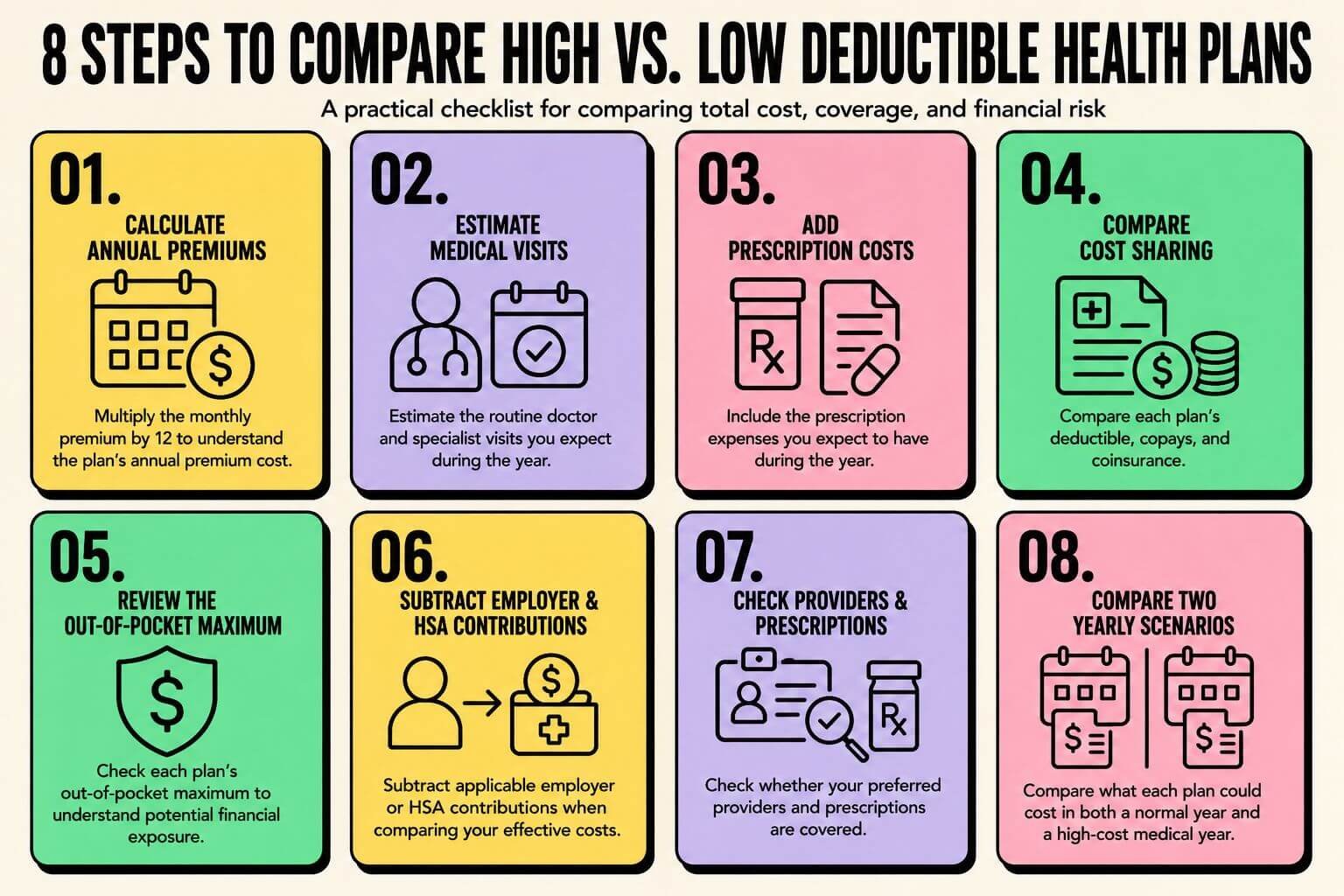
Low deductible health insurance may provide better value when you expect frequent care, while a higher-deductible plan may save more when medical use is low and premium savings are substantial. The right decision comes from comparing total annual cost and financial risk, not one number on the plan summary.