A Business Owners Policy, often called a BOP, can combine business property and general liability coverage in one package for eligible small businesses. The important word is eligible. Carriers set their own underwriting rules, and a policy that works for one office, shop, or service business may not fit another. This guide is for Summerville business owners who want to understand the common BOP eligibility questions before requesting a quote.
A BOP is not an approval category established by South Carolina law. It is an insurance package whose availability, terms, and optional coverages depend on the insurer, your operations, property, claims history, location, and other underwriting details. Use this checklist to prepare for the conversation, then review the actual policy forms and quote with a licensed insurance professional.
Key Takeaways
- A BOP commonly combines commercial property and general liability coverage, and may also include business income and extra expense coverage.
- There is no universal revenue, employee-count, or square-footage threshold that guarantees BOP eligibility. Each insurer uses its own underwriting rules.
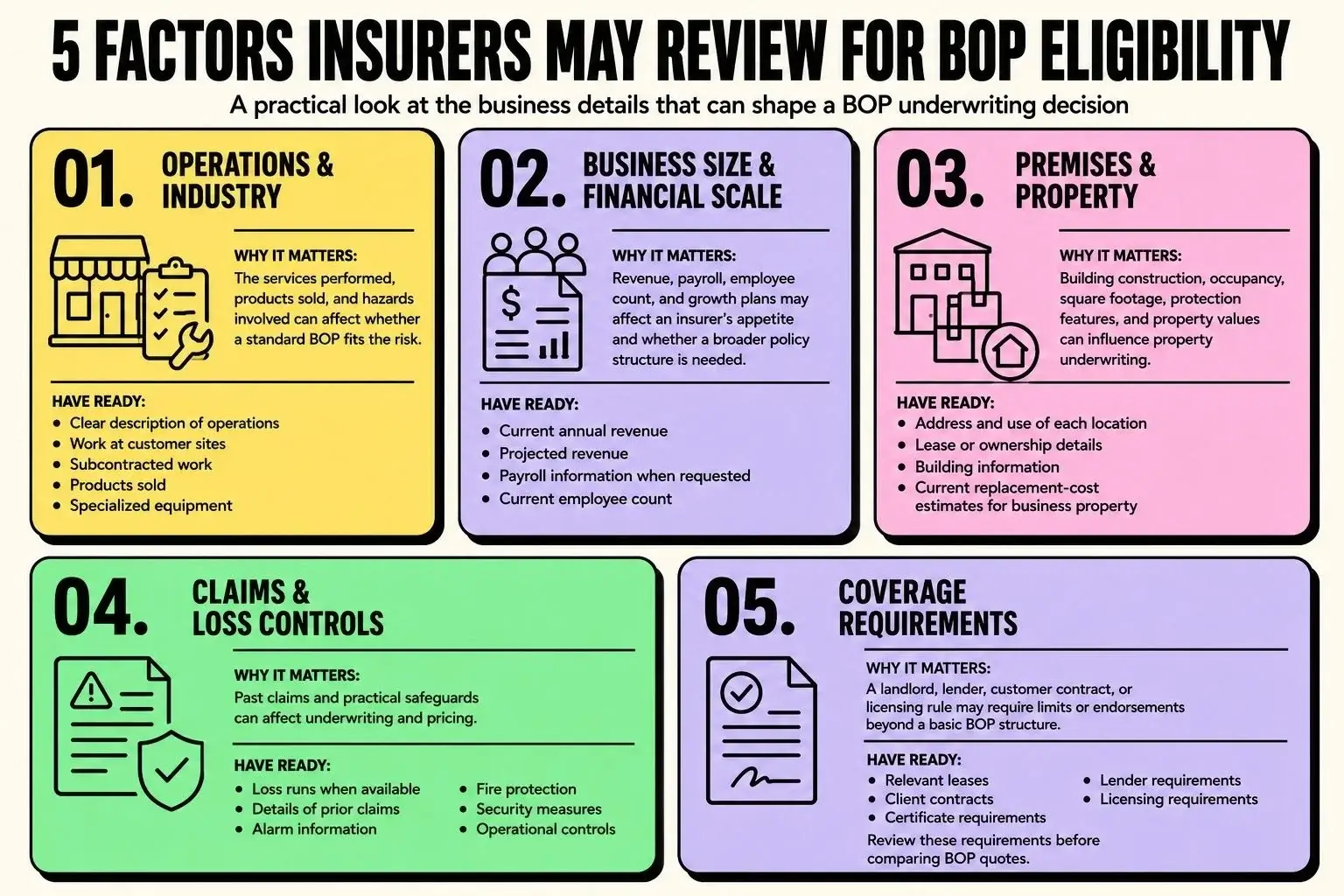
- Insurers may review operations, revenue, payroll, employee count, property values, claims history, locations, and contractual insurance requirements before offering a BOP.
- Businesses with more complex or specialized risks may need a commercial package policy, separate property and liability policies, or additional specialty coverage instead of a standard BOP.
- Workers’ compensation, commercial auto, professional liability, cyber liability, and other exposures should be reviewed separately because a basic BOP does not automatically cover them.
What a Business Owners Policy Typically Includes
A BOP commonly combines commercial property insurance and general liability insurance. Many policies also include business income and extra expense coverage, subject to the policy’s terms and covered causes of loss. The Insurance Information Institute’s BOP overview describes the package as a common way for small businesses to address property, liability, and interruption-related exposures.
- Commercial property coverage may help pay for covered damage to business property such as a building you own, equipment, furniture, or inventory. What is covered and how it is valued depend on the policy.
- General liability coverage may respond to certain third-party bodily injury, property damage, or personal and advertising injury claims. It does not replace professional liability coverage for errors in professional services.
- Business income and extra expense coverage may apply when a covered property loss causes a suspension of operations. The period of restoration, waiting period, limits, and coverage triggers matter.
A BOP is not a complete insurance program. Workers’ compensation, commercial auto, professional liability, cyber liability, employment practices liability, and other coverages may need to be purchased separately or added only when available and appropriate.
The Core BOP Eligibility Checklist
There is no universal revenue, employee-count, or square-footage cutoff that guarantees BOP eligibility. Instead, insurers typically review several connected facts about the business. The table below gives you a practical way to organize those details before requesting a quote.
Businesses That May Fit a Standard BOP
A standard BOP is often considered for smaller businesses with relatively straightforward property and liability exposures. Professional offices, retailers, and some personal and business service operations are common examples. That does not mean every business in one of those categories will qualify, or that every BOP will include the same coverage. Operations with more complex, specialized, or higher-hazard exposures may need a different insurance structure. That can include:
- A commercial package policy
- Separate property and liability policies
- Specialty coverage
- Additional endorsements
For example, an operation with multiple locations, unusual property values, extensive off-site work, or specialized professional exposures may require more customization. The right answer depends on the insurer’s underwriting rules and the actual risk, not simply the business name, industry label, or Summerville address.
What to Do If a Standard BOP Is Not Available
Not qualifying for a particular BOP does not mean a business is uninsurable. It often means the risk needs a different policy design. The Insurance Information Institute explains commercial package policies as an option for businesses that are growing in size or complexity or have specialized risks. Possible alternatives include:
- A commercial package policy (CPP). A CPP can combine property and liability coverage with more flexibility for businesses that fall outside standard BOP guidelines.
- Separate commercial property and general liability policies. These may make sense when a package is unavailable or when coverage needs differ significantly by exposure.
- Additional policies or endorsements. These may be needed for vehicles, employee injuries, professional services, cyber incidents, employment practices, mobile equipment, or other exposures not addressed by a basic BOP.
Once you know a BOP is available, cost should be evaluated alongside deductibles, limits, exclusions, endorsements, and the property values used in the quote. Benni Agency’s affordable BOP guide for Dorchester County and Summerville covers that comparison process in more detail.
South Carolina Workers’ Compensation Is Separate
A BOP does not provide workers’ compensation coverage. In South Carolina, the general rule is that businesses that regularly employ four or more employees must maintain workers’ compensation coverage, although exceptions and fact-specific situations apply. The South Carolina Workers’ Compensation Commission employer FAQs explain that part-time workers and family members count toward the employee total and also describe several exceptions.
That requirement is separate from BOP eligibility. A business may be a good candidate for a BOP and still need workers’ compensation coverage. Another business may not qualify for a standard BOP but may still have a workers’ compensation obligation. If you use contractors, have a borderline employee count, or believe an exception applies, confirm the requirement with the Commission, legal counsel, or a qualified insurance professional.
A Summerville Checklist Before You Request Quotes
The local part of this decision is your actual business and property, not a generic citywide eligibility rule. For a Summerville quote, gather the same operational and property information you would provide to any South Carolina insurer, then make sure the application accurately reflects your current premises and activities.
1. Confirm Business and Location Details
Verify the legal business name, DBA, mailing address, and the address and use of every business location.
2. Describe What the Business Actually Does
Write a clear, plain-language description of operations, including:
- Work performed at customer locations
- Products sold
- Subcontractor use
- Specialized equipment
- Higher-risk activities
- Any material changes since the last application
3. Update Financial and Property Information
Gather current:
- Revenue
- Payroll
- Employee count
- Building values
- Business personal property values
- Inventory
- Equipment values
- Tenant improvements
Use current information rather than relying automatically on figures from an older policy.
4. Collect Insurance Requirements From Other Parties
Review any:
- Lease requirements
- Client contracts
- Lender requirements
- Certificate requirements
- Licensing requirements
These documents may call for particular limits or endorsements that affect whether a basic BOP structure is sufficient.
5. Review Claims and Current Policies
Collect prior claims information and current insurance documents so the insurer can compare existing coverage and identify material operational or property changes.
6. Ask About Important Exclusions and Limitations
Before choosing a policy, ask whether needed coverages are:
- Included
- Excluded
- Limited
- Subject to a sublimit
- Available only by endorsement
- Better addressed under another policy
For broader commercial insurance questions, review Benni Agency’s business and commercial insurance services. Summerville businesses can also use the Summerville service-area page for information about Benni Agency’s local business insurance and employee benefits services.
Quick BOP Eligibility Checklist
Before requesting a quote, confirm that:
- Your operations are described clearly enough for an underwriter to classify the business.
- You have current revenue, payroll, employee-count, and claims information available when requested.
- You know the address, use, and property values for every business location.
- You have reviewed lease, client, lender, and licensing requirements that could affect limits or endorsements.
- You have identified exposures a BOP may not address, including vehicles, employee injuries, professional services, cyber risk, and equipment used away from the premises.
- You understand that carrier availability and actual policy terms, not a generic eligibility checklist, determine the final answer.
Getting the Right Coverage in Place
BOP eligibility is only the first step. Two businesses that both receive a BOP quote can still need different limits, deductibles, endorsements, and separate policies. Review each quote against:
- How the business operates today
- The property it would need to repair or replace
- Contractual insurance requirements
- Employee exposures
- Vehicle use
- Professional services
- Data and cyber exposures
- Potential operational interruptions
Benni Agency can help Summerville business owners compare commercial insurance options and understand how each quote addresses their stated exposures. A licensed advisor can also help determine whether a standard BOP, commercial package policy, or another structure is the more appropriate starting point. Coverage remains subject to policy terms, conditions, exclusions, insurer underwriting, and approval.
2 thoughts on “Summerville Small Business BOP Eligibility Checklist”
Comments are closed.