An employee asks HR why a prescription costs more than expected or whether a pharmacy coupon is better than insurance. What should the company tell them? Columbia SMBs can use prescription discount platforms as optional tools that help employees compare cash prices at participating pharmacies. The platform should be explained alongside the company’s current prescription coverage, not presented as a replacement for insurance. This guide is for Columbia employers that want to share a useful savings resource, explain its limits clearly, and avoid adding another confusing benefit employees do not understand.
Key Takeaways
- Prescription discount platforms show cash prices at participating pharmacies, but they are not health insurance.
- Employees should compare the platform price with their insurance price before choosing how to pay.
- A discounted cash purchase may not count toward the employee’s deductible or out-of-pocket maximum.
- Employers can share a platform during enrollment and onboarding without collecting private medication details.
- Compare local pharmacy access, fees, privacy terms, employee support, and price accuracy before choosing a platform.
- A discount tool may help with some prescriptions, but it does not replace a review of the company’s pharmacy benefit or health plan.
Why Prescription Affordability Matters to Columbia Employers
Prescription affordability is not always a one-time enrollment question. Employees and their family members may manage ongoing health conditions that require regular appointments, treatment, or medication. The South Carolina Department of Public Health reports that 6 in 10 adults in the state have a chronic disease, while 1 in 3 have two or more chronic diseases, based on 2023 state survey data. That does not mean every employee takes recurring medication, but it shows why ongoing healthcare costs can remain a concern throughout the year.
A prescription discount platform will not solve every affordability problem. It may, however, give some employees another price to compare when a medication is excluded from their plan, subject to a high deductible, or more expensive through insurance than expected.
What Prescription Discount Platforms Actually Do
A prescription discount platform lets a person search for a medication and view available cash prices at participating pharmacies. The user generally enters:
- The medication name
- Dosage
- Form, such as a tablet or capsule
- Quantity
- Location
The platform may then provide a digital card, coupon, or billing code that the employee presents at the pharmacy. The employee pays the discounted cash price rather than processing that purchase through insurance. The platform is not insurance. Prices can differ by medication and pharmacy, and an estimate shown online may change by the time the prescription is filled. Some platforms also show generic versions. Employees should discuss any medication change with their doctor or pharmacist rather than switching based only on price.
When a Platform May Help
A discount platform may be worth checking when:
- A medication is not covered by the employee’s plan
- The employee has not met a high deductible
- The insurance copay is higher than the discounted cash price
- An employee or dependent does not have prescription coverage
- The medication is being purchased outside insurance
- Prices differ among nearby pharmacies
The platform will not produce the lowest price in every situation. Employees need to compare the exact medication, dosage, quantity, and pharmacy each time.
What It Does Not Replace
A discount platform does not replace:
- Health insurance
- A pharmacy benefit manager
- The health plan’s formulary
- Prior-authorization support
- Specialty-drug assistance
- Manufacturer assistance programs
- A complete review of the employer’s pharmacy benefit
A pharmacy benefit manager, or PBM, helps administer prescription benefits for health plans. South Carolina regulates PBMs separately under state insurance law, including licensing, reporting, external-review, and examination requirements. A consumer discount platform and a PBM should not be treated as the same service.
How Columbia SMBs Can Introduce a Prescription Discount Platform
An employer can simply make employees aware of a public discount resource, enter a formal relationship with a platform, or fund part of a prescription program. The right approach depends on the problem the company is trying to solve. Employers can promote discount resources through enrollment materials or employee handbooks, but a discount card should sit within a broader review of prescription coverage and employee needs.
Review the Current Prescription Benefit First
Before selecting a platform, look at what employees already have. Review:
- The plan’s pharmacy network
- Prescription deductibles
- Copays and coinsurance
- Formulary exclusions
- Specialty-medication rules
- Common employee questions
- Problems reported during enrollment
- Available support from the broker, carrier, or PBM
Ask a basic question: What problem is the platform meant to solve? Employees may simply need a way to compare cash prices. In another company, repeated complaints may point to narrow pharmacy access, formulary problems, or a high prescription deductible. A price-comparison tool can help with the first issue. It will not fix the others.
Compare Platforms and Local Pharmacy Access
A large national pharmacy network sounds helpful, but the platform still needs to work where employees live and fill prescriptions. For a Columbia employer, check whether participating pharmacies are reasonably accessible near employees’ homes, workplaces, or regular travel routes. Compare:
- Participating local pharmacies
- Brand-name and generic availability
- Search accuracy
- How often prices are updated
- Mobile and desktop access
- Employer or employee fees
- Dependent eligibility
- Customer support
- Privacy terms
- Employer reporting
- Required insurance disclaimers
- Options for employer funding
Test the platform before sharing it. Search several common medications in different quantities and review how clearly the site explains its prices and limitations. Do not use the test to promise specific savings. Prescription prices can change, and the result will depend on the medication and pharmacy.
Prepare Clear Employee Instructions
Employees should not have to guess whether to use insurance or the discount. Provide simple instructions:
- Search for the exact medication, dosage, form, and quantity.
- Compare prices at more than one nearby pharmacy.
- Check the price available through the health plan.
- Ask the pharmacy to confirm the final price.
- Choose either the insurance price or the discount price.
- Check whether an outside cash purchase counts toward the deductible.
- Search again before a future refill because prices may change.
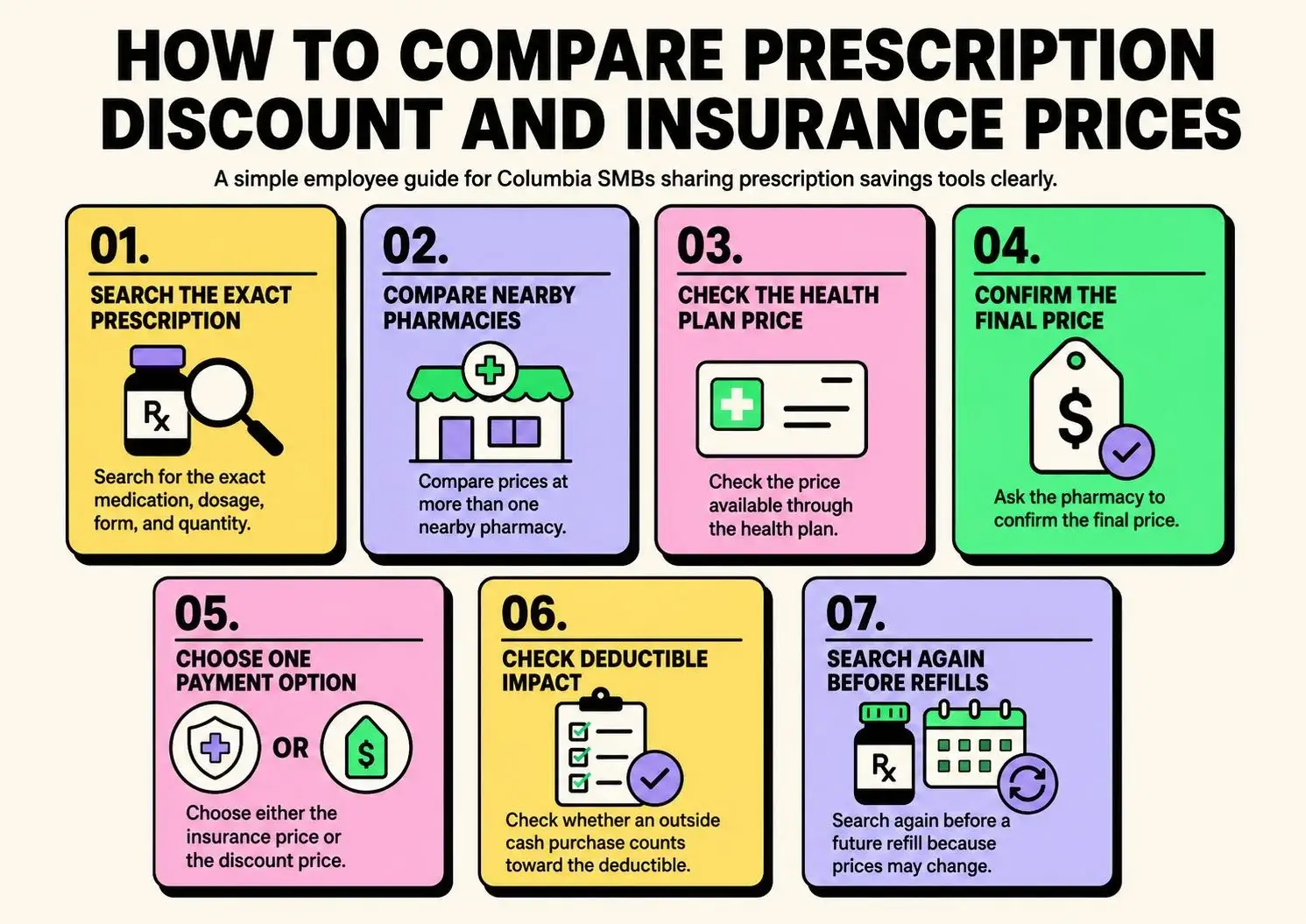
The materials should plainly state that the discount platform is not insurance and generally cannot be combined with insurance for the same purchase. Include the instructions during:
- Open enrollment
- New-hire onboarding
- Benefits education meetings
- Annual benefits reminders
- Employee portal updates
A short example can help. Explain that an employee may find the insurance price is lower for one medication and the discount price is lower for another. The employee needs to compare rather than assume one option always wins.
How Employees Should Compare Discount and Insurance Prices
A prescription discount platform gives the employee another price to review. It does not automatically determine the best way to pay. The immediate cash price matters, but so does the employee’s broader health-plan spending.
Compare the Full Cost Before Paying
An employee can ask the pharmacy to compare:
- The insurance copay or coinsurance
- The plan’s negotiated price
- The platform’s discounted cash price
- The pharmacy’s regular cash price
A discount price may help when a drug is not covered, the employee is still paying toward a high deductible, or the insurance cost is higher than the available cash price. The employee should confirm the final price before paying. An online estimate may not reflect a change in pharmacy pricing or the exact prescription submitted. Employees should also review whether changing pharmacies affects convenience, refills, delivery, or communication with their healthcare providers.
Check What Counts Toward the Deductible
A lower cash price today may affect how much the employee accumulates toward the health plan’s deductible or out-of-pocket maximum. When an employee uses a discount platform, the purchase is generally processed outside insurance.
It may not count toward the deductible unless the plan allows it or accepts documentation afterward. Employees should check with their insurance plan before making that decision. Employers should include this warning in employee instructions. HR should not tell an employee which option to choose because the right answer depends on the person’s plan, prescription, and annual healthcare spending.
What Employers Should Compare Before Choosing a Platform
The best-known platform is not automatically the best fit for every workforce. Use a practical vendor checklist.
Pharmacy Access
- Are major pharmacies in and around Columbia included?
- Can employees compare more than one pharmacy?
- Does the platform cover locations employees can reach easily?
- Can traveling or remote employees use it elsewhere?
Pricing and Usability
- Can employees search without creating an account?
- Does the search require the correct dosage and quantity?
- How often are displayed prices updated?
- Does the platform explain that prices may change?
- Is the app or website easy to use on a phone?
Costs and Eligibility
- Is the platform free to the employer?
- Are employees charged membership or subscription fees?
- Can spouses and dependents participate?
- Does the company need a contract?
- Can the employer fund part of the prescription cost?
Privacy and Reporting
- What personal information does the vendor collect?
- Is an account required?
- What information is shared with the employer?
- Are employer reports aggregated?
- Can employees get help directly from the vendor?
Employee Support
- Is phone or chat support available?
- What happens if a pharmacy rejects the discount?
- Can the vendor explain the difference between discount and insurance pricing?
- Are materials available in languages used by the workforce?
The current article’s unsourced medication-price tables should not be retained. A useful comparison requires the drug name, dosage, quantity, location, pharmacy, date, and platform. Without those details, a price claim gives the reader little reliable information.
Protect Employee Privacy When Sharing Prescription Resources
HR does not need employees’ medication names or diagnoses to decide whether a general savings resource could be useful. Avoid asking employees to provide:
- Medication lists
- Diagnoses
- Prescriber information
- Individual pharmacy receipts
- Treatment details
Instead, collect broader feedback:
- Are employees having trouble understanding prescription coverage?
- Do they know where to compare pharmacy prices?
- Is the platform easy to use?
- Are nearby pharmacies included?
- Do employees know the difference between insurance and a cash discount?
Anonymous surveys and aggregate vendor reports can show whether employees know about the resource without identifying what medication a person takes. Review the vendor’s privacy terms before introducing the platform. Confirm what data it collects, why it collects that information, and what the employer can see.
When a Discount Platform Is Not Enough
A platform may help an employee find a lower cash price for an individual prescription. It will not repair every pharmacy-benefit problem. A broader review may be needed when employees repeatedly report:
- High specialty-drug costs
- Formulary exclusions
- Prior-authorization delays
- A narrow pharmacy network
- Confusing copay or coinsurance rules
- Poor support from the carrier or PBM
- Difficulty obtaining recurring medications
- Prices that remain unaffordable after discounts
The employer may need to examine the formulary, pharmacy network, cost-sharing rules, PBM arrangement, health plan, or available patient-assistance programs. Do not add another platform before understanding the problem. More tools can create more confusion when employees already struggle to understand where to go for help.
Does a Prescription Savings Platform Fit Your Team?
Start with the issue employees are reporting. Are they facing high copays, paying full price before meeting a deductible, or finding that certain medications are not covered? A free comparison resource may be enough when employees mainly need another way to check pharmacy prices. A wider benefits review may make more sense if the company receives repeated complaints about formularies, specialty medications, prior authorizations, or limited pharmacy access. Those concerns may come from the health plan or pharmacy benefit rather than the discount platform.
Also decide how involved the employer wants to be. Some businesses share a vetted public resource. Others create a formal vendor arrangement or consider an employer-funded program. Employers comparing these choices with their current coverage can review Benni Agency’s Columbia benefits support for broader plan and workforce guidance. A useful first step is to identify the specific prescription problem the company wants to solve before selecting another tool.