Employer health insurance contributions determine how much your business pays toward employee coverage and how much employees pay from their own paycheck. Health insurance employer contribution rules can vary based on company size, plan type, ACA requirements, carrier rules, and the contribution method you choose.
For employers, business owners, and HR teams, the key question is finding a contribution level that fits the budget, keeps coverage affordable for employees, and meets applicable requirements. This guide explains the main rules, contribution options, tax treatment, and practical factors that can shape your decision.
Key Takeaways
- Employer contribution rules depend on company size, plan type, and ACA requirements. Businesses with 50 or more FTEs face different federal rules than smaller employers.
- There is no universal federal rule requiring every employer to pay 50% of health insurance premiums. That figure applies in certain situations, including small-business tax credit eligibility.
- For 2026, the ACA affordability percentage is 9.96%. Applicable Large Employers should test the employee cost of qualifying self-only coverage against this limit.
- Employers can use different contribution levels for employee-only and family coverage. Contribution structures may vary by coverage tier or permitted employee class when plan and tax rules are followed.
- ICHRA and QSEHRA give employers other ways to fund health benefits. ICHRA has no federal contribution minimum or maximum, while QSEHRA follows annual reimbursement limits.
What Are Employer Health Insurance Contributions?
Employer health insurance contributions are the amounts your business pays toward employees’ health plan premiums. The remaining cost is usually paid by the employee through payroll deductions.
For example, if employee-only coverage costs $600 per month and your business pays $450, your employer contribution is $450, and the employee pays $150. Your contribution can be set as a percentage of the premium or as a fixed dollar amount, depending on the plan structure. The amount you choose affects your benefits budget, employee payroll costs, and whether coverage meets applicable ACA affordability rules.
What Are Rules for Health Insurance Employer Contribution?
The rules depend heavily on the size of your workforce. Federal ACA requirements treat an employer with at least 50 full-time employees, including full-time-equivalent employees, differently from a smaller employer.
For larger employers, the main concerns are whether qualifying coverage is offered to enough full-time employees and whether that coverage meets affordability and minimum-value standards. Smaller employers are usually outside the federal employer mandate, giving them more freedom in deciding whether to offer group health coverage. Plan terms, insurer requirements, tax-credit rules, and state requirements can still affect how a contribution strategy is structured.
Rules for Employers With 50 or More FTEs
Businesses classified as Applicable Large Employers, or ALEs, have an average of at least 50 full-time employees, including FTEs, during the prior calendar year. Under the ACA, an ALE can face employer shared responsibility payments if it fails to offer qualifying coverage to at least 95% of its full-time employees and their dependents and a full-time employee receives a Marketplace premium tax credit.
Rules for Employers With Fewer Than 50 FTEs
Employers below the 50-FTE threshold are usually not subject to the ACA employer shared responsibility mandate. This means federal law does not require most small employers to offer health insurance.
If you choose to offer coverage, your group size can affect available plans, rating rules, contribution requirements, and carrier participation standards. Reviewing how small group health insurance differs from large-group coverage can help you see which rules may apply to your business. Small employers may still need to follow plan eligibility, insurer, tax, and state requirements when setting up coverage.
How Much Do Employers Have to Contribute to Health Insurance?
There is no single federal rule requiring every employer to pay the same percentage of employee health insurance premiums. Your required contribution depends on factors such as company size, plan type, ACA affordability rules, tax-credit eligibility, and plan requirements. An Applicable Large Employer may need to contribute enough to keep the lowest-cost qualifying employee coverage within the ACA affordability limit. A smaller employer has more flexibility under federal law.
One customer described the experience as smooth and manageable from start to finish, with knowledgeable and responsive support throughout the process. Clear guidance helped make complicated benefit decisions easier to understand and gave the business confidence in its choices.

Businesses looking for a fixed-budget approach can review ICHRA contribution options, which let employers set a defined monthly allowance that employees can use for eligible individual health insurance costs. The often-cited 50% figure applies in certain cases. For example, an eligible small employer seeking the Small Business Health Care Tax Credit must pay at least 50% of the cost of employee-only coverage.
Is There a Minimum Employer Contribution Percentage?
required amount depends on the rules tied to your business and coverage. The 50% requirement applies to employers seeking the Small Business Health Care Tax Credit. Eligible employers must pay at least half of each enrolled employee’s employee-only premium under the qualifying arrangement.
Employee-Only vs. Family Coverage Contributions
Your business does not have to use the same contribution amount for every coverage tier. You might pay a larger share of employee-only coverage and a smaller share of spouse, child, or family premiums. For ACA employer-mandate affordability testing, the employee’s required contribution is based on the lowest-cost self-only coverage that provides minimum value. This makes employee-only coverage a major figure when setting contributions
How Do ACA Affordability Rules Affect Employer Contributions?
ACA affordability rules can affect how much an Applicable Large Employer pays toward employee health coverage. For 2026, coverage is considered affordable if the employee’s required contribution for the lowest-cost self-only plan that provides minimum value does not exceed the federal affordability limit.
This matters for employers with 50 or more full-time employees, including FTEs. If employee contributions are set too high, coverage may fail the affordability test and create potential employer shared responsibility penalties when an eligible employee receives a Marketplace premium tax credit. Employers should review contribution amounts each plan year since the affordability percentage can change annually.
2026 ACA Affordability Percentage
For plan years beginning in 2026, the ACA affordability percentage is 9.96%. This means an employee’s required contribution for qualifying self-only coverage generally cannot exceed 9.96% of the income measure used for the affordability test. The IRS increased the percentage from 9.02% in 2025 to 9.96% for 2026.
ACA Affordability Safe Harbors
Employers usually do not know an employee’s total household income. The IRS provides three safe harbors that ALEs can use instead:
- Form W-2 wages
- Rate of pay
- Federal poverty line
An employer can use different safe harbors for reasonable employee categories if each method is applied consistently within that category.
What Does an Employer Health Insurance Contribution Look Like?
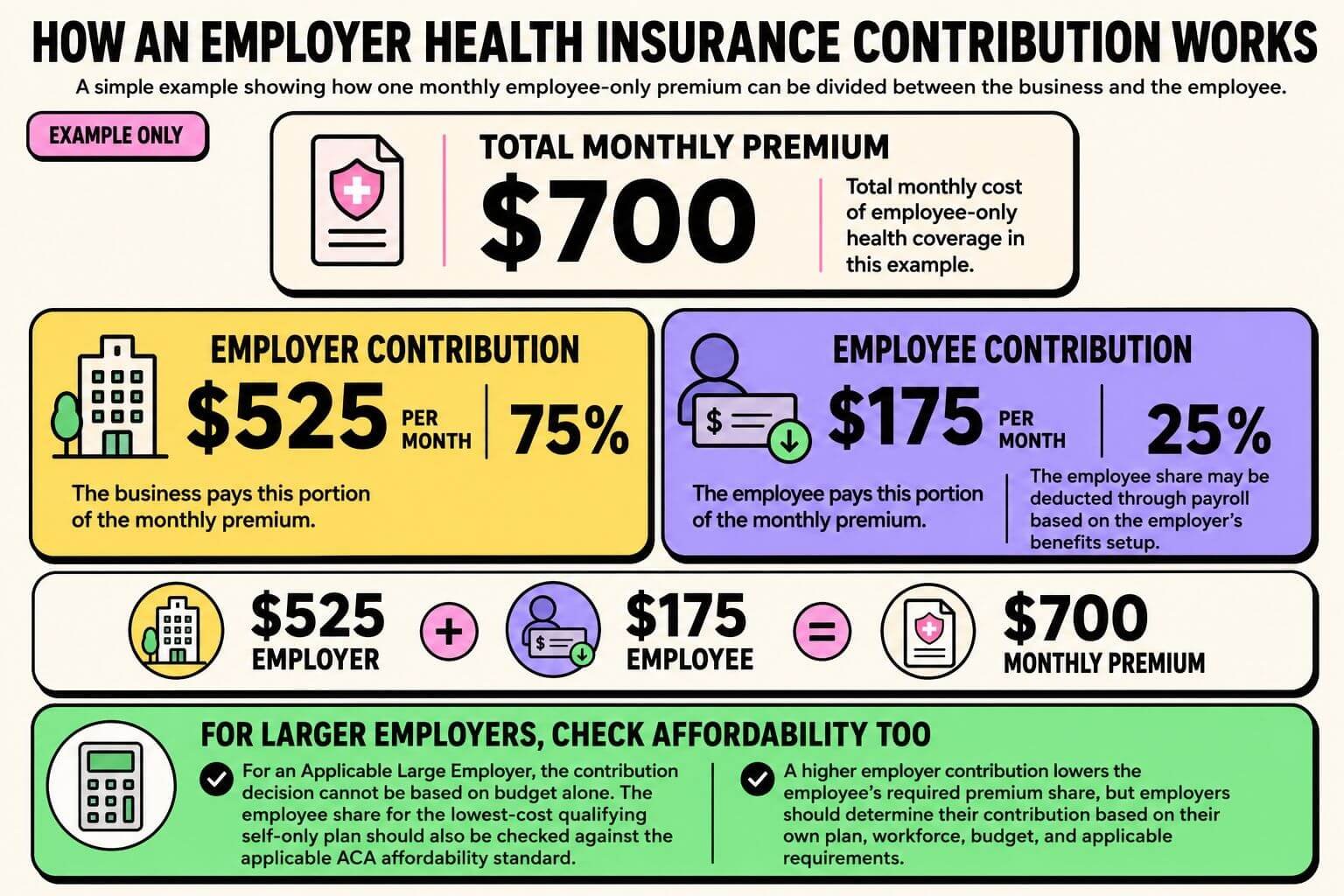
A simple example shows how employer and employee costs are divided. Suppose employee-only health coverage costs $700 per month:
- Monthly premium: $700
- Employer pays: $525
- Employee pays: $175
- Employer contribution: 75%
- Employee contribution: 25%
The employee’s $175 share may be deducted from payroll based on the employer’s benefits setup. For an ALE, the contribution decision cannot be based on budget alone. The employee share for the lowest-cost qualifying self-only plan should be checked against the ACA affordability standard. A higher employer contribution lowers the employee’s required premium share and can help keep coverage within that limit.
Can Employers Contribute Different Amounts for Different Employees?
Employers can use different contribution structures in certain situations, but contribution differences should follow clear plan rules rather than individual preferences. For example, an employer may set different amounts based on coverage tier, employment classification, or another permitted category. The plan documents and contribution policy should clearly state how each group is treated.
For ALE affordability testing, the IRS permits different safe harbors across reasonable employee categories when the same method is applied consistently within each category. Employers with self-funded health plans may face separate nondiscrimination requirements, so contribution differences should be reviewed before they are put into place.
Contribution Differences by Coverage Tier
A business may pay 80% of employee-only coverage and 50% of dependent coverage, for example. Common tiers include:
- Employee only
- Employee plus spouse
- Employee plus child
- Family
The employer does not have to contribute the same percentage to every tier under one universal federal contribution rule. Plan and carrier requirements can still affect the structure.
Employee Classes and Nondiscrimination Rules
Contribution differences may be based on legitimate employee categories, such as full-time versus part-time status or other plan-defined classes. The key point is consistency. Employees within the same category should be treated under the same contribution method when the applicable rules require uniform treatment. Employers using self-insured plans should pay close attention to federal nondiscrimination rules before creating richer benefits for selected employees.
Are Employer Health Insurance Contributions Tax-Deductible?
Employer-paid health insurance premiums can usually qualify as a business expense deduction when your business provides group hospitalization or medical insurance for employees. This can reduce the taxable cost of providing health benefits.
The tax treatment for employees is different. Employer payments for qualifying accident and health insurance are usually excluded from employee wages for federal income tax withholding and employment tax purposes. Special tax rules apply to certain owners, including S corporation shareholders who own more than 2%. Your business structure, plan setup, and eligibility for tax credits can affect the final tax result
Tax Treatment for Employers and Employees
For employers, group medical insurance premiums paid for employees are commonly deductible business expenses. For employees, the value of employer-paid health coverage is usually excluded from taxable wages. For example, an employer paying $500 each month toward an employee’s qualifying health insurance usually does not add that $500 to the employee’s taxable wages. Special ownership and plan rules can change this treatment.
Small Business Health Care Tax Credit
Eligible small employers may qualify for a federal tax credit worth up to 50% of qualifying premiums paid, or up to 35% for eligible tax-exempt employers. The business must have fewer than 25 FTEs, meet applicable average-wage limits, purchase qualifying SHOP coverage, and pay at least 50% of employee-only premium costs. The credit is available for two consecutive taxable years.
How Do Employer Contributions Work With ICHRA and QSEHRA?
ICHRA and QSEHRA let employers fund health benefits through reimbursement arrangements rather than paying part of a traditional group insurance premium. Under an ICHRA, employers choose an allowance that employees can use for eligible individual health insurance premiums and medical expenses under the plan terms. A QSEHRA is limited to eligible smaller employers and has annual federal reimbursement caps.
These arrangements can give employers a more predictable benefits budget. The rules differ sharply, so business size, existing group coverage, employee classes, affordability, and reimbursement limits need to be reviewed before choosing either option.
ICHRA Contribution Rules
There is no federal minimum or maximum ICHRA contribution amount. An employer chooses how much money to make available under the arrangement. Contribution amounts may differ across permitted employee classes, subject to ICHRA rules. For Applicable Large Employers, the allowance may need to be high enough for the ICHRA offer to meet ACA affordability requirements and reduce employer mandate risk.
QSEHRA Contribution Rules
A QSEHRA is funded entirely by the employer and is available to eligible employers that are not Applicable Large Employers and do not offer a group health plan. For 2026, the maximum reimbursement is $6,450 for employee-only coverage and $13,100 for family coverage. QSEHRA benefits are normally offered on the same terms to eligible employees, subject to permitted variations and exclusions.
How Should Employers Set Their Health Insurance Contribution?
Your contribution should balance employee affordability, business cost, compliance requirements, and workforce needs. A contribution that fits the company budget can still leave employees with premium costs that feel too high. Before setting the amount, review your monthly benefits budget, employee and dependent premium costs, affordability requirements, carrier rules, employee classes, and possible tax advantages.
Another employer shared that the benefits process became much easier for the entire staff because everything was explained clearly and in an easy-to-understand way. Helpful guidance throughout the process made it easier for both the employer and employees to understand their choices.

Many employers work with Benni Agency to compare contribution options, review affordability, and choose a structure that works for both the business and its employees. Review the contribution strategy each plan year, as premiums, workforce size, affordability percentages, and federal limits can change.
5 thoughts on “How Do Employer Health Insurance Contribution Rules Work?”
Comments are closed.