A benefits renewal can leave you choosing between higher costs, reduced coverage, or larger employee contributions. At the same time, your team may be handling enrollment questions, billing problems, and payroll corrections.
A Ridgeville benefits broker adds value by helping you compare options, understand the tradeoffs, support employees, and plan ahead instead of reacting at renewal. This article is for Ridgeville business owners and HR leaders who want clearer benefits decisions, fewer administrative problems, and a better way to evaluate their broker.
Key Takeaways
- A benefits broker should connect plan decisions to your budget, workforce, and business goals, not simply collect quotes.
- Cost analysis should consider premiums, employee contributions, deductibles, provider access, and prescription coverage.
- Year-round support can include employee questions, eligibility changes, billing problems, compliance reminders, and renewal preparation.
- Ridgeville employers may need enrollment methods that work for shift-based, deskless, commuting, or multi-location employees.
- A productive broker relationship should reduce repeated work and give employers enough time to make informed decisions.
How Does a Benefits Broker Create Real Value?
Insurance quotes are part of the broker’s job, but they aren’t the full job. A useful broker helps you understand what each option means for the company and its employees. That includes comparing costs, reviewing plan design, identifying administrative problems, and explaining where a change could help.
This work should continue throughout the plan year. Your broker should help resolve current issues while preparing for future decisions. By the time renewal arrives, you should already have a clear picture of what is working, what employees are struggling with, and which alternatives deserve consideration.
Better Plan and Funding Decisions
Employers have more choices than simply renewing the current plan or switching insurance carriers. Depending on the company, a broker may compare:
- Fully insured coverage
- Level-funded arrangements
- Self-funded plans
- PPO, HMO, or EPO networks
- HDHP and HSA-compatible plans
- Individual Coverage HRAs
- Dental, vision, and supplemental coverage
The right choice depends on the employer’s budget, workforce needs, claims exposure, provider access, and ability to manage the plan. For example, a predictable monthly premium may matter most to one employer. Another may accept more financial risk in exchange for greater control over plan costs. A broker should explain these differences without pushing every company toward the same structure.
Employers can review available group health options to better understand how medical, dental, vision, and funding choices may fit together. Some businesses may also investigate an ICHRA option when a traditional group plan no longer fits their workforce, budget, or coverage goals.
Cost Control Beyond the Monthly Premium
The plan with the lowest monthly premium isn’t always the most affordable choice. A lower premium may come with a higher deductible, a smaller provider network, increased prescription costs, or larger employee contributions. Those changes can reduce participation or leave employees unable to use the coverage effectively. A broker should help you compare the total impact of each option, including:
- Employer contributions
- Employee payroll deductions
- Deductibles and copays
- Out-of-pocket limits
- Prescription coverage
- Provider-network access
- Expected plan participation
- Administrative costs and errors
The goal isn’t simply to cut benefits. It is to identify where the company may be paying for features employees rarely use while protecting the coverage they value. Employers may also consider supplemental benefits that help employees prepare for certain medical expenses without placing the entire additional cost on the company.
Support That Employees Can Actually Use
Benefits have less value when employees don’t understand them or can’t get help. Employees may need support with plan comparisons, identification cards, eligibility questions, life-event changes, carrier records, or claims problems. Without a clear support process, many of these issues return to HR.
A broker can help by explaining where employees should go, following up with carriers, and checking that unresolved problems reach the right person. The broker may not control a carrier’s final claims decision, but they should help the employee understand the process and identify the next step. Clear education also matters during enrollment. Employees need practical explanations of premiums, deductibles, networks, prescriptions, and out-of-pocket costs. Sending a plan document without context rarely gives them enough information to choose confidently.
How a Broker Reduces Work for HR
A benefits program can create a surprising amount of administrative work. New hires need to be enrolled, former employees must be removed, payroll deductions need to match elections, and carrier invoices need to be checked.
Technology can help, but software alone won’t fix a poorly managed process. The broker should help establish clear responsibilities, timelines, and methods for handling changes. The result should be fewer repeated corrections and less uncertainty about who is responsible for each task.
Enrollment, Payroll, and Eligibility Support
A broker’s administrative support may include:
- Setting up open enrollment
- Adding eligible new employees
- Processing terminations
- Recording qualifying life events
- Checking payroll deductions
- Coordinating carrier files
- Reviewing enrollment reports
- Helping correct billing problems
The exact level of support should be discussed before the relationship begins. Employers shouldn’t assume every broker handles the same tasks. The right benefits administration support can help connect enrollment, employee eligibility, payroll deductions, and carrier records. This is especially useful when HR teams are managing benefits alongside several other responsibilities.
Compliance Planning and Renewal Preparation
Compliance support should follow a schedule rather than depend on last-minute reminders. A broker can help organize renewal dates, enrollment deadlines, required employee notices, carrier requests, and eligibility records. When legal or tax advice is needed, the broker should also help the employer identify the appropriate professional resource.
Renewal preparation should begin well before the current plan ends. Early planning gives the employer time to:
- Review participation and contribution levels
- Gather employee feedback
- Compare funding and plan options
- Discuss budget limits
- Prepare employee communication
- Coordinate payroll or system changes
Waiting until the final weeks can limit the available choices and make it harder for employees to understand what is changing.
Why Ridgeville Workforce Needs Matter
Benefits decisions should reflect how employees actually work and where they receive care. According to the U.S. Census Bureau, Dorchester County had 2,861 employer establishments and 33,506 employees in 2023. The county’s growing employer base can create more competition for workers and increase pressure on local companies to offer benefits that employees understand and value.
Ridgeville is also connected to the larger Charleston-area economy. Local and nearby employers may have workers in logistics, manufacturing, construction, professional services, retail, or other industries. A standard office presentation may not work for every workforce. Employers with shifts, field workers, or employees across several locations may need:
- Mobile-friendly enrollment
- Short educational sessions offered at different times
- Printed materials for employees without regular computer access
- Provider networks that extend beyond Ridgeville
- Clear explanations of payroll contributions
- Support for employees who cannot contact HR during normal office hours
A broker should ask these questions before recommending a plan or communication method.
How to Evaluate Your Current Benefits Broker
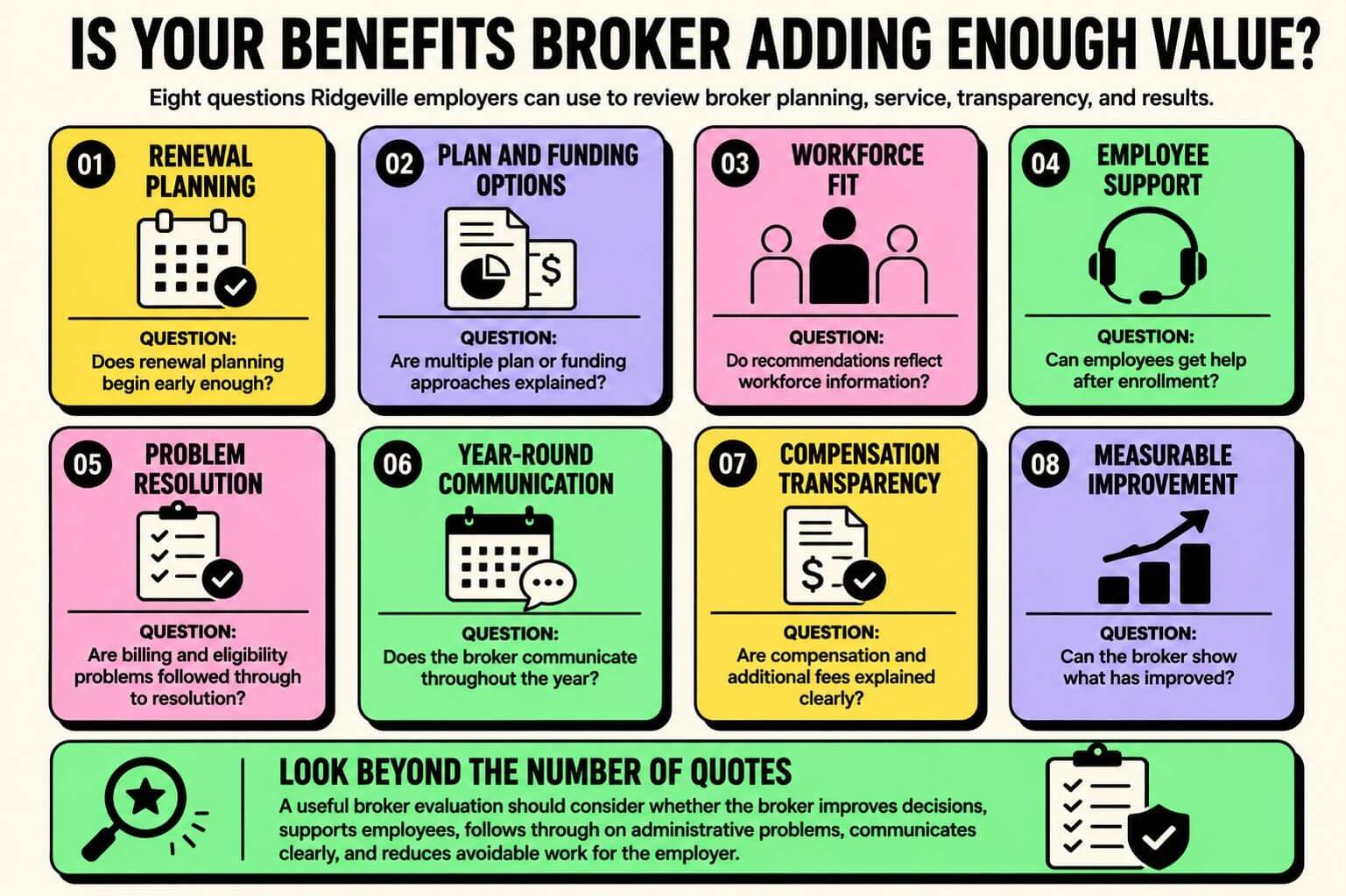
Broker performance shouldn’t be judged only by whether emails receive a quick reply. The better question is whether the broker helps your company make stronger decisions and reduces avoidable work. Consider asking:
- Does renewal planning begin early enough?
- Are multiple plan or funding approaches explained?
- Do recommendations reflect workforce information?
- Can employees get help after enrollment?
- Are billing and eligibility problems followed through to resolution?
- Does the broker communicate throughout the year?
- Are compensation and additional fees explained clearly?
- Can the broker show what has improved?
These questions give you a more useful picture than simply comparing the number of carrier quotes provided.
Signs the Relationship Is Working
A productive broker relationship usually has visible results. Renewal preparation begins early. Recommendations come with a clear explanation. Employees know where to take questions. Administrative problems are acknowledged and tracked. Your team receives updates during the year rather than hearing from the broker only before enrollment.
You should also understand why the broker recommends a certain plan. Even when you choose to keep the current coverage, the decision should follow a real review rather than an automatic renewal.
Signs You May Have Outgrown Your Broker
One mistake doesn’t necessarily mean you need a different broker. Repeated patterns deserve a closer look. Possible warning signs include:
- Renewal information arrives at the last minute.
- Similar plans are presented every year without much explanation.
- Billing and eligibility problems keep returning.
- Employees are redirected without receiving useful support.
- Your broker rarely discusses workforce changes or business goals.
- No annual service schedule is provided.
- Most benefits tasks remain with your internal team.
An employer can outgrow a broker as the company adds employees, locations, plan options, or administrative requirements. The service model that once worked may no longer provide enough support.
Is Your Benefits Broker Reducing the Work?
A useful broker relationship should make benefits easier to understand and manage. Renewal planning should begin early enough to compare options, employees should know where to take coverage questions, and HR shouldn’t spend every month correcting the same enrollment or billing problems. Look at what changed during the past year. Did your broker explain why one plan was recommended over another? Were employee questions handled clearly? Did the process reduce work for your team, or did most of the responsibility stay with you?
Benni Agency helps employers review plan structure, administrative workflows, employee communication, and renewal preparation. The point isn’t to change benefits simply for the sake of change. It is to identify what works, what creates avoidable problems, and what should be addressed before the next renewal.