A workers’ compensation payroll audit reconciles the estimated payroll used to issue a policy with the payroll, job duties, classifications, and contractor records from the completed policy period. The audit request may arrive with a short deadline, while the necessary information may be spread across payroll systems, tax filings, contractor records, and policy documents.
This guide is for Summerville employers, owners, and bookkeepers who need to prepare for a workers’ comp audit, review a completed audit, or create better records for the next policy year. It provides general educational information, not legal, tax, or individualized insurance advice.
Key Takeaways
- Workers’ compensation premium audits compare estimated payroll and classifications with actual records from the completed policy period.
- Prepare payroll registers, tax filings, job-duty information, contractor records, certificates of insurance, and ownership documents for the exact audit period.
- Workers’ compensation remuneration can include more than base wages, so commissions, bonuses, paid leave, overtime, and other compensation need careful review.
- Do not rely on job titles, 1099 status, or outdated certificates alone when documenting classifications or contractor relationships.
- After the audit, compare payroll totals, class codes, contractor entries, and owner or officer treatment with your submitted records and address errors promptly.
What a Workers’ Comp Payroll Audit Checks
Workers’ compensation premium is commonly based on estimated payroll and the classifications describing the work employees perform. At the end of the policy period, the carrier may audit the policy to compare those estimates with the actual payroll, job duties, and other relevant records for that period. Depending on the policy and final records, the audit may result in:
- Additional premium
- A premium credit
- No adjustment
The carrier’s audit request should identify the deadline, audit method, and documents required. Start by reading those instructions carefully because the insurer’s request controls what should be submitted.
Do Summerville Employers Need Workers’ Comp Coverage?
South Carolina generally requires businesses that regularly employ four or more people to maintain workers’ compensation coverage. Part-time employees and family members count toward that total. The South Carolina Workers’ Compensation Commission Employer FAQs also list exceptions, including certain casual employees, some agricultural employees, businesses with fewer than four employees or annual payroll below $3,000, and other specific categories.
Coverage requirements can depend on facts that are not obvious from a payroll report. The Commission also explains that paying someone through a 1099 does not, by itself, determine whether workers’ compensation requirements apply. Independent-contractor questions can be fact-specific. If employee count, contractor status, or an exemption is uncertain, confirm the issue with the Commission, legal counsel, or a qualified insurance professional.
The Complete Payroll Audit Checklist
Start with records covering the exact policy period stated in the audit notice, rather than automatically using calendar-year records. Keep the original supporting documents available even if the carrier allows an online, telephone, virtual, or mail-in audit.
Payroll and Wage Records
Prepare:
- Payroll journal or payroll register covering the complete policy period
- Employee earnings records
- Employee time records
- Overtime reports showing regular pay and overtime premium separately when available
- Commission records
- Bonus records
- Paid-leave information
- Other compensation paid during the policy period
The goal is to make the payroll totals traceable instead of submitting one blended figure without supporting detail.
Tax and Business Records
Depending on the carrier’s request, gather:
- Quarterly federal payroll tax returns, such as Form 941
- South Carolina unemployment insurance filings or comparable payroll summaries
- Business income tax returns when requested
- 1099 forms
- Profit-and-loss statements when requested
- Other records the auditor identifies
These documents can help the auditor reconcile payroll totals with independently reported business records.
Employee Duties and Classification Support
Prepare:
- A current job description or concise duties summary for each position
- Payroll grouped by the classification codes shown on the policy
- Notes about new positions
- Documentation of significant duty changes during the policy period
Do not rely on job titles alone.
A title such as “manager,” “technician,” or “assistant” may not fully explain the work performed. Actual duties are important when classifications are reviewed.
Subcontractor and Independent-Contractor Records
Prepare a list of subcontractors and other outside labor paid during the policy period. Keep:
- Certificates or other carrier-accepted evidence of workers’ compensation coverage
- Coverage dates
- Contracts
- Invoices
- Payment records
- A description of the work performed
The South Carolina Workers’ Compensation Commission Coverage and Compliance FAQs explain that payment method alone does not determine independent-contractor status and also address contractor-related coverage questions. Match proof of insurance to the dates the subcontracted work was actually performed.
Ownership and Officer Records
Have available:
- Ownership information
- Officer information
- Member information
- Partner information
- Any inclusion or exclusion documents requested
- Applicable election or rejection forms
- Documentation of ownership or role changes during the policy period
Do not assume owner or officer payroll treatment remained unchanged if responsibilities or business structure changed during the year.
How Payroll Is Reviewed for Premium Purposes
Workers’ compensation audits often use the broader term remuneration because the premium basis can include more than an employee’s base wages.
The carrier applies the rating and policy rules governing the audit.
The following are common examples and should not replace the carrier’s specific instructions.
| Commonly Included as Remuneration | Commonly Excluded When Properly Documented |
| Wages and salaries, including retroactive pay | Employee-reported tips |
| Commissions, bonuses, profit sharing, and incentive payments | Severance pay |
| Holiday, vacation, and sick pay | Employer retirement or pension contributions |
| Meals or lodging furnished instead of wages | Documented business-expense reimbursements |
| Regular-pay portion of overtime | Identifiable overtime premium portion when records support the exclusion |
NCCI’s payroll rules define payroll or remuneration broadly as money or substitutes for money and identify numerous forms of compensation that may be included in the premium basis.
Pay Special Attention to Overtime
Overtime deserves its own review. Under common NCCI-based rules, the employee’s regular-pay portion is generally included, while the additional overtime premium may be excluded when the records clearly separate and support that amount. Do not simply subtract all overtime from payroll. Keep payroll reports showing the regular and premium portions separately, and confirm the carrier’s treatment before removing an amount from audited payroll.
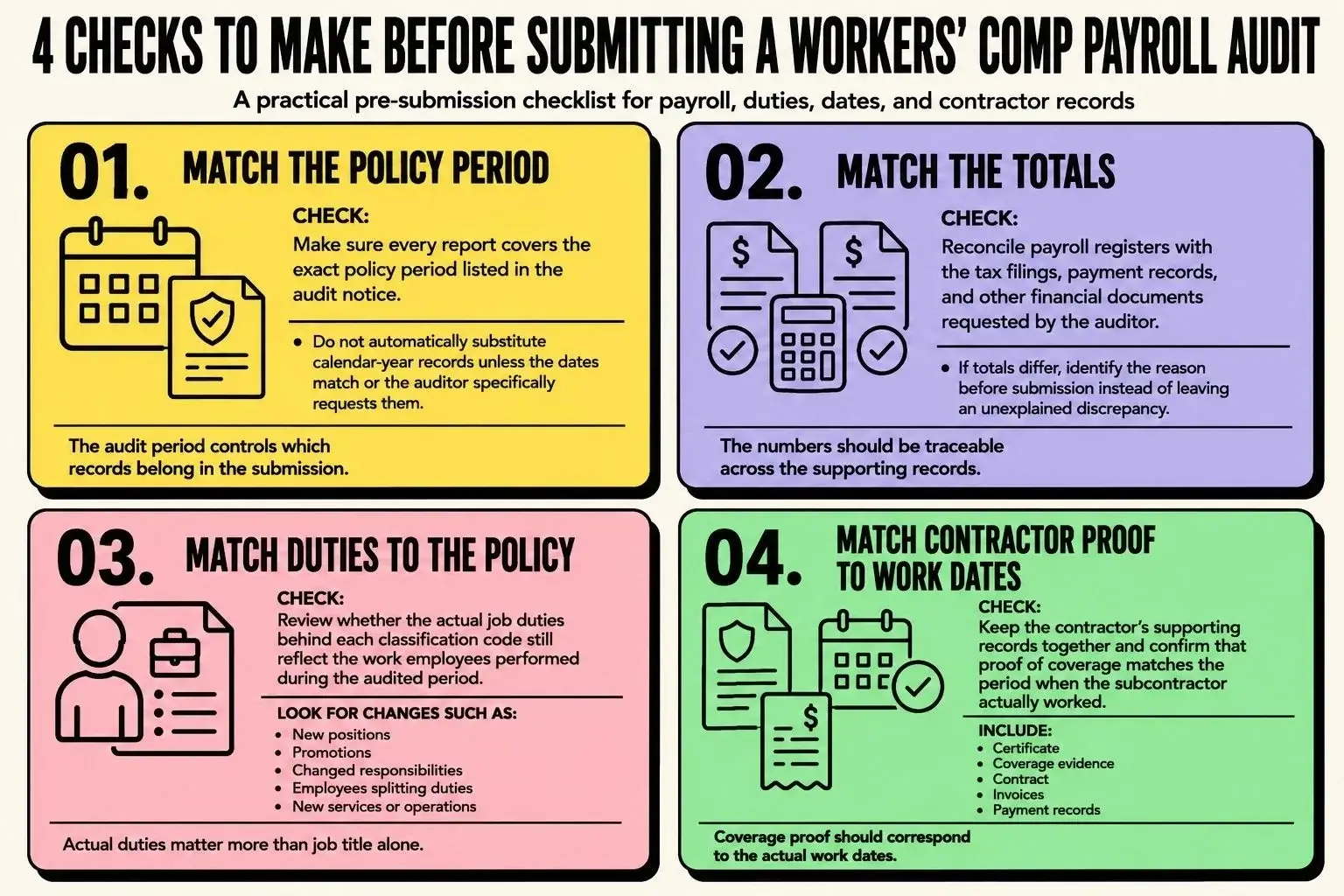
Four Document Checks Before You Submit
Before sending the audit information, perform four basic checks.
1. Match the Policy Period
Every report should cover the exact audit policy period. Do not substitute calendar-year information unless the dates happen to match or the auditor specifically requests it.
2. Match the Totals
Reconcile payroll registers with the tax filings, payment records, and other financial documents requested by the auditor. If totals differ, identify the reason before submission rather than leaving the auditor to interpret an unexplained discrepancy.
3. Match Duties to the Policy
Review whether the actual job duties behind each classification code still reflect the work employees performed during the audited period. Pay particular attention to:
- New positions
- Promotions
- Changed responsibilities
- Employees splitting duties
- New services or operations
4. Match Contractor Proof to Work Dates
Keep each contractor’s:
- Certificate
- Coverage evidence
- Contract
- Invoices
- Payment records
Together. Confirm that the proof of coverage corresponds to the period when the subcontractor actually worked for the business.
Common Mistakes That Can Complicate an Audit
Several documentation problems can make an otherwise routine audit more difficult. Avoid:
- Submitting only a blended payroll total. Provide the class-code or employee detail requested by the carrier.
- Using job titles as the only classification support. Actual duties matter, particularly when responsibilities changed.
- Treating 1099 status as automatic proof of independent-contractor status. Worker status can depend on additional facts.
- Providing an outdated contractor certificate. Verify that the coverage evidence includes the dates work was performed.
- Ignoring ownership or officer changes. Payroll treatment may need review when roles or business structure change.
- Submitting records for the wrong dates. Audit documentation should match the policy period.
- Missing the audit deadline. Respond on time or contact the carrier promptly if additional time or clarification is needed.
Keep a copy of every document submitted and, when possible, record when and how it was provided.
What to Review After the Audit
Do not file away the audit result without reviewing it. Retain the final audit worksheet, statement, or other documentation showing the payroll and classifications used. Compare:
- Policy period
- Total payroll
- Payroll by classification
- Class codes
- Contractor entries
- Officer or owner treatment
- Adjustments made by the auditor
Compare those figures with the documents originally submitted. If something appears incorrect, contact the carrier or agent promptly with supporting records and ask about the carrier’s correction or dispute process. If a material disagreement remains, consider seeking qualified professional advice.
What a Payroll Audit Does Not Decide
A workers’ compensation premium audit is not a workers’ compensation claim decision. It does not determine:
- Whether an injury is work-related
- Whether medical treatment is covered
- Whether an employee qualifies for benefits
- What benefits an injured worker may receive
- Whether another business insurance policy covers a loss
Its purpose is to reconcile premium-related information for the audited policy period. Other insurance policies and workers’ compensation claims have their own terms, procedures, and requirements.
Preparing for the Next Audit Year-Round
Good recordkeeping can make the next audit easier long before the audit request arrives.
- Store contractor certificates and contracts when work begins. Track renewal and expiration dates instead of collecting documents months later.
- Review payroll and job duties quarterly. Identify changes before renewal or audit.
- Keep audit, payroll, tax, and policy records together. A consistent filing system makes reconciliation easier.
- Document role changes when they happen. Do not wait until the auditor asks why duties no longer match the policy.
- Keep overtime detail available. Separate regular pay from identifiable overtime premiums in payroll reporting when possible.
For a broader review of workers’ compensation and related commercial coverages, visit Benni Agency’s Business & Commercial Insurance services. Summerville employers can also review the Summerville service-area page for information about Benni Agency’s local commercial insurance and employee benefits services. These resources do not replace the carrier’s audit instructions or individualized insurance, legal, or tax advice.