A difficult renewal can leave you paying more while employees still struggle to understand or use their coverage. A Beaufort insurance broker can help by reviewing your workforce, comparing realistic plan options, improving administration, and supporting employees throughout the year.
The broker’s job should go well beyond collecting carrier quotes. This guide is for Beaufort employers and HR teams who want to control benefit costs, reduce administrative problems, and make better decisions before their next renewal.
Key Takeaways
- A broker should help with plan strategy, costs, administration, communication, and renewal planning, not only carrier quotes.
- Smarter benefits start with your workforce, budget, current plan problems, and employee needs.
- Comparing plans means looking at contributions, deductibles, networks, coverage, and affordability together.
- Benefits technology should reduce enrollment and payroll work while giving employees easier access to information.
- Strong broker support continues throughout the year, not only during renewal season.
What Smarter Employee Benefits Look Like
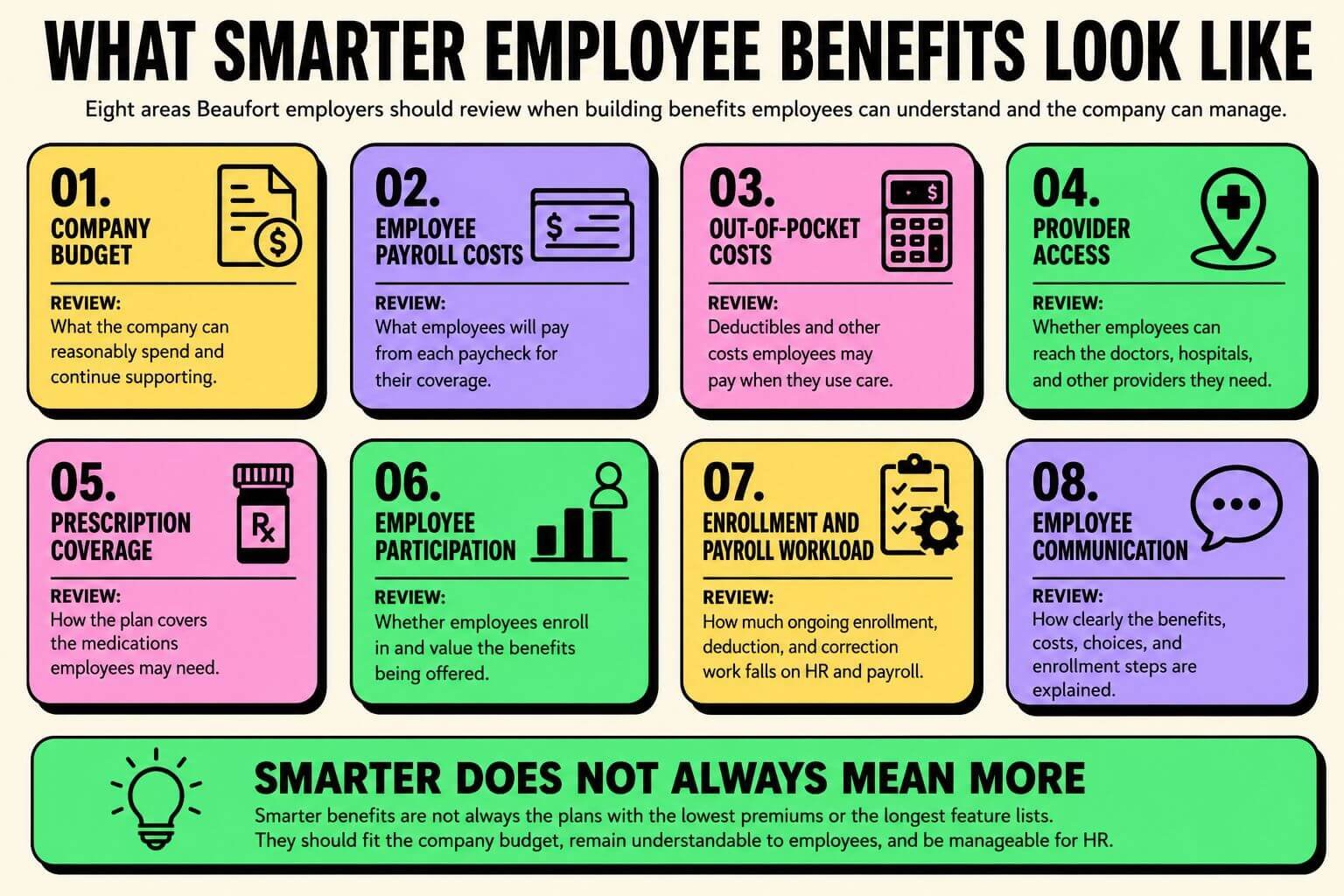
Smarter employee benefits are not always the plans with the lowest premiums or the longest list of features. They are benefits your company can afford, your employees can understand, and your HR team can manage without constant corrections. For one employer, that may mean offering two medical plan choices instead of one. Another company may need to adjust employer contributions, improve voluntary benefit options, or simplify enrollment. A stronger benefits strategy considers:
- What the company can reasonably spend
- What employees pay from each paycheck
- Deductibles and other out-of-pocket costs
- Provider and hospital access
- Prescription coverage
- Employee participation
- Enrollment and payroll workload
- How clearly the benefits are explained
A plan can look competitive on paper and still create problems. Employees may avoid using coverage they do not understand, while HR spends hours answering the same questions or correcting deductions.
How a Beaufort Insurance Broker Helps Employers
Reviews Your Workforce and Current Plans
Before recommending coverage, a broker should learn how your company operates. That review may include employee locations, work schedules, eligibility groups, participation rates, contribution levels, current plan usage, and common employee concerns.
Beaufort-area employers do not all have the same workforce. Regional employment includes hospitality, food service, sales, office support, healthcare, construction, and other occupations with different schedules and pay levels. A contribution or enrollment approach that works for an office-based team may not work as well for hourly, seasonal, or distributed employees. The goal is not to make assumptions based on an industry or job title. It is to use real company information to identify where the current plan works and where employees or administrators are running into problems.
Compares Costs, Coverage, and Funding Options
Premiums matter, but they are only one part of the cost. A broker should also compare employer contributions, employee payroll deductions, deductibles, copays, provider networks, prescription coverage, and expected out-of-pocket expenses. A lower premium does not help much if employees cannot afford to use the plan or cannot find their preferred providers. The review may also consider whether the company should:
- Offer more than one medical plan
- Adjust employer contribution levels
- Add voluntary benefits
- Review alternative funding arrangements
- Change deductibles or copays
- Improve prescription coverage
- Remove benefits with consistently low value or participation
The best choice depends on the company’s budget, workforce, risk tolerance, and administrative capacity. A broker should explain the tradeoffs clearly instead of presenting one option as the right answer for every employer.
Supports Enrollment and Administration
Benefits work continues after the plans are selected. Eligibility rules must be set correctly, enrollment information must reach carriers, payroll deductions must match employee elections, and new hires need a clear process for choosing coverage. Useful benefits administration technology can connect enrollment, eligibility, reporting, and payroll information while giving employees easier access to their benefit details.
Technology should reduce manual work, not give HR another complicated system to manage. The broker should help with setup, testing, employee instructions, enrollment files, and issue resolution. Employers should also know who handles common tasks after enrollment, including:
- New-hire enrollment
- Employment status changes
- Qualifying life events
- Dependent updates
- Carrier eligibility errors
- Payroll deduction corrections
- Employee access problems
Clear responsibilities help prevent small errors from turning into larger payroll or coverage issues.
Helps Employees Understand Their Benefits
Employees may overlook valuable coverage when they do not understand how it works. Terms such as deductible, coinsurance, network, voluntary coverage, and evidence of insurability can be difficult to interpret without clear guidance. A broker can support employees through benefit summaries, enrollment meetings, recorded explanations, decision tools, and help with individual questions.
Communication should also reflect how employees receive information. Some teams may respond well to online meetings and email reminders. Others may need printed materials, onsite sessions, or extra time to review choices. Better communication does not guarantee that every employee will choose the ideal plan. It does give them a better chance of making an informed choice while reducing the number of routine questions sent to HR.
Provides Support Throughout the Year
A broker relationship should not disappear after open enrollment. During the year, employers may need help with carrier errors, difficult claims, eligibility changes, employee questions, compliance reminders, reporting, or new benefit needs. Waiting until renewal to discuss these issues leaves little time to solve them properly.
Year-round support should also prepare the company for its next decision. A broker can review participation, recurring service problems, workforce changes, and employee feedback before requesting new proposals. Early preparation gives employers more time to compare choices, model contributions, communicate changes, and avoid a rushed enrollment.
What Beaufort Employers Should Look for in a Broker
Service and Implementation Support
Access to insurance carriers is only part of the broker’s role. Employers should also examine how the broker manages implementation and daily service. Useful questions include:
- Who will handle routine HR and employee questions?
- What response time should the company expect?
- Who manages enrollment and carrier files?
- Is employee education available?
- How are difficult carrier or claim issues escalated?
- What support is provided between enrollment and renewal?
The City of Beaufort used a broad approach when evaluating employee benefits broker proposals in 2025. Its review considered industry experience, online HR and employee resources, onsite presentations, enrollment assistance, and consulting capabilities, not only carrier access. This public example shows why broker evaluation should cover the full service relationship. A private employer may use different criteria, but the same principle applies. Ask how the work will actually get done after the broker is selected.
Technology and Employee Resources
Do not evaluate a benefits platform from a list of features alone. Ask to see how employees enroll, how HR reviews elections, how new hires are added, and how payroll data is handled. A useful technology review should cover:
- Employee self-service access
- Mobile and desktop usability
- Enrollment confirmation
- Payroll coordination
- Eligibility reporting
- New-hire onboarding
- Document storage
- Employee support
- Administrative reports
The broker should also explain what happens when the system and carrier records do not match. A polished platform is not enough if HR must solve every error without support.
Fees, Commissions, and Clear Expectations
Employers should understand how a broker is paid before agreeing to the relationship. Some brokers receive commissions from insurance carriers. Others charge consulting, technology, implementation, or administrative fees. Some arrangements use a combination of these methods. Ask for a clear explanation of:
- Broker commissions
- Employer-paid fees
- Technology charges
- Enrollment or implementation costs
- Services included in the arrangement
- Services that may cost extra
Compensation alone does not determine service quality. Transparency helps the employer compare proposals fairly and understand what support it should expect. Responsibilities should also be documented. The employer should know who manages enrollment, employee questions, carrier issues, reporting, compliance resources, and renewal planning.
Signs Your Current Broker May Not Be Providing Enough Support
You do not need to replace a broker because of one delayed email or a difficult renewal. Repeated service problems, however, may point to a larger issue. Your current broker may not be providing enough support when:
- Renewal discussions regularly begin at the last minute.
- Recommendations focus only on premiums.
- Employees cannot get answers without going through HR.
- Payroll and eligibility errors continue after enrollment.
- The company receives little reporting or participation information.
- The service team is difficult to reach.
- Plan recommendations remain unchanged despite workforce changes.
- Employees repeatedly say they do not understand their benefits.
These problems do not always require changing carriers or replacing every plan. Sometimes the first step is setting clearer expectations and identifying which parts of the process need attention.
Review Your Benefits Strategy Before the Next Renewal
A difficult renewal is not the only reason to review your benefits strategy. Repeated payroll corrections, employee confusion, slow broker responses, and plans that no longer fit your workforce also deserve attention. Start by looking at what has changed since the last enrollment. Has your workforce grown or shifted? Are employees raising the same questions each year? Is HR spending too much time fixing eligibility or deduction problems? Are renewal discussions starting early enough to compare meaningful options?
The answers can help you identify whether the main concern is plan design, employee cost, administration, communication, or broker service. Benni Agency can help employers review their current approach and identify areas that deserve a closer look. The goal is not to change plans without a reason. It is to understand what is working, what is creating extra work, and what should be addressed before the next renewal.