Rising premiums, confusing plan choices, and repeated employee questions can make benefits difficult to manage. An Orangeburg insurance broker can help your business compare coverage, control costs, handle enrollment, and explain benefits to employees. The right broker should also provide support after open enrollment instead of disappearing until the next renewal.
This article is for Orangeburg business owners and HR leaders who want to improve their benefits program, reduce administrative problems, and know what useful broker support should include.
Key Takeaways
- A broker can help your business compare plans based on cost, coverage, networks, and employee needs.
- Good broker support includes enrollment, eligibility changes, billing questions, and renewal planning.
- The lowest premium is not always the most affordable option for employees.
- Clear benefits education can reduce employee confusion and repeated questions for HR.
- Orangeburg wage conditions make payroll deductions and out-of-pocket costs important parts of plan design.
What Should an Orangeburg Insurance Broker Help With?
A benefits broker should start by learning how your business operates. That includes understanding your workforce, budget, hiring plans, employee needs, and the amount of time your team can spend managing benefits. The broker can then help with several parts of your benefits program:
- Comparing insurance carriers and plan structures
- Reviewing premiums and employee contributions
- Explaining deductibles, copays, networks, and prescriptions
- Coordinating enrollment and eligibility updates
- Helping employees understand their choices
- Addressing billing or coverage problems
- Preparing for renewals before deadlines become urgent
This is the difference between receiving a set of quotes and building a useful benefits strategy. Quotes show what plans cost. A strategy looks at whether those plans fit your workforce, budget, and business goals.
How a Broker Helps Balance Cost and Coverage
Cost usually gets the most attention during renewal, but the monthly premium tells only part of the story. A plan with a lower premium may have a narrow provider network, higher prescription costs, or a deductible that employees struggle to afford. Another plan may cost the company more but give employees better access to doctors and lower costs when they need care. A broker should help you compare:
- Employer premium contributions
- Employee payroll deductions
- Individual and family deductibles
- Copays and coinsurance
- Prescription coverage
- Provider networks
- Dependent coverage
- Maximum out-of-pocket costs
Local income levels make these details especially relevant. According to the U.S. Bureau of Labor Statistics, Orangeburg County’s average weekly wage was $982 in the fourth quarter of 2025, compared with $1,276 across South Carolina. That does not describe every employee, but it shows why payroll deductions, deductibles, and dependent costs deserve careful review.
A broker cannot guarantee lower premiums. The broker can help you understand where the money is going and which trade-offs make sense for your company.
What Health Plan Options Can a Broker Compare?
Businesses do not all need the same health plan. The right structure depends on the number of employees, available budget, workforce needs, risk tolerance, and administrative capacity. A broker should explain the differences in plain language and show how each option may affect both the company and its employees.
Traditional Group Health Plans
Employers may consider fully insured, level-funded, PPO, HMO, EPO, or high-deductible plans. Each option handles costs, provider access, and financial risk differently. A broker can help your company compare group health options based on:
- Monthly premiums
- Provider networks
- Prescription formularies
- Claims risk
- Employee contributions
- Expected medical use
- Administrative requirements
The goal is not to choose the plan with the longest list of features. It is to find coverage that employees can use and the business can continue supporting.
ICHRA and Other Flexible Arrangements
An Individual Coverage Health Reimbursement Arrangement, or ICHRA, allows an employer to reimburse eligible employees for individual health insurance and certain medical expenses. This arrangement may work for businesses with employees in different areas, varied eligibility groups, or difficulty finding a practical group plan. However, it is not automatically the right choice for every company.
A broker should explain affordability requirements, employee classes, reimbursement limits, enrollment responsibilities, and the individual insurance options available to employees. Reviewing an ICHRA rollout example may also help employers understand how the arrangement can work in practice.
Benefits Beyond Major Medical
Health insurance is often the foundation of a benefits package, but employees may also value:
- Dental and vision coverage
- Life insurance
- Short-term and long-term disability
- Accident insurance
- Critical illness coverage
- Hospital indemnity plans
The broker should help decide which options address real workforce needs. Adding more plans does not automatically create a better package. Employees need to understand what each benefit covers, what it costs, and when it may be useful.
How Broker Support Can Reduce HR Work
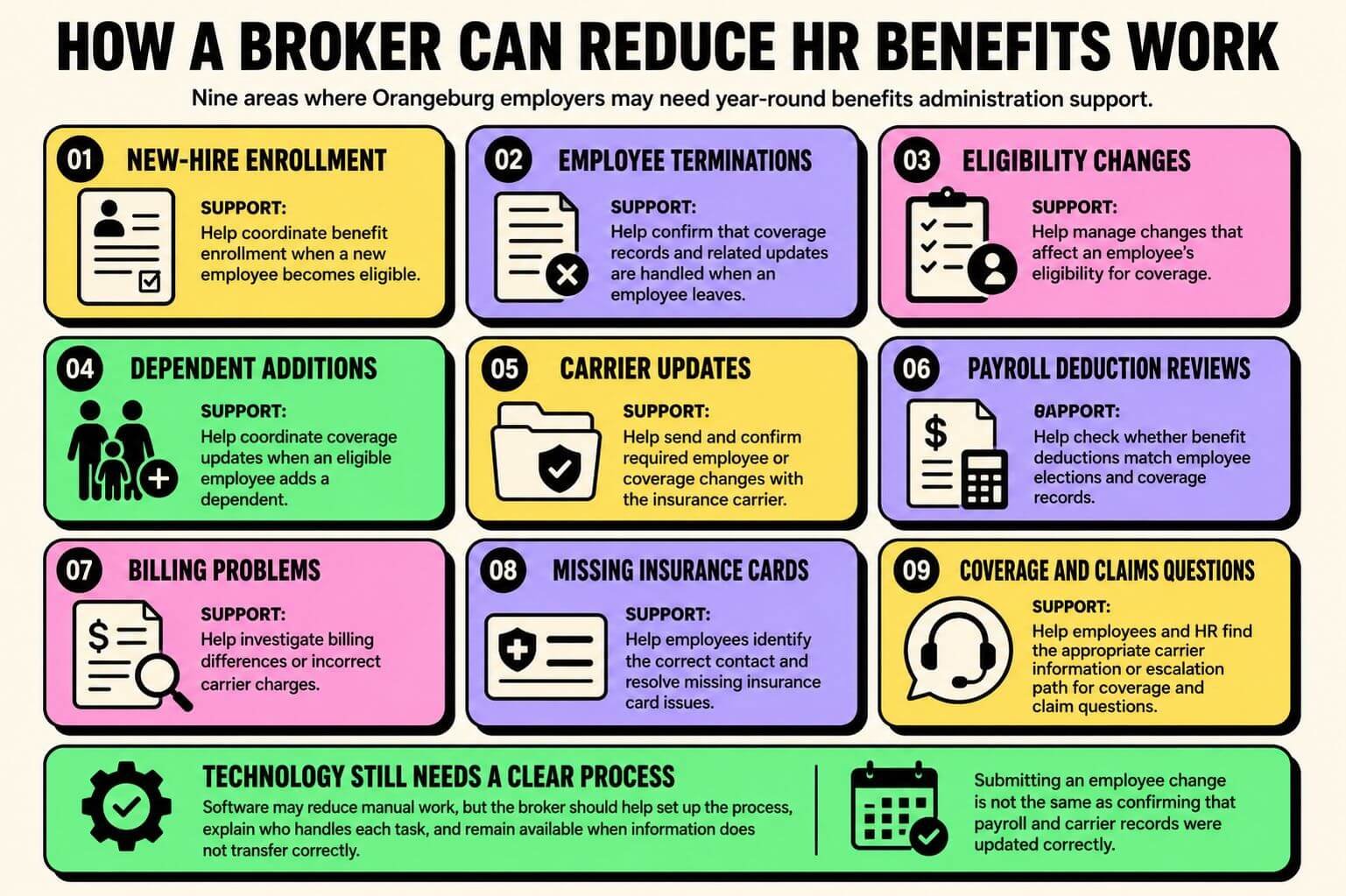
Benefits administration continues long after open enrollment ends. New employees join, others leave, dependents change, deductions need updates, and coverage questions appear throughout the year. A broker may support your team with:
- New-hire enrollment
- Employee terminations
- Eligibility changes
- Dependent additions
- Carrier updates
- Payroll deduction reviews
- Billing problems
- Missing insurance cards
- Coverage and claims questions
Reliable benefits administration can be especially useful for a small company without a dedicated benefits specialist. Consider a common situation: an employee adds a spouse during an eligible life event, but the carrier does not receive the update correctly. Without support, HR may spend hours contacting the carrier, checking documents, and explaining delays. A responsive broker can help identify the problem and coordinate the correction. Technology can also reduce manual work, but software alone does not fix a weak process. Your broker should help set up the system, explain who handles each task, and remain available when something goes wrong.
Why Employee Communication Matters
A benefits package provides limited value when employees do not understand it.
Workers may choose a plan based only on the payroll deduction without checking deductibles, networks, or prescription coverage. Others may skip voluntary benefits because they do not understand what the policies pay for. A broker can help by providing:
- Clear plan comparison materials
- Open-enrollment meetings
- Plain-language benefit summaries
- Help with employee questions
- Instructions for using enrollment systems
- Explanations of payroll deductions
- Support after coverage begins
Better communication does not mean pushing employees toward one plan. It means giving them enough information to make an informed choice. This also helps HR. When employees know where to find answers and who to contact, business owners and internal teams receive fewer repeated questions.
Why Orangeburg Business Conditions Matter
A benefits plan should reflect the people who will use it. Local wages, hiring conditions, commuting patterns, and nearby job opportunities can influence what employees consider affordable and valuable. The Orangeburg County wage figure shows why employee costs deserve attention. A plan may look affordable from the employer’s side while creating high payroll deductions or out-of-pocket expenses for workers.
Local knowledge can also help a broker ask better questions. Does your company employ hourly workers, salaried staff, seasonal employees, or people working across several locations? Are you competing for workers with larger employers? Do employees need access to doctors outside Orangeburg County? The broker does not need to guess what local employees want. The better approach is to review workforce data, employee questions, plan usage, and the problems your company has experienced.
Questions to Ask Before Choosing or Keeping a Broker
A broker relationship should be evaluated based on the help you receive, not just the insurance carriers represented. Consider asking:
- Which plan structures and carriers will you compare?
- How are you paid?
- Are you paid by commissions, employer fees, or both?
- What support do you provide outside renewal?
- Who handles employee questions?
- How do you manage enrollment and eligibility changes?
- What benefits technology can you support?
- How quickly does your team usually respond?
- Do you provide plan reports or year-round reviews?
- Are there carrier or contract limitations we should know about?
Compensation should be explained clearly. A commission arrangement is not automatically a problem, but employers should understand how the broker is paid and what services are included. You should also ask who will handle daily questions. The person presenting the renewal may not be the person helping with an enrollment mistake three months later.
When Your Current Benefits Approach Needs a Review
One problem does not always mean you need a new plan or broker. Repeated problems, however, may point to a process that no longer fits your business. A review may be useful when:
- Your broker only contacts you near renewal
- Renewal options arrive too late for careful review
- Employees remain confused after enrollment
- Eligibility or deduction errors keep happening
- Plan differences are not explained clearly
- Costs increase without a clear discussion of alternatives
- Your company has grown or changed locations
- HR still manages most carrier problems alone
Start by identifying where the process breaks down. The issue may involve plan design, communication, technology, administration, or the level of broker support.
Review Your Benefits Before the Next Renewal
A benefits review does not have to begin with replacing your current plan or broker. Start by looking at what is causing the most difficulty for your business. Gather your current plan summaries, renewal information, employer contribution amounts, employee questions, enrollment errors, and any payroll or billing concerns. Then review how much support your broker provides during the year.
Does the broker explain different options clearly? Are employees getting useful answers? Does HR know who is responsible for each task? Are problems resolved promptly, or does your team spend hours following up? These questions can show whether the problem is the insurance plan, the way it is being managed, or a lack of employee communication. Benni Agency can help Orangeburg employers review these areas and understand which changes may be worth considering. A practical first step is to examine your current plan before renewal and identify the cost, coverage, or administrative issue that needs the most attention.