Matching every chain pharmacy discount may bring in a few prescriptions, but it can also leave an independent pharmacy filling orders at little or no profit. Rock Hill pharmacies can compete on pricing in 2026 by knowing their full dispensing costs, protecting a pricing floor, checking reimbursement, and comparing selected medications instead of cutting every price.
This article is for independent pharmacy owners and managers who want to stay competitive, explain prices clearly, and protect the financial health of their business.
Key Takeaways
- Do not lower every prescription price. Compare selected medications while protecting a minimum pricing floor.
- Calculate the full dispensing cost. Include the medication, labor, packaging, card fees, delivery, overhead, and operating margin.
- Review PBM reimbursement separately. A low cash price will not fix a claim that pays less than the pharmacy’s cost.
- Use services to support value. Delivery, synchronization, packaging, and pharmacist access can reduce price concerns.
- Review prices throughout the year. Acquisition costs, shortages, contracts, and competitor offers can change.
- Use local patient data. Focus on the medications, services, and affordability concerns that appear in your own records.
Why Lowering Every Price Is Not a Sustainable Strategy
Large pharmacy chains may have greater purchasing power, higher prescription volume, national advertising, and several sources of retail revenue. That can give them more room to promote low prices on selected medications. An independent pharmacy usually works with tighter margins. Matching every advertised chain price may increase prescription volume without generating enough income to cover the work involved. Consider a common generic prescription. The medication itself may cost very little, but the pharmacy still pays for:
- Pharmacist and technician time
- Labels, bottles, bags, and other supplies
- Software and claim processing
- Payment-processing fees
- Rent, utilities, and insurance
- Inventory management
- Delivery or mailing, when offered
A low price may look competitive at the counter while failing to cover those expenses. The better goal is not to be the cheapest pharmacy on every medication. It is to be competitively priced where it matters most while giving patients clear reasons to stay.
Know the Real Cost of Filling a Prescription
A pricing decision should start with the pharmacy’s actual cost, not a competitor’s advertisement. The acquisition price is only one part of that calculation. Pharmacy owners should also consider the labor, supplies, administration, and services required to fill and deliver the prescription safely.
Build a Clear Pricing Floor
A pricing floor is the lowest price the pharmacy can reasonably accept without losing money on the transaction. That floor may include:
- Medication acquisition cost
- Pharmacist and technician labor
- Packaging and supplies
- Credit or debit card fees
- Delivery expenses
- Inventory carrying costs
- General overhead
- A reasonable operating margin
There is no universal markup that works for every pharmacy. A store offering free local delivery has different costs from a store that provides counter pickup only. A compounded medication also requires a different calculation from a common generic tablet. Knowing the pricing floor helps the pharmacy decide when a promotion, discount, or price match makes sense.
Review Costs by Prescription Type
One pricing method should not be applied across the entire pharmacy. A useful review separates prescriptions into groups such as:
- Common cash-pay generics
- Insured generic prescriptions
- Brand-name medications
- High-cost products
- Compounded prescriptions
- Medications affected by shortages
- Maintenance medications
- Prescriptions that include delivery or special packaging
Common generics with stable acquisition costs may give the pharmacy more room to compete. A high-cost brand medication with poor reimbursement may offer almost no flexibility. This is also why promoting a generic option can help, but only when the generic is appropriate and permitted by the prescription, the prescriber, the patient’s plan, and pharmacy rules.
Review PBM Reimbursement Before Changing Cash Prices
Cash prices and insurance reimbursement are related but separate parts of pharmacy pricing. Before lowering a public cash price, the pharmacy should review its contracts and understand whether that price could affect reimbursement.
Understand U&C and MAC Pricing
A pharmacy’s usual and customary price, often called the U&C price, generally refers to the cash price charged to customers without insurance or another discount arrangement. Maximum allowable cost, or MAC, is a reimbursement limit that a pharmacy benefit manager may apply to certain medications, often generics.
Depending on the contract, reimbursement may be based on the lowest of several amounts. Those amounts could include a calculated reimbursement rate, a MAC amount, or the pharmacy’s U&C price. That creates a risk. Lowering a cash price to match one competitor may affect more than the customer standing at the counter. Pharmacy owners should review their specific contract terms and speak with qualified reimbursement or legal advisers before changing prices across an entire medication category.
Track Prescriptions That Lose Money
A pharmacy can stay busy and still lose money on certain prescriptions. The owner should compare:
- The medication’s acquisition cost
- The amount reimbursed
- Any fees deducted later
- The cost of dispensing
- The cost of delivery or packaging
- The final margin
The Federal Trade Commission has reported concerns about PBM practices and found that large PBMs reimbursed affiliated pharmacies more than unaffiliated pharmacies for nearly every specialty generic drug included in one study. That finding does not describe every prescription or contract, but it shows why independent pharmacies need to review reimbursement rather than judge performance by prescription count alone. A monthly report of below-cost and low-margin claims can help the pharmacy spot patterns before they create a larger cash-flow problem.
Compare Prices Selectively, Not Across the Entire Pharmacy
A pharmacy does not need to track the price of every medication at every competitor. A smaller and more useful approach is to create a comparison basket of medications that patients frequently ask about.
Create a Basket of Common Medications
The comparison basket might include:
- Frequently requested cash-pay generics
- Common maintenance medications
- Prescriptions that regularly lead to price objections
- Medications with relatively stable acquisition costs
- Products patients often compare through discount websites
The pharmacy can check this group periodically against nearby chains, online prices, and legitimate discount programs. Prices should be compared using the same:
- Medication
- Strength
- Dosage form
- Quantity
- Manufacturer, where relevant
- Pickup or delivery conditions
A price for 30 tablets cannot be fairly compared with a price for 90 tablets. A temporary new-customer promotion may also be different from the normal retail price.
Set Rules for Price Matching
Price matching can be useful, but staff should not make decisions without clear limits. A pharmacy may choose to match a verified price when:
- The prescription remains above the pricing floor
- The medication and quantity are identical
- The competitor price is currently available
- The price is not tied to an unavailable membership or coupon
- The match supports a valuable long-term patient relationship
The pharmacy may decline when the requested price would create a loss, applies only to a limited promotion, or does not include the same medication details. Written rules help staff respond consistently and avoid making a rushed decision while a patient is waiting.
Compete on Total Patient Value
Patients do not choose a pharmacy based on price alone. They may also care about wait times, personal attention, delivery, medication packaging, refill coordination, and whether they can speak directly with a pharmacist.
Make Convenience Worth the Cost
Services that can support patient value include:
- Local delivery
- Medication synchronization
- Compliance packaging
- Refill reminders
- Vaccinations
- Medication reviews
- Shorter pickup times
- Direct pharmacist access
These services are already part of the competitive picture among independent pharmacies in Rock Hill. Local pharmacies publicly promote services such as delivery, synchronization, compounding, packaging, medication support, and health services. However, a service should not automatically be offered for free. The pharmacy should calculate what delivery, special packaging, or extended support costs. It should then decide whether the service will be:
- Included for all eligible patients
- Limited to a certain delivery area
- Included above a purchase amount
- Offered through a membership program
- Charged separately
A service supports the pricing strategy only when patients value it and the pharmacy can afford to provide it.
Explain Prices and Alternatives Clearly
Patients may see several different prices for the same medication:
- An insurance copay
- A cash price
- A discount-card price
- A manufacturer assistance price
- A different price at another pharmacy
Staff should be prepared to explain why those amounts may differ without promising that one option will always be cheapest.
A helpful conversation might include checking whether:
- The insurance claim was processed correctly
- A generic version is available and appropriate
- The prescribed quantity affects the price
- The patient can use a legitimate assistance program
- A longer supply is allowed
- A discount price has restrictions
- Another covered medication should be discussed with the prescriber
Clear explanations build more trust than simply saying, “That is the price.”
Use Local Data to Guide Pricing Decisions
Rock Hill had 74,372 residents at the 2020 Census. A market of that size includes patients with different insurance arrangements, income levels, medication needs, and expectations about convenience. Local population data can provide context, but the pharmacy’s own records will give a clearer picture of what its patients need.
Review What Rock Hill Patients Actually Use
Instead of relying only on national trends, review what happens inside the pharmacy. Useful questions include:
- Which prescriptions receive the most price objections?
- Which medications are frequently abandoned?
- How many patients ask for a cash price?
- Which prescriptions are transferred out after a price check?
- How many patients use delivery or synchronization?
- Which services bring patients back?
- Which claims regularly pay below the desired margin?
This information helps the pharmacy focus its pricing work where it can make a real difference. For example, there may be little value in discounting a long list of medications that patients rarely request. A better approach may be to adjust five common cash-pay generics that cause frequent transfers.
Measure Whether the Strategy Is Working
A pricing change should be measured after it is introduced. Useful measures include:
- Gross margin by prescription group
- Number of below-cost claims
- Cash-pay prescription volume
- Abandoned prescriptions
- Prescription transfers
- Delivery use
- Synchronization retention
- Repeat patient visits
- Staff time spent resolving price questions
Do not look at prescription volume alone. A pricing strategy is working when it supports patient retention and produces enough margin to keep the service available.
A Practical 90-Day Pricing Review
A pharmacy does not need to rebuild every price at once. A focused 90-day review can reveal where changes are most useful.
1. Review Acquisition Costs and Reimbursement
Compare recent acquisition costs with what the pharmacy received from insurers and PBMs. Flag prescriptions with negative or unusually low margins.
2. Identify the Main Problem Areas
Look for medication groups that generate frequent losses, patient complaints, abandoned prescriptions, or transfers.
3. Build a Comparison Basket
Select a manageable group of common cash-pay medications and compare identical quantities, strengths, and dosage forms.
4. Separate Transaction Types
Review cash, insurance, discount-card, and assistance-program transactions separately. Combining them can hide the source of a pricing problem.
5. Calculate Service Costs
Measure the cost of delivery, packaging, synchronization, and other patient services. Decide which services can remain included and which need limits or fees.
6. Give Staff Clear Guidance
Create a simple process for checking prices, discussing generics, explaining discount restrictions, and handling price-match requests.
7. Review the Results
After 60 to 90 days, check whether margins, retention, abandoned prescriptions, and patient questions have improved.
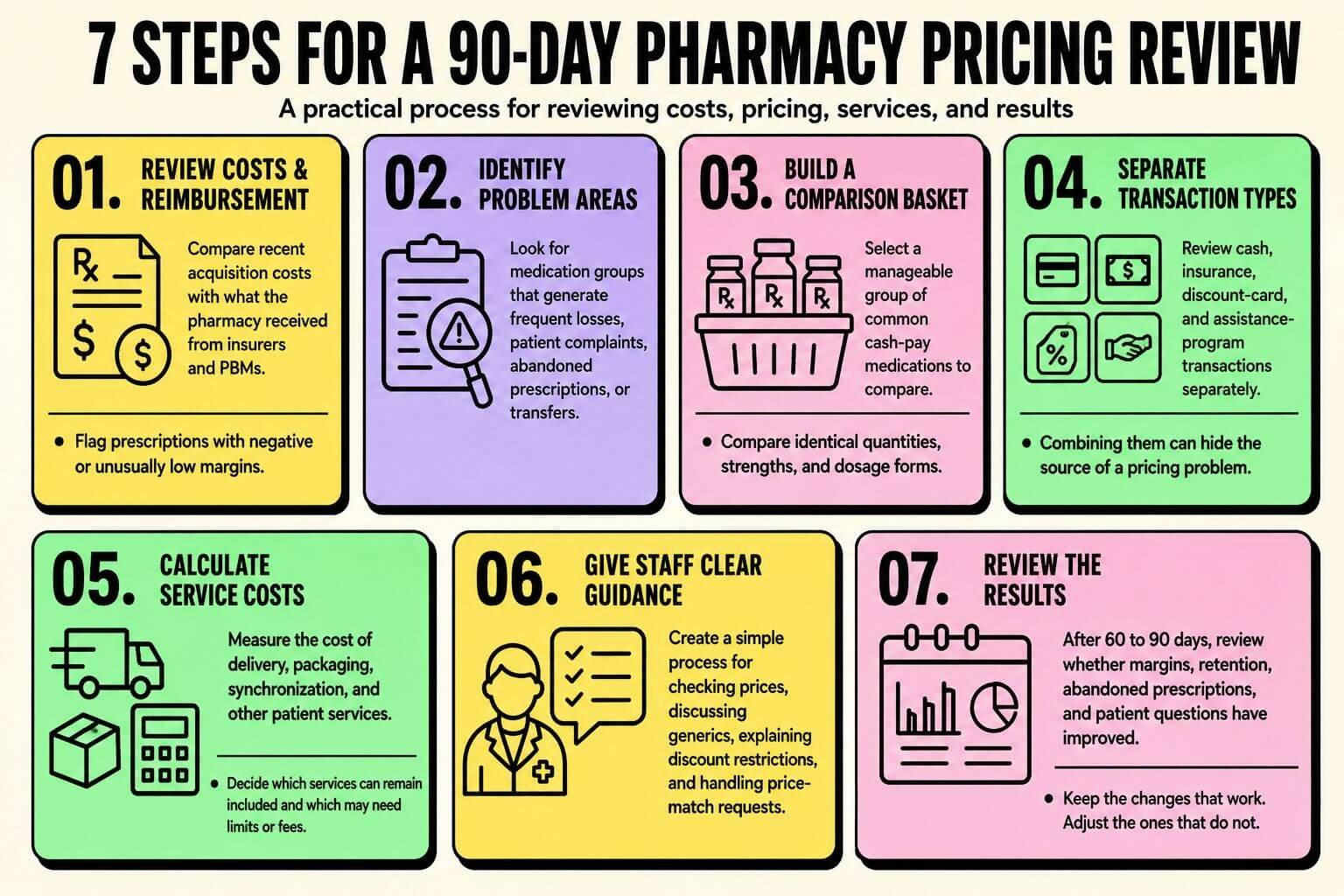
Keep the changes that work. Adjust the ones that do not. Check whether margins, patient retention, abandoned prescriptions, and staff workload improved during the review period. Use those results to decide which pricing or service changes should stay, be refined, or be removed.
Review the Pharmacy as an Employer, Too
Independent pharmacies manage more than prescription prices. They also handle payroll, employee retention, health coverage, prescription benefits, enrollment questions, and day-to-day benefit administration. These costs do not determine what a patient pays at the counter, but they still affect the financial health of the business.
A benefits review can help an owner see whether the current plan still fits the workforce, whether employees understand their prescription coverage, and whether administration is taking too much time. Benni Agency helps Rock Hill employers review health coverage, prescription benefits, voluntary benefits, and benefit administration. This is separate from retail pharmacy pricing or PBM contract advice, but it can help the owner review another major area of business cost and employee support. A simple benefits review can show whether the current approach still works for both the team and the pharmacy’s budget.