Renewal season can make a benefits plan feel broken fast. Premiums go up, employees ask questions HR cannot answer quickly, and the plan that worked last year may no longer fit the business. A Mount Pleasant insurance broker can help by reviewing your costs, workforce, plan options, renewal strategy, and benefits administration before you make another decision.
This article is for Mount Pleasant employers who want clearer benefits choices, less HR stress, and a plan that supports hiring and retention.
Key Takeaways
- A Mount Pleasant insurance broker can help your business choose benefits that fit your team, budget, and hiring goals.
- The right broker does more than collect quotes. They review costs, plan design, employee needs, and renewal options.
- Local context matters because Mount Pleasant employers compete for talent across the Charleston area.
- A good broker can reduce HR workload by helping with enrollment, payroll coordination, eligibility changes, and employee questions.
- Better benefits communication can help employees understand their options instead of guessing during open enrollment.
What a Mount Pleasant Insurance Broker Should Actually Do
A strong broker should help your business make better benefits decisions. That starts with quotes, but it should not stop there.
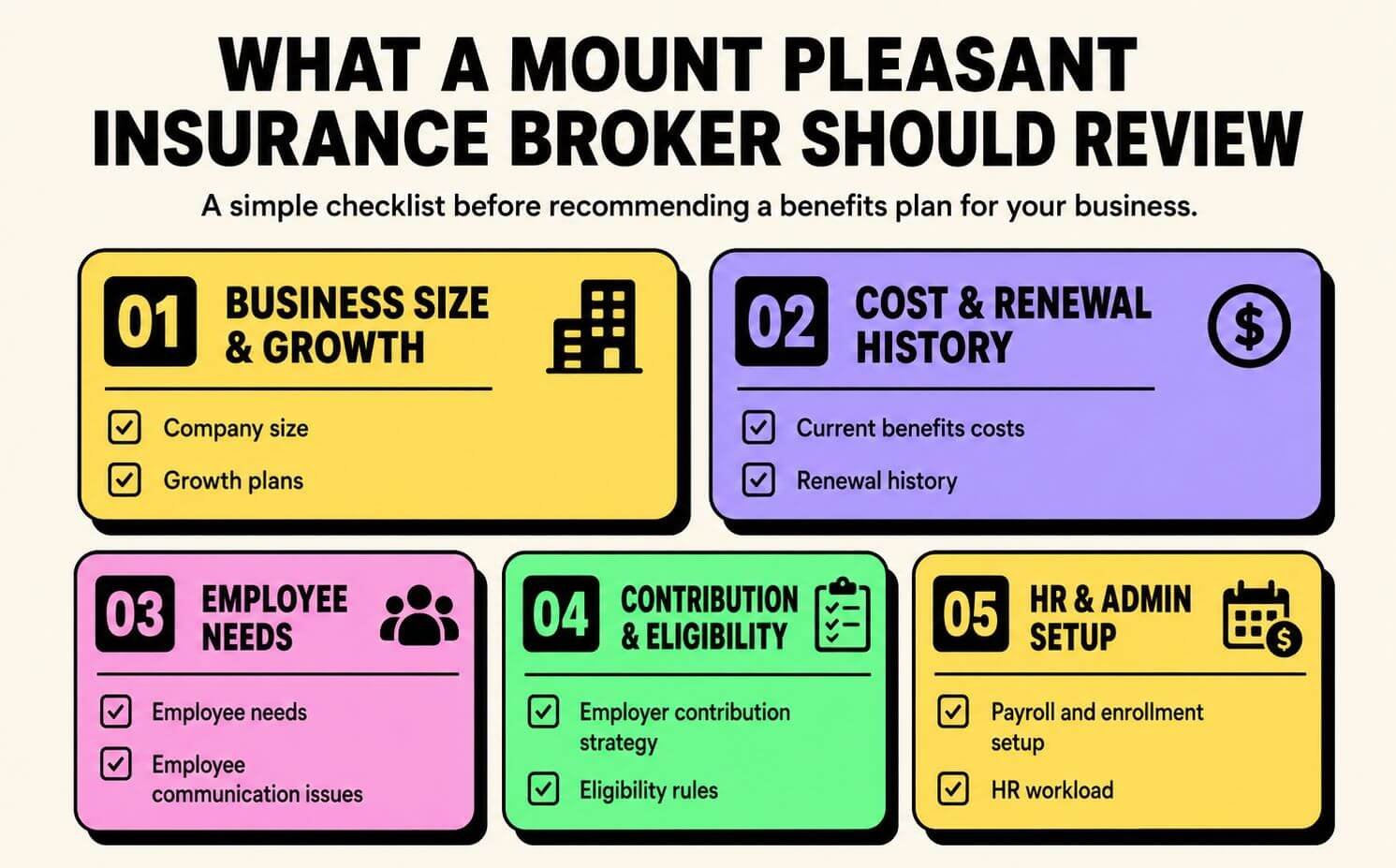
Before recommending a plan, a broker should look at:
- Your company size and growth plans
- Current benefits costs
- Renewal history
- Employee needs
- Employer contribution strategy
- Payroll and enrollment setup
- Eligibility rules
- HR workload
- Employee communication issues
This matters because benefits are not just an insurance purchase. They affect hiring, retention, payroll, compliance, and the amount of time your internal team spends answering the same questions. A broker who understands Mount Pleasant benefits should help you compare your options in a way that fits the business, not just the carrier spreadsheet. That may include group health insurance, dental, vision, life insurance, disability coverage, voluntary benefits, tax-advantaged accounts, or ICHRA options. The best recommendation depends on your workforce, budget, and how much support your team needs to manage the plan.
Why Local Context Matters for Mount Pleasant Employers
Mount Pleasant employers are competing in a real local labor market. A benefits plan that works for one company may not work for another, even if both are in the same area. A healthcare practice, a professional services firm, a construction company, a hospitality business, and a multi-location employer may all need different benefits strategies.
Data USA reports that Mount Pleasant’s largest local employment sectors in 2024 included professional, scientific, and technical services, healthcare and social assistance, and educational services. It also reports that 58.4% of Mount Pleasant residents had employer health coverage.That is useful context. Benefits are not a side issue for many local workers. They are part of how employees compare jobs, think about family needs, and decide whether to stay with an employer.
A local benefits strategy should consider:
- What employees are likely to value
- How much cost-sharing they can handle
- Whether dependent coverage is a major concern
- How competitive the plan feels in the Charleston area
- Whether the business can manage the plan without adding more HR strain
Local support also matters when something goes wrong. Open enrollment confusion, billing problems, eligibility errors, and employee questions do not always happen on a convenient schedule. Employers need a broker who can help after the plan is sold.
How a Broker Helps With Cost Control
Most employers want lower premiums. That makes sense. But premium shopping alone is not a real cost strategy.
A good broker should help you look at the full picture:
- What is driving the renewal increase?
- Are employees using the plan in a way that suggests a different design?
- Is the employer contribution set up properly?
- Are employees paying too much for dependent coverage?
- Would voluntary benefits add value without raising core plan costs?
- Should the business compare traditional group coverage with other models?
KFF reported that average annual employer-sponsored health insurance premiums in 2025 were $9,325 for single coverage and $26,993 for family coverage. Single coverage increased 5%, and family coverage increased 6% from the prior year. For a small or mid-sized employer, those numbers matter. A broker should help you make choices that control cost without weakening the plan so much that employees stop valuing it.
For some businesses, that may mean reviewing contribution levels. For others, it may mean comparing fully insured plans with level-funded plans, voluntary benefits, or ICHRA options. The goal is simple: keep benefits useful while making the cost easier to manage.
How a Broker Reduces HR and Admin Work
A benefits plan can look fine on paper and still create problems every week. If HR is handling manual onboarding, fixing payroll deductions, chasing eligibility updates, and answering every employee question alone, the plan is costing more than the premium shows.
A broker can help reduce that pressure by supporting:
- Open enrollment planning
- New hire enrollment
- Eligibility changes
- Carrier paperwork
- Payroll coordination
- Employee questions
- Renewal communication
- Benefits technology setup
This is where many employer benefits strategies break down. The plan may be good, but the process is messy. The right broker can help your team choose enrollment tools that make open enrollment, eligibility changes, and employee communication easier to manage. That support becomes more important as the company grows. A benefits process that works with 12 employees may not work with 40. What works at 40 may become a problem at 100. Good benefits administration should make growth easier, not add more friction every time headcount changes.
How a Broker Improves the Employee Experience
Employees do not experience benefits as a spreadsheet. They experience them when they have to choose a plan, add a dependent, understand a deductible, use dental coverage, or figure out what comes out of their paycheck. That is why communication matters.
A good broker helps employees understand:
- What each plan covers
- How premiums and deductibles work
- What voluntary benefits are optional
- How payroll deductions will look
- What to do during open enrollment
- Who to ask when they need help
This does not mean every employer needs the richest plan. It means the benefits package should be clear, useful, and realistic for the workforce. A confusing plan can hurt participation. A clear plan gives employees more confidence in their choices. For employers, that can lead to fewer repeated HR questions, smoother enrollment, and a benefits package employees are more likely to value.
What to Ask Before Choosing a Broker
If you are comparing brokers, do not only ask whether they can get quotes. Almost every broker can do that. Ask questions that show how they work after the sale.
Useful questions include:
- How do you review our current benefits setup?
- What do you look at before making a recommendation?
- How do you help with renewal planning?
- Do you support employee questions during open enrollment?
- Can you help with payroll, eligibility, and enrollment issues?
- What types of plans do you compare?
- How often will we hear from you after implementation?
- How do you help control costs without weakening the benefits package?
A red flag is a broker who gives the same recommendation no matter the employer size, workforce, budget, or admin capacity. A 15-person business with no internal HR department may need simplicity first. A 100-person employer with hiring pressure may need stronger communication, more plan choices, and better technology. The right broker should be able to explain those trade-offs clearly.
A Better Next Step for Mount Pleasant Benefits Planning
If your benefits plan feels harder to manage every year, it may be time to step back and look at the whole setup. The problem is not always the carrier. It could be the plan design, contribution strategy, renewal process, enrollment system, or the way employees are getting information. For Mount Pleasant employers, the right broker should help connect those pieces. That means looking at what your company is paying, what employees actually value, where HR is losing time, and whether your current plan still fits the business.
Benni helps employers think through those decisions in a practical way. The goal is not to add more complexity. It is to make benefits easier to understand, easier to manage, and better aligned with the people your business needs to keep. A simple benefits review can show where your current setup is working and where it may need a smarter plan.