A difficult renewal can leave you wondering whether traditional group health insurance is still the right fit. The best alternative depends on your workforce size, employee locations, budget, risk tolerance, and ability to manage the plan. Some options replace a traditional group plan, while others change how coverage is funded or purchased.
This guide is for employers and HR leaders who want to compare realistic choices, understand the trade-offs, and narrow their options before the next renewal.
Key Takeaways
- The best option depends on your workforce, budget, risk tolerance, and administrative capacity.
- ICHRA and QSEHRA reimburse eligible individual coverage but follow different rules.
- Level-funded and self-funded plans offer more claims insight but carry more employer responsibility.
- PEO and association plans change how employers access health coverage.
- An HDHP with an HSA may lower premiums but can increase employees’ upfront costs.
- Traditional fully insured coverage may still provide the best balance for some employers.
Why Employers Consider Alternatives to Traditional Group Coverage
Employers usually start looking at alternatives after a difficult renewal. Higher premiums may be part of the problem, but they’re rarely the only concern. A company may also be dealing with:
- Low employee participation
- Workers living in several states
- Limited provider access
- High deductibles
- A small HR team
- Employees asking for more plan choice
- Unpredictable annual increases
South Carolina employers have a practical reason to review their options carefully. The South Carolina Department of Insurance reported a 10.93% weighted average approved rate increase across the state’s 2026 small-group market. Approved average changes varied by insurer, and an individual employer’s renewal can differ based on its plan and workforce. A rate increase doesn’t automatically mean an employer should leave traditional coverage. It does mean the company should compare the renewal against other arrangements before accepting it without review.
What Counts as a Group Health Plan Alternative?
Not every alternative replaces group health insurance in the same way. The options in this guide fall into four broad categories:
- Reimbursement arrangements: The employer reimburses eligible employees for individual coverage.
- Alternative funding models: The employer changes how group medical claims are funded.
- Alternative purchasing arrangements: The employer accesses coverage through another organization.
- Alternative plan designs: The company keeps group coverage but changes how employees and the employer share costs.
Understanding these differences matters. An ICHRA, self-funded plan, PEO arrangement, and HSA aren’t four versions of the same product. Each changes a different part of the benefits strategy.
7 Group Health Plan Alternatives Employers Can Compare
1. Individual Coverage HRA
An Individual Coverage Health Reimbursement Arrangement, or ICHRA, lets an employer reimburse eligible employees for individual health insurance premiums and certain medical expenses. The employer sets a monthly allowance instead of selecting one group health plan. Employees purchase qualifying individual coverage, and eligible expenses are reimbursed according to the plan’s terms. An ICHRA may work well for an employer with:
- Employees in several states
- A workforce spread across different counties
- Low group-plan participation
- A need for predictable employer contributions
- Employees who want more plan choice
The employer gains control over its contribution. Employees may gain access to several individual plans, but the number and quality of those options depend on where they live. That local difference matters. Individual-market carriers and provider networks can vary by county, so an employer should review actual plan availability before deciding that an ICHRA will improve employee choice. Employers also need to consider employee classes, affordability, required notices, reimbursement administration, and enrollment support. Those reviewing this approach can learn more about ICHRA plan design.
Best fit: Employers seeking defined contributions and individual employee choice.
Main trade-off: Employees must understand and enroll in individual plans, which can require more education and support.
2. Qualified Small Employer HRA
A Qualified Small Employer Health Reimbursement Arrangement, or QSEHRA, lets an eligible small employer reimburse employees for individual health insurance premiums and qualified medical expenses. A QSEHRA is available only to employers that meet the federal eligibility rules and don’t offer a group health plan. Unlike an ICHRA, it has annual reimbursement limits that may change each year. A QSEHRA may suit a small business that:
- Doesn’t offer group medical coverage
- Wants to set a defined reimbursement budget
- Has employees who can access suitable individual plans
- Needs a simpler option than managing a traditional group plan
The main difference between a QSEHRA and an ICHRA is flexibility. An ICHRA can be offered by employers of different sizes and can support more employee-class options. A QSEHRA is limited to qualifying small employers and follows annual contribution caps.
Best fit: Eligible small employers that don’t provide group health insurance.
Main trade-off: Contribution limits and employer eligibility rules make it less flexible than an ICHRA.
3. Level-Funded Health Plan
A level-funded plan combines predictable monthly payments with some features of self-funding. The employer usually pays a fixed monthly amount covering:
- Expected employee claims
- Administrative fees
- Stop-loss insurance
- Other plan expenses
If claims are lower than expected, the contract may provide for part of the unused claims funding to be returned or credited. That result isn’t automatic. Refund terms, runout claims, contract language, and carrier rules all matter. If claims are higher than expected, stop-loss insurance may limit the employer’s exposure based on the agreement. The employer still needs to understand what the protection covers and whether additional liability is possible.
Level funding can give employers more access to claims information than a traditional fully insured plan. That data may help identify high-cost claim patterns, prescription spending, and opportunities for employee education. Before selecting one, employers should review how claims funding, stop-loss protection, surplus provisions, and renewals work within level-funded plans.
Best fit: Employers seeking predictable monthly payments with greater claims visibility.
Main trade-off: Renewal costs and possible refunds depend partly on claims experience and contract terms.
4. Self-Funded Health Plan
With a self-funded plan, the employer takes direct responsibility for paying employee healthcare claims. Most employers don’t manage the entire plan alone. They usually work with a third-party administrator to process claims and may purchase stop-loss insurance to protect against unusually high individual claims or total plan spending. Self-funding can give an employer more control over:
- Plan design
- Provider arrangements
- Claims data
- Cost-management programs
- Pharmacy strategies
- Employee contributions
That control comes with more responsibility. Claims can change from month to month, and the employer needs enough financial capacity to handle that variation. The company must also coordinate administration, compliance, vendor performance, employee communication, and claims oversight. A review of cash flow, workforce needs, claims history, and available protection should be part of any health plan funding decision.
Best fit: Employers with stable finances, enough covered employees, and the ability to manage claims risk.
Main trade-off: The employer accepts greater financial and operational responsibility.
5. PEO-Sponsored Health Coverage
A professional employer organization, or PEO, may give a company access to health coverage as part of a broader HR and payroll arrangement. The business enters a co-employment relationship with the PEO. The PEO may handle payroll, tax administration, benefits enrollment, certain compliance tasks, and other HR functions. For an employer with limited internal HR resources, this can reduce some of the day-to-day workload. Health coverage is only one part of the arrangement, so the full cost should be reviewed. Employers should compare:
- PEO service and administration fees
- Available health plans
- Provider networks
- Payroll services
- HR support
- Contract terms
- Employee service quality
- The process for leaving the PEO
A PEO plan that looks attractive based on premiums alone may be less appealing after adding administrative fees or considering the loss of control over certain HR functions.
Best fit: Small or midsize employers that also need payroll and HR administration support.
Main trade-off: The employer may give up some control and must evaluate the cost of the complete PEO relationship.
6. Association Health Plan
An association health plan allows eligible employers to access coverage through a trade group, professional organization, or other qualifying association. The arrangement may pool several employers for insurance purposes. Depending on the plan, this may provide access to rates, plan designs, or networks that aren’t available to the employer on its own.
Not every business can join every association plan. Eligibility may depend on the company’s industry, profession, location, or relationship with the association. Before enrolling, an employer should review:
- Association eligibility
- Plan governance
- Financial stability
- Provider networks
- Renewal history
- Administrative fees
- Coverage rules
- State and federal oversight
Employers should also confirm that the association has a legitimate purpose beyond offering insurance. A lower initial price provides little value if the plan has weak networks, unstable rates, or unclear administration.
Best fit: Employers eligible for a credible and stable industry or professional association plan.
Main trade-off: Plan quality and long-term stability can vary widely between associations.
7. High-Deductible Health Plan With an HSA
A high-deductible health plan paired with a Health Savings Account can change the cost structure of an existing group benefits program. The insurance plan generally has a higher deductible and may have a lower premium than a plan with richer first-dollar coverage. Eligible employees can contribute money to an HSA for qualified medical expenses, and employers may contribute as well.
The account belongs to the employee. Unused funds can remain in the account and carry forward from one year to the next. This approach may work well when employees:
- Want to build tax-advantaged healthcare savings
- Can manage the higher deductible
- Value lower payroll deductions
- Understand how to compare healthcare costs
It may be less suitable for employees who regularly need expensive prescriptions, specialist care, or ongoing treatment and struggle to cover costs before meeting the deductible. An HSA is an account, not health insurance. Employers should compare its eligibility and ownership rules with other health account options.
Best fit: Employers that want to keep group coverage while offering lower premiums and tax-advantaged savings.
Main trade-off: Employees may face higher upfront medical costs.
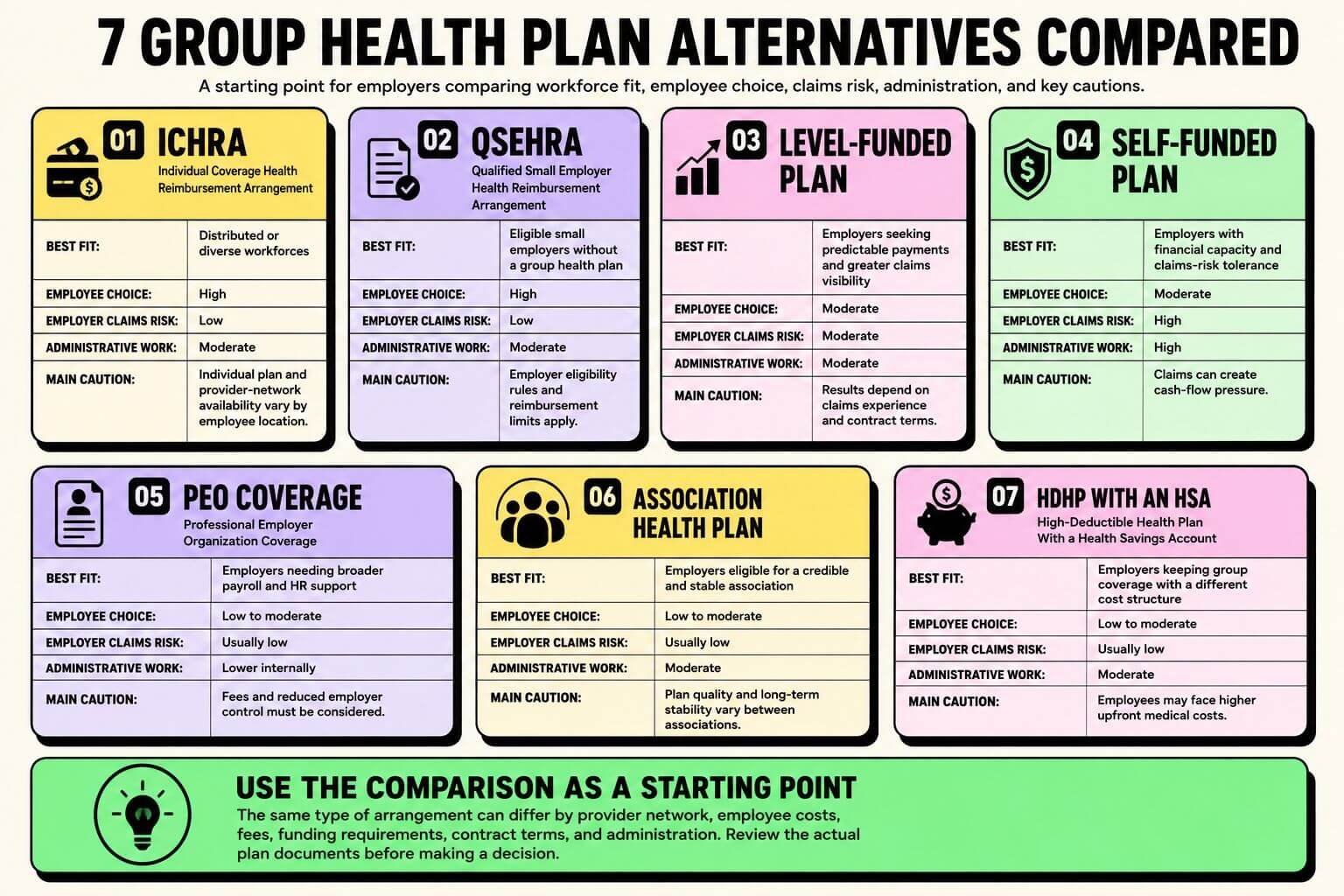
How the Seven Alternatives Compare
These seven alternatives differ in cost, employee choice, claims risk, and administrative work. Employers should use the comparison as a starting point, then review actual plan documents, networks, fees, and employee costs before deciding.
How to Narrow the Options for Your Workforce
A plan may look good on paper and still be wrong for the people who need to use it. Before narrowing your choices, answer these six questions.
How Many Employees Are Eligible?
Employer size affects which arrangements are available and how well risk can be spread across the group. A QSEHRA, for example, follows specific employer eligibility rules. Self-funding may be harder for a very small employer because one large claim can have a greater effect on total spending.
Where Do Employees Live?
Location matters when employees purchase individual plans or use regional provider networks. An ICHRA may work differently for employees in Charleston, South Carolina, than for employees in another county or state. Compare plans in the places where employees actually live rather than relying on a statewide average.
How Predictable Must the Budget Be?
ICHRA and QSEHRA allow employers to set defined reimbursement amounts. Fully insured and level-funded plans generally use regular monthly payments, although renewal results may vary. Self-funded plans can create more monthly claims variation. The employer needs enough cash flow to manage it.
How Much Risk Can the Company Accept?
Some employers are comfortable accepting claims risk in exchange for more control and data. Others need the stability of an insured arrangement. Neither approach is automatically better. The decision depends on the company’s finances, workforce, claims experience, and leadership’s comfort with risk.
How Much Choice Do Employees Need?
An ICHRA may let employees select from individual-market options. A traditional group plan, PEO plan, or association plan usually offers a smaller employer-selected menu. More choice can help a varied workforce, but it can also make enrollment harder. Employees may need help comparing premiums, deductibles, prescriptions, and provider networks.
What Can the HR Team Realistically Manage?
A plan change can create new responsibilities even when it removes old ones. Ask who will handle:
- Employee notices
- Enrollment questions
- Reimbursements
- Payroll deductions
- Eligibility changes
- Plan documents
- Claims problems
- Ongoing employee education
The strongest option is one the employer can manage correctly throughout the year, not only during enrollment.
What Administration Looks Like After a Change
Choosing a health plan is only the beginning. Implementation and ongoing support can shape how employees view the benefit. An employer moving to an ICHRA may no longer manage one group medical enrollment, but employees will need help purchasing individual coverage and submitting eligible expenses.
A level-funded or self-funded plan may provide better claims reporting, but someone must review that information and coordinate with the administrator, stop-loss carrier, pharmacy vendors, and other partners. Ongoing work may include:
- Confirming employee eligibility
- Managing new hires and terminations
- Coordinating payroll deductions
- Sending required notices
- Reviewing reimbursement requests
- Answering employee questions
- Escalating unresolved claims problems
- Preparing for renewal
Good benefits administration tools can help organize enrollment, employee records, deductions, and communication. Technology still needs clear processes and dependable human support behind it.
When Traditional Group Coverage May Still Be the Better Fit
An alternative isn’t automatically better because it’s newer or structured differently. Traditional fully insured group coverage may remain a good choice when:
- The current provider network works well for employees.
- The company can manage the renewal cost.
- Employees value having one common plan.
- The employer wants less exposure to claims risk.
- The HR team needs a familiar enrollment process.
- Individual-market options are limited in employees’ locations.
- Changing plans would create more disruption than value.
A traditional plan may also provide more predictable administration for an employer that doesn’t have the time or staff to manage reimbursement arrangements or alternative funding models. The goal isn’t to replace traditional coverage at any cost. It’s to choose the structure that gives the company and its employees the best overall balance.
Compare the Options Before Changing Your Plan
Choosing an alternative should start with your workforce, not the name of the plan. Review how many employees are eligible, where they live, which providers they use, and how much they currently pay through premiums, deductibles, and other out-of-pocket costs. Then consider how much claims risk and administrative work your company can reasonably accept. The lowest premium doesn’t always produce the best result. A plan with weak provider access, confusing enrollment, or higher employee costs can create participation and retention problems later.
Benni Agency helps employers compare traditional group coverage, reimbursement arrangements, and alternative funding models using the company’s actual renewal and workforce needs. Employers that need another perspective can use benefits planning support before making a change. A side-by-side review can help narrow the options without assuming that the newest or least expensive arrangement is automatically the right one.