If an employee has surgery, an illness, an injury, or another covered medical condition and cannot work, short-term disability may replace part of their income while they recover. Benefits usually start after a waiting period, and the employee must meet the plan’s claim requirements before payments begin.
For employers, the details matter because employees often have questions at the exact moment they need the benefit. This article is for business owners and HR teams that want to understand the claim process, explain coverage clearly, and choose plan terms employees can actually use.
Key Takeaways
- Short-term disability replaces part of an employee’s income when a qualifying medical condition temporarily prevents them from working.
- Benefits usually begin after a waiting period, and medical documentation may be needed before a claim is approved.
- Payment depends on the plan’s income-replacement percentage, weekly maximum, and benefit period.
- Short-term disability does not automatically protect an employee’s job. Leave laws and company policies may apply separately.
- Who pays the premium can affect taxes. Employer-paid and after-tax employee-paid plans can produce different tax results.
How Do Short-Term Disability Benefits Work for Employees?
Short-term disability is designed to replace part of an employee’s paycheck during a temporary medical absence. The exact process varies by carrier and policy, but most claims follow a similar path. Employers comparing income protection coverage should pay attention to more than the benefit percentage. The waiting period, claim requirements, benefit limit, and coordination with other leave can make a big difference for employees.
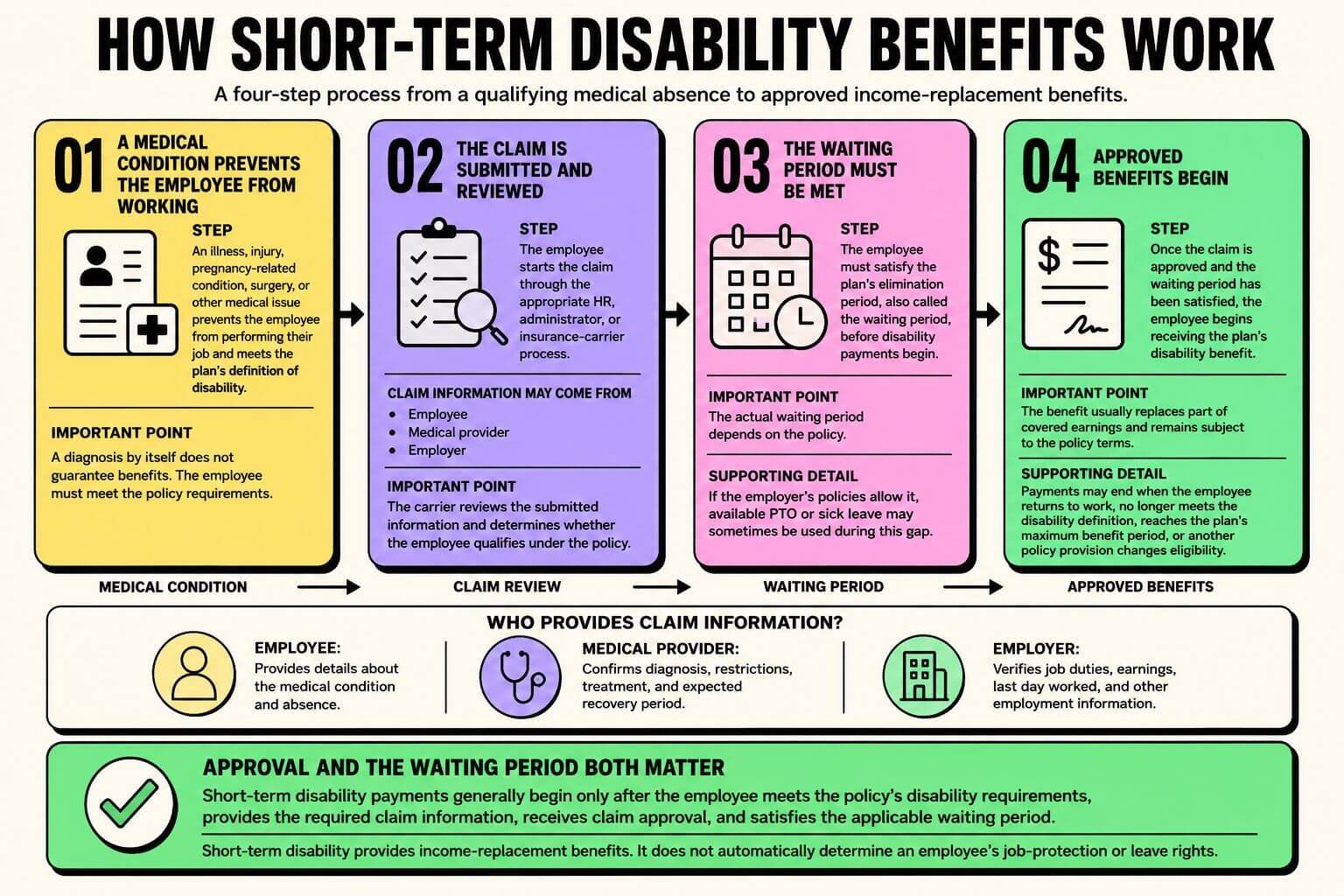
1. The Employee Has a Covered Medical Condition
The process starts when an illness, injury, pregnancy-related condition, surgery, or other medical issue prevents the employee from performing their job and meets the plan’s definition of disability. Coverage usually applies to non-work-related conditions. A job-related injury or occupational illness is generally handled through workers’ compensation instead. A diagnosis by itself does not guarantee benefits. The employee still has to meet the policy requirements and provide the medical information the carrier requests.
2. The Claim Is Submitted and Reviewed
Depending on the plan, the employee may start the claim through HR, an administrator, or directly with the insurance carrier. A typical claim may require information from several people:
- The employee provides details about the condition and absence.
- The medical provider confirms the diagnosis, restrictions, treatment, and expected recovery period.
- The employer verifies job duties, earnings, last day worked, and other employment information.
The carrier reviews that information and determines whether the employee qualifies under the policy.
3. The Waiting Period Must Be Met
Most plans have an elimination period, often called a waiting period, before disability payments begin. For example, a plan might require an employee to be disabled for seven or fourteen days before benefits are payable. The actual period depends on the policy. Employees may be able to use PTO or sick leave during that gap if the employer’s policies allow it. This is worth explaining during enrollment because an employee who expects disability payments immediately could otherwise face an unexpected income gap.
4. Approved Benefits Begin
Once the claim is approved and the waiting period has been satisfied, the employee begins receiving the plan’s disability benefit. The amount is usually based on a percentage of covered earnings and may be capped by a weekly maximum. Payments normally continue until the employee returns to work, no longer meets the policy’s definition of disability, reaches the maximum benefit period, or another plan provision changes their eligibility.
What Does Short-Term Disability Usually Cover?
Coverage varies by policy, but short-term disability commonly applies to medical situations such as:
- Recovery after surgery
- Pregnancy and childbirth recovery
- Musculoskeletal injuries
- Serious illnesses
- Certain mental health conditions
- Other medical conditions that temporarily prevent someone from working
The key word is qualifying. A condition must meet the specific policy definition, and the employee may need medical evidence showing why they cannot perform their job. Plans may also contain exclusions or limitations. Work-related injuries, certain pre-existing conditions, unsupported claims, or conditions excluded by the contract may not qualify. Pregnancy is another area where clear communication helps. A policy may cover the medically supported period when an employee is unable to work, but that is not the same as paying for an entire parental leave.
How Much Does Short-Term Disability Pay?
Many short-term disability plans replace a portion of an employee’s regular earnings rather than the full paycheck. A plan might pay around 50% to 70% of covered income, but the actual percentage depends on the policy. Employers should also check the weekly maximum. For example, a plan may replace 60% of earnings but cap the weekly payment at a stated dollar amount. Higher-paid employees could therefore receive less than 60% of their normal income once the maximum applies.
It is also worth checking how the policy defines earnings. Base salary may be treated differently from commissions, bonuses, overtime, or other compensation. Some plans include partial-disability or return-to-work provisions that allow an employee to receive reduced benefits while gradually returning to work.
How Long Do Benefits Last?
Short-term disability is intended for temporary periods of disability. The maximum benefit period varies by plan, so employers should not assume every policy provides the same number of weeks. The plan may stop paying when the employee recovers, reaches the maximum duration, or no longer qualifies under its disability definition. If your benefits package includes both types of coverage, understanding how short-term and long-term disability work together can help avoid a gap if an employee remains unable to work for a longer period.
Are Short-Term Disability Benefits Taxable?
Whether an employee owes income tax on disability payments often depends on who paid the premium and how it was paid. The IRS generally treats the benefit differently in these situations:
- If the employer paid the premium, the disability benefit is generally taxable to the employee.
- If the employee paid the entire premium with after-tax dollars, the benefit is generally not included in taxable income.
- If both the employer and employee paid part of the premium, part of the benefit may be taxable.
- Employee contributions made through a pretax arrangement can receive different tax treatment from after-tax contributions.
Because funding affects what an employee actually receives after taxes, employers should understand the tax setup before describing the benefit as a percentage of income. IRS guidance provides additional detail on disability insurance proceeds.
How Does Short-Term Disability Work With PTO, FMLA, and Workers’ Compensation?
Disability insurance is easy to confuse with other workplace programs because several may apply during the same absence. They do different jobs:
- Short-term disability replaces part of an employee’s income.
- PTO or sick leave provides paid time off under the employer’s policy.
- FMLA may provide job-protected leave to eligible employees when the legal requirements are met.
- Workers’ compensation generally applies to qualifying work-related injuries and occupational illnesses.
An employee could potentially be receiving disability payments while also using FMLA leave. Federal guidance allows FMLA and disability leave to run at the same time when the absence qualifies and the required notices are provided. Employers should manage the disability claim and the employee’s leave status as related but separate issues.
Does Short-Term Disability Protect an Employee’s Job?
No. Short-term disability insurance does not automatically provide job protection.
The carrier decides whether the employee qualifies for income benefits under the disability policy. The employer separately has to determine whether FMLA, the ADA, company leave policies, or other applicable employment rules affect the employee’s leave or return-to-work rights. That distinction matters. An approved disability claim tells you the employee qualifies for a payment under the plan. It does not settle every employment or leave question connected to the absence.
Employer-Paid vs. Employee-Paid Short-Term Disability
Employers can structure short-term disability in several ways. With employer-paid coverage, the company pays the premium and employees who meet the plan requirements receive the benefit without purchasing coverage themselves. With voluntary coverage, employees elect the benefit and pay premiums, often through payroll deductions. Employers that cannot fully fund disability coverage may include it among their voluntary benefit options.
Neither approach is automatically better. An employer-paid benefit may encourage broader participation. A voluntary option can give employees access to coverage without requiring the employer to fund the full premium. The choice can also affect taxation, payroll administration, enrollment, and how clearly employees understand what they selected.
What Should Employers Compare Before Choosing a Plan?
Short-term disability still isn’t available to every worker. According to the U.S. Bureau of Labor Statistics, 37% of private-industry workers in the South had access to short-term disability benefits in March 2025. South Carolina is part of the BLS South region. For employers evaluating coverage, price is only one part of the decision. Compare:
- Income-replacement percentage
- Weekly benefit maximum
- Waiting period
- Maximum benefit period
- Definition of disability
- Exclusions and limitations
- Partial-disability provisions
- Employer and employee premium contributions
- Claim submission process
- Employee communication
- Enrollment and payroll administration
- Coordination with long-term disability
Administration deserves attention too. If eligibility data, deductions, enrollment records, and employee information are difficult to manage, even a good insurance contract can create unnecessary work for HR. For growing companies, benefits administration technology can help organize enrollment, eligibility, payroll connections, and employee benefit information. Before choosing a plan, ask a simple question: Could your HR team explain exactly what happens if an employee needs this benefit next Monday? If the answer is unclear, employees are likely to have the same problem.
Make the Benefit Easy for Employees to Use
Short-term disability is more useful when employees know what the plan pays, when benefits start, and what they need to do when a medical leave happens. Communication and administration matter as much as the benefit shown on an enrollment sheet. Review the plan from the employee’s point of view. Is the waiting period clear? Do employees know where to start a claim? Can HR explain how PTO, FMLA, and disability payments may work together? Are eligibility records and payroll deductions accurate?
Benni Agency helps employers review these details alongside the rest of their employee benefits. For companies looking for benefits support in Summerville, that can include comparing disability options, explaining funding choices, and spotting administration issues before they create confusion. A practical next step is to review your current disability plan and identify any gaps in coverage, communication, or administration.