Rising premiums, confusing plan choices, and employee questions can make benefits difficult to manage. A Walterboro insurance broker can help by reviewing your workforce, comparing coverage options, planning employer contributions, improving enrollment, and providing support after the plans take effect. The right broker should give you more than a spreadsheet of quotes.
This guide is for Walterboro business owners and HR teams who want to improve their benefits, solve ongoing administration problems, and know what to expect from a broker.
Key Takeaways
- A broker should review your workforce, budget, current plans, and administration problems before recommending coverage.
- Smarter benefits balance useful coverage with employer costs and affordable employee deductions.
- A broker can compare group insurance, ICHRA, voluntary benefits, and different contribution strategies.
- Benefits technology should simplify enrollment, payroll coordination, eligibility changes, and employee access.
- Strong broker support continues throughout the year, not only when renewal quotes arrive.
- Walterboro employers should choose benefits that reflect their workforce rather than copying another company’s package.
What Smarter Employee Benefits Actually Mean
Smarter benefits are not simply the plans with the highest premiums or the longest list of coverage options. They are benefits that make sense for the people receiving them and the business paying for them. A useful benefits package should balance:
- Employer contributions
- Employee payroll deductions
- Deductibles and other out-of-pocket costs
- Provider and prescription access
- Employee participation
- Administrative workload
- Recruitment and retention needs
A construction company may need a different package than a healthcare practice, manufacturer, or professional office. Workforce age, wages, family coverage needs, turnover, and hiring goals can all affect which plans work.
A richer medical plan may be valuable for one company. Another may get better results from a more affordable major medical plan combined with dental, vision, disability, life, or supplemental coverage.
How a Walterboro Insurance Broker Helps Your Business
A broker should first understand what is happening inside your company. Recommending plans before reviewing your workforce, costs, and current problems often leads to poor decisions.
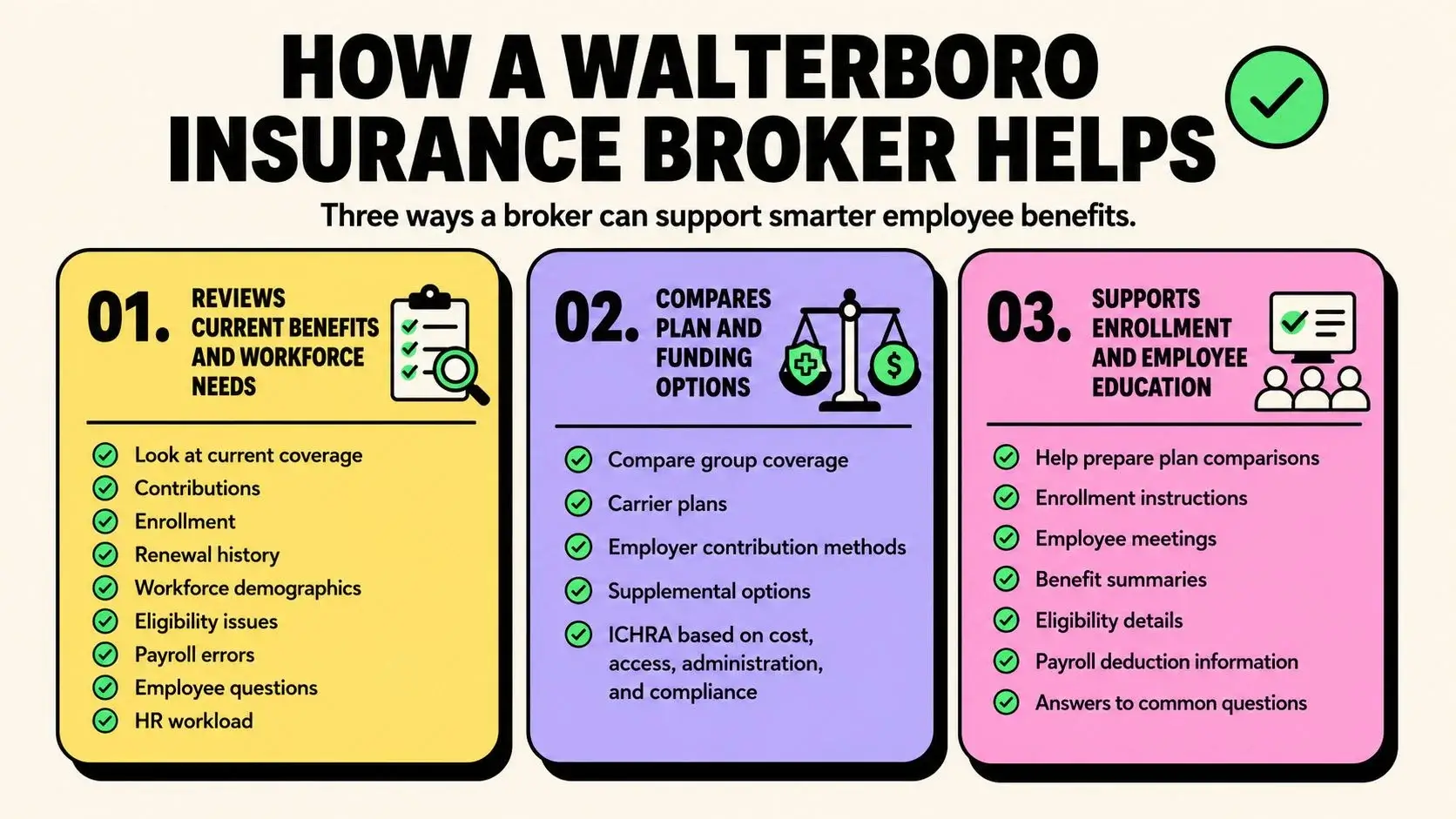
Reviews Your Current Benefits and Workforce Needs
A proper benefits review should examine more than the upcoming renewal rate. The broker should look at:
- Current coverage and plan options
- Employer and employee contributions
- Enrollment and participation
- Renewal history
- Workforce demographics
- Eligibility problems
- Payroll deduction errors
- Common employee questions
- Time spent by HR or operations teams
This review may uncover problems that are easy to miss. Employees might have coverage but struggle to afford family premiums. A plan may have a low monthly premium but limited provider access. The company may also be paying for benefits that few employees understand or select. The broker needs this information before suggesting what should stay, change, or receive a closer review.
Compares Plan and Funding Options
There is no single plan structure that works for every Walterboro employer. A broker may compare traditional group coverage, different carrier plans, employer contribution methods, supplemental options, or an Individual Coverage Health Reimbursement Arrangement. The comparison should explain how each choice affects cost, employee access, administration, and compliance.
Price matters, but it should not be the only deciding factor. A cheaper plan may come with a narrow network, higher deductibles, or more employee complaints. Paying more is not automatically better either, especially when employees do not understand or use the added coverage. A good comparison shows the trade-offs clearly so the employer can make a practical decision.
Supports Enrollment and Employee Education
Selecting a plan is only part of the work. Employees still need to understand what they are being offered, what it costs, and how to enroll. A broker may help prepare:
- Plan comparisons
- Enrollment instructions
- Employee meetings
- Benefit summaries
- Eligibility information
- Payroll deduction details
- Answers to common questions
Clear education matters because too many options can make enrollment harder rather than better. Employees should know the difference between their medical choices and understand how dental, vision, disability, life, or supplemental coverage fits alongside them. Support should also continue after enrollment. New hires, qualifying life events, terminations, and coverage questions occur throughout the year.
How Brokers Help Manage Benefits Costs
A broker cannot control insurance market pricing, but they can help an employer make better cost decisions. That may include:
- Comparing premiums and employee out-of-pocket costs
- Reviewing employer contribution levels
- Checking whether employees are using the current options
- Identifying unnecessary or overlapping coverage
- Evaluating different plan designs
- Comparing traditional group coverage with other funding approaches
- Starting renewal planning earlier
- Reducing avoidable enrollment and eligibility errors
Employee affordability deserves careful attention. A plan may fit the company budget but still receive poor participation if payroll deductions, deductibles, or family coverage costs are too high for the workforce. Cost control should not mean cutting coverage without considering the result. The aim is to spend more carefully and place employer dollars where they provide useful value.
Technology Should Make Benefits Easier to Manage
Benefits technology should reduce real work for employers and employees. It should not become another system that HR has to fix or manage manually. A well-configured platform may help with:
- New-hire enrollment
- Eligibility changes
- Digital plan comparisons
- Payroll deduction records
- Employee plan access
- Life-event updates
- Reporting
- Open enrollment
The setup matters as much as the software. Incorrect eligibility rules or payroll deductions can create problems quickly, even on a modern platform. Technology also does not replace employee support. Employees may still need help comparing plans, understanding deductions, adding dependents, or completing an enrollment change. The broker should connect the platform, the plans, and the support process rather than leaving each part disconnected.
When ICHRA and Voluntary Benefits May Fit
A broker should be able to explain different benefit structures without pushing the same option to every company.
When an ICHRA Deserves Consideration
An ICHRA allows an employer to provide defined reimbursements that eligible employees can use toward qualifying individual health coverage. It may deserve consideration when a company:
- Wants greater control over employer contributions
- Has employees in different insurance markets
- Struggles with participation in a group plan
- Has different employee classes
- Wants employees to choose individual coverage
An ICHRA is not automatically simpler than group insurance. Plan documents, employee classes, notices, substantiation, reimbursement administration, and employee education must be handled correctly. Employers considering this option should review an ICHRA compliance checklist before deciding how the arrangement will operate. Some companies may benefit from the contribution control and employee choice. Others may find that traditional group coverage remains a better fit.
How Voluntary Benefits Can Fill Coverage Gaps
Accident, critical illness, hospital indemnity, life, and disability coverage can help employees prepare for expenses or income disruption that major medical insurance may not fully address. A broker can help employers compare voluntary health benefits based on workforce needs rather than adding every available product.
These plans may be employer-paid, employee-paid, or offered through a shared contribution arrangement. The right approach depends on the budget and the value employees are likely to receive. Supplemental coverage should not be presented as a replacement for major medical insurance. Employees also need clear explanations of what each policy covers, how claims work, and what limitations apply.
What to Expect From a Strong Broker Throughout the Year
A useful broker relationship should not disappear after open enrollment. Throughout the year, employers may need help with:
- Employee eligibility issues
- Carrier questions
- New-hire enrollment
- Coverage changes
- Participation reviews
- Employee communication
- Compliance deadlines
- Renewal planning
The broker should also help the employer review whether the program still fits. Workforce size may change. Employee participation may decline. Costs may rise, or a new hiring need may make certain benefits more valuable.
Benefits can support employee retention when they remain affordable, understandable, and useful. They are less likely to help when employees cannot access the coverage or when administration creates repeated frustration. Employers exploring that connection can review how benefits support retention. Year-round service gives the employer time to solve problems before the next renewal deadline.
Questions to Ask Before Choosing a Benefits Broker
Ask questions that show how the broker works after the plans are sold. Useful questions include:
- How will you evaluate our workforce before recommending plans?
- What support do you provide outside renewal season?
- Who handles employee and eligibility questions?
- How do you help employees understand their choices?
- What technology is included?
- How do you coordinate enrollment with payroll?
- When do you begin renewal planning?
- How are you compensated?
- How will you help us review participation and plan performance?
Listen for specific processes rather than broad promises. The broker should be able to explain who handles each task, when reviews occur, and what support the employer and employees receive.
Why Walterboro Workforce Conditions Matter
Walterboro employers compete for workers within a regional labor market, but they may not have the same budgets or workforce needs as companies in larger cities.
Preliminary U.S. Bureau of Labor Statistics data reported an average weekly wage of about $997 in Colleton County during the fourth quarter of 2025, compared with roughly $1,276 across South Carolina.
That difference helps explain why employee deductions, deductibles, and employer contributions need careful review. A benefits package based on assumptions from a higher-wage market may be difficult for some local employees to afford.
Workforce type matters too. A manufacturer with hourly employees may prioritize affordable deductions and accident coverage. A healthcare practice may care more about recruitment and dependable medical access. A professional office may value employee choice and simple administration.
Local knowledge is useful when it helps the broker ask better questions. It should lead to practical decisions, not just repeated mentions of Walterboro.
Start With a Clear Review of Your Current Benefits
Before changing carriers or adding another plan, review what is already working and where employees are struggling.
Look at renewal costs, participation, employer contributions, payroll deductions, employee questions, and the time your team spends correcting benefits problems. This review can show whether the main issue is plan cost, weak communication, poor administration, missing coverage, or limited broker support.
It also gives your broker better information when comparing medical plans, contribution strategies, ICHRA, or voluntary options.
Benni Agency can help Walterboro employers examine these areas and organize the questions that need answers before the next benefits decision. The goal is not to add coverage without a reason. It is to make sure each recommendation fits the workforce, budget, and way the company operates.