A Business Owners Policy, or BOP, and a Commercial Package Policy, or CPP, both combine commercial insurance coverages, but they are designed for different levels of complexity. A BOP is usually a more standardized package for qualifying businesses with relatively straightforward risks. A CPP is more customizable, allowing a business to assemble commercial property, liability, and selected additional coverages around its actual operations. This guide is for Charleston business owners and decision-makers comparing a BOP and CPP before a new quote, renewal, lease, expansion, or operational change. It provides general educational information, not individualized insurance, legal, or tax advice.
Key Takeaways
- A BOP is usually a standardized package for qualifying businesses, while a CPP offers more flexibility to structure coverage around specialized or changing risks.
- Business size alone does not determine the better option. Property values, locations, contracts, equipment, services, and underwriting requirements all matter.
- Neither a BOP nor a CPP should be assumed to cover every exposure, including flood, workers’ compensation, professional liability, or other specialty risks.
- Charleston businesses should review wind, flood, storm surge, business income, deductibles, and location-specific endorsements separately from the package label.
- The best comparison looks at actual limits, exclusions, deductibles, endorsements, and selected coverage parts rather than deciding based only on price or policy name.
The Core Difference: Standard Package vs. Custom Program
The central question is not which policy name sounds better. It is whether the available package, limits, endorsements, deductibles, and exclusions match the business’s actual exposures. A BOP simplifies common property and liability needs for qualifying businesses. A CPP provides more flexibility when an operation has:
- Specialized property
- Multiple locations
- Changing operations
- Higher contractual requirements
- Mobile equipment
- More complex insurance needs
A simpler BOP is not automatically inadequate, and a CPP is not automatically better. The right choice depends on how well the policy structure matches the business.
What Is a Business Owners Policy (BOP)?
A BOP is a pre-packaged commercial insurance policy. Exact coverage varies by carrier and policy form, but a typical BOP combines commercial property and general liability coverage. Many BOP forms also provide business income and extra expense coverage after a covered loss, subject to policy terms, limits, exclusions, and waiting periods.
A BOP may include:
- Commercial property coverage for covered damage to buildings, equipment, furniture, inventory, or other insured property
- General liability coverage for covered third-party bodily injury, property damage, personal injury, or advertising injury claims
- Business income and extra expense coverage when a covered property loss interrupts operations, if included in the form
A BOP can be a practical starting point for a business whose industry, size, property, location, and operations fit the carrier’s program rules. Do not treat a published employee count, revenue amount, or square-footage threshold as universal. BOP eligibility is determined by the insurer and may vary based on:
- Industry
- Property characteristics
- Claims history
- Location
- Business operations
- State-specific underwriting
What Is a Commercial Package Policy (CPP)?
A CPP allows a business to combine selected commercial coverage parts into a more customized insurance program. It commonly begins with commercial property and general liability coverage, then may be structured around additional risks. The Triple-I guidance on commercial package policies explains how CPPs can combine multiple commercial coverages under one coordinated policy structure. Depending on the insurer and program, a CPP may include or coordinate:
- Business income
- Equipment breakdown
- Crime coverage
- Inland marine
- Commercial auto or fleet coverage
- Employment practices liability
- Pollution coverage
- Cyber coverage
- Professional liability
- Different limits or deductibles for separate exposures
The selected coverages, limits, deductibles, and endorsements must be confirmed in the actual quote and policy. A CPP can suit a growing or more complex business, but size alone does not decide the answer. A smaller business with specialized equipment, multiple locations, mobile property, or complex contracts may need a more flexible program. At the same time, a larger business may still have some exposures insured under separate standalone policies.
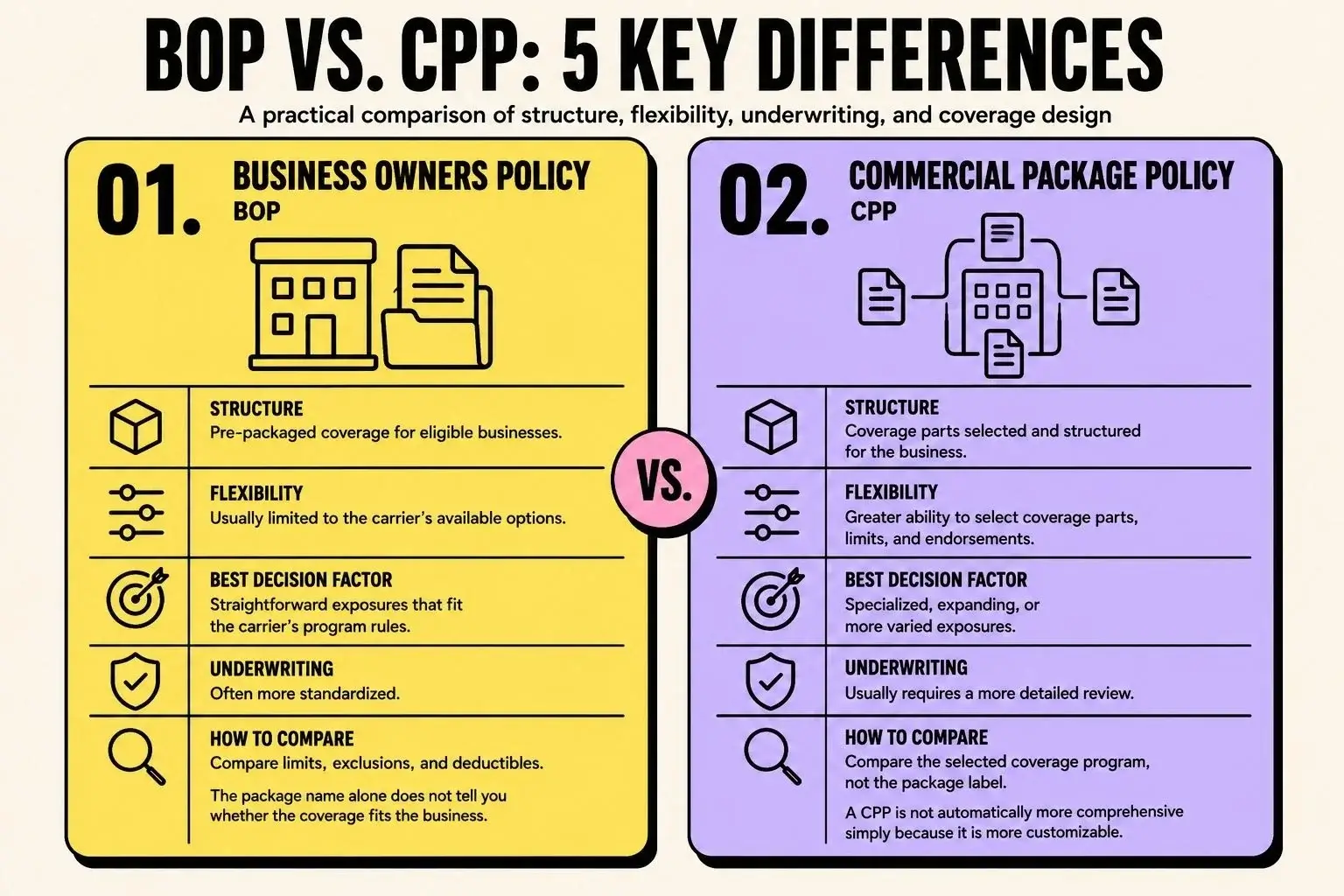
The important point is that the names describe structures, not guaranteed levels of protection.
When a BOP May Be Worth Exploring
A BOP may be worth requesting when a business has:
- A limited number of locations
- Conventional property needs
- Straightforward liability exposures
- An industry that fits the insurer’s BOP appetite
- Relatively standard contractual requirements
Retailers, offices, professional-service businesses, restaurants, and some service operations may qualify. Eligibility and available endorsements remain carrier-specific. The useful question is whether the standard form provides appropriate:
- Property valuation
- Business income protection
- Liability limits
- Deductibles
- Endorsements
- Covered causes of loss
A simpler policy is not automatically weaker if its terms match the actual business.
When a CPP May Make More Sense
A CPP may deserve consideration when the business has exposures a standard BOP does not adequately address or when the insurer will not offer a BOP. Common reasons include:
- Multiple properties
- Higher-value equipment
- Mobile equipment
- Operations in multiple states
- Fleet exposure
- Complex customer contracts
- Specialized services
- Different required limits across coverage parts
A CPP is not automatically more comprehensive. Coverage only applies when the relevant coverage part is selected and the loss falls within the policy terms. Its main advantage is flexibility. A CPP can allow the insurance program to be built around documented risks rather than forcing every exposure into one standardized package.
Charleston Property Risks Need a Separate Coverage Review
Charleston relevance matters because coastal property, flood, and storm exposure can affect the coverage questions a business should ask. The South Carolina Department of Insurance flood insurance guidance explains that standard commercial property coverage, including BOPs and CPPs, generally does not include flood damage. That includes flooding caused by storm surge. Flood insurance may be available through:
- The National Flood Insurance Program
- Private flood insurers
Do not assume a property package handles all storm-related exposures the same way. Review:
- Wind coverage
- Flood coverage
- Storm surge treatment
- Business income
- Named-storm deductibles
- Property valuation
- Causes of loss
- Exclusions
- Location-specific endorsements
For a closer look at endorsements and separate coverage questions, see Benni Agency’s Charleston BOP add-ons guide.
Coverage Commonly Written Separately
Neither a BOP nor a CPP should automatically be treated as a complete insurance program. Depending on the insurer and the business, some exposures may require separate policies or forms. These can include:
- Workers’ compensation
- Directors and officers liability
- Group health benefits
- Disability benefits
- Flood insurance
- Professional liability
- Specialty liability coverage
- Certain cyber exposures
- Other industry-specific insurance
Confirm how each exposure is actually written rather than assuming it is included because it appears on a proposal summary. General liability also has important limitations. It may respond to certain covered third-party claims, but it does not replace workers’ compensation, professional liability, or other specialized coverage.
How to Compare a BOP and CPP Quote
1. Start With Operations
List:
- Business locations
- Property values
- Vehicles
- Equipment
- Contracts
- Professional services
- New activities planned for the next policy term
The comparison should begin with actual operations, not the policy name.
2. Compare Property Terms
Review:
- Valuation method
- Property limits
- Deductibles
- Covered causes of loss
- Business income conditions
- Location-specific exclusions
- Endorsements
- Sublimits
Two policies can have similar names while providing materially different property protection.
3. Compare Liability Limits and Gaps
Check:
- Per-occurrence limits
- Aggregate limits
- Products-completed operations
- Contractual liability terms
- Additional insured endorsements
- Exclusions
- Deductibles or retentions
A matching premium does not mean the liability terms are equivalent.
4. Separate What Needs Separate Coverage
Identify exposures that require their own review, such as:
- Flood
- Workers’ compensation
- Professional liability
- Employee benefits
- Commercial auto
- Specialty liability
Do not force these exposures into the BOP-vs.-CPP comparison when they are being handled separately.
5. Revisit the Fit at Renewal
Review the structure again after:
- Signing a new lease
- Opening another location
- Adding a service
- Purchasing vehicles
- Buying major equipment
- Expanding into another state
- Signing a major contract
- Material business growth
A policy that fit last year may not remain the best structure after operations change.
Where Benni Agency Can Help
A side-by-side quote review can help a business compare the coverage actually being offered rather than choosing based only on the BOP or CPP label. Benni Agency’s Business & Commercial Insurance services include BOPs, CPPs, commercial property, liability, and other business coverage. Charleston businesses can also review the Charleston service-area page for local service information. The goal is to compare:
- Coverage parts
- Limits
- Deductibles
- Endorsements
- Exclusions
- Contract requirements
- Property exposures
- Operational changes
before deciding which structure fits the business.
2 thoughts on “Charleston BOP vs. CPP: Which Commercial Insurance Package Fits Your Business?”
Comments are closed.