General liability and professional liability insurance protect against different business claims. General liability typically addresses third-party bodily injury, property damage, and certain personal or advertising injury claims. Professional liability generally addresses allegations that an error, omission, or negligent professional service caused client financial harm. A Charleston business may need one or both, depending on its operations, contracts, and policy terms.
Key Takeaways
- General liability focuses mainly on third-party physical injury, property damage, and certain personal or advertising injuries.
- Professional liability focuses on alleged errors, omissions, negligence, or failure to deliver professional services as agreed.
- A business that serves clients and also has physical or job-site exposure may need both policies.
- Neither policy should be treated as a substitute for workers’ compensation, commercial auto, cyber, or commercial property coverage.
- Contracts, leases, licensing rules, policy exclusions, and claims-reporting terms can affect the coverage a Charleston business needs.
What General Liability Insurance Usually Covers
Commercial general liability insurance, often shortened to CGL, is designed around claims from people or organizations outside the business. It may respond when a customer, visitor, landlord, vendor, or another third party alleges that the business caused covered bodily injury or property damage.
Common examples include:
- A customer slips at an office, store, restaurant, or event space and is injured.
- An employee damages a client’s furniture or equipment while performing work.
- Completed work allegedly causes injury or damage after the job is finished.
- An advertisement leads to a covered claim involving libel, slander, or copyright infringement.
Coverage can include defense expenses and covered settlements or judgments, subject to the policy’s limits, exclusions, and conditions.
What Professional Liability Insurance Usually Covers
Professional liability insurance is often called errors and omissions, or E&O, insurance. In some professions, a specialized form may be called malpractice coverage. It generally applies when a client alleges that advice, judgment, design, or another professional service caused a financial loss.
Examples may include allegations that:
- A consultant’s recommendation caused a client to lose money.
- An accountant made an error in professional work.
- A designer’s mistake required expensive corrections.
- A technology provider failed to deliver contracted services.
- A professional missed a deadline or omitted an important step.
A claim does not have to succeed to create defense costs. Whether a policy responds depends on its insuring agreement, exclusions, retroactive date, reporting requirements, and other terms. The Travelers comparison of general and professional liability provides a useful overview.
General Liability vs. Professional Liability at a Glance
| Comparison point | General liability | Professional liability |
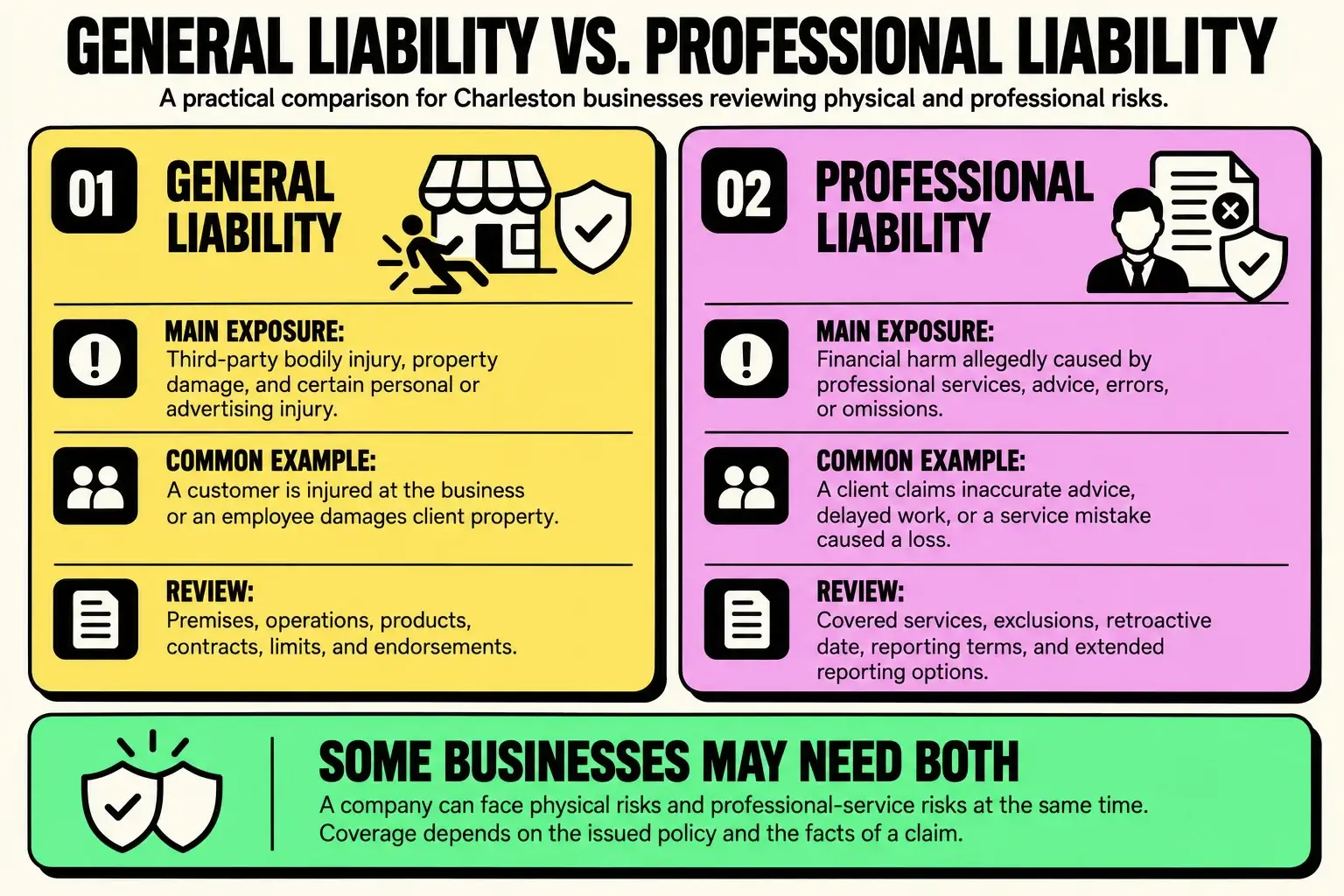
| Main exposure | Third-party physical injury, property damage, and certain personal or advertising injury | Financial harm allegedly caused by professional services, advice, errors, or omissions |
| Typical example | A visitor is injured at the business | A client claims inaccurate advice caused a loss |
| Common policy trigger | Often occurrence-based, though forms vary | Commonly claims-made, though forms vary |
| Often included in a BOP | Commonly, subject to the form | Usually separate or added by endorsement, if available |
| Key documents to review | Premises, operations, products, contracts, limits, and endorsements | Scope of services, exclusions, retroactive date, reporting terms, and extended reporting options |
The table is a starting point, not a coverage determination. Similar allegations can involve more than one policy, and insurers evaluate claims under the actual facts and contract language.
When a Charleston Business May Need Both Policies
Many businesses have both physical and professional exposures. A marketing agency may advise clients while also hosting meetings at its office. A contractor may perform physical work and provide design or specification services. An IT company may visit client locations while also recommending or configuring systems. In each case, general liability may address a covered injury or property-damage allegation, while professional liability may address a covered claim about the service itself. Buying one policy does not automatically fill the gaps in the other. Review the business’s premises, customer interactions, job sites, contracts, services, and travel. Businesses comparing a broader insurance program can also review Benni Agency’s guide to BOP versus CPP options in Charleston.
Are These Policies Required in South Carolina?
South Carolina does not impose one blanket general-liability or professional-liability requirement on every business. Requirements can arise through a commercial lease, customer agreement, government contract, licensing rule, or profession-specific regulation. A contract may specify limits, additional-insured status, primary and noncontributory wording, a waiver of subrogation, or a certificate of insurance. Workers’ compensation is separate. The South Carolina Workers’ Compensation Commission states that, as a general rule, businesses regularly employing four or more employees in the state must maintain workers’ compensation coverage. Part-time workers and family members count, and exemptions and fact-specific classifications can affect the result. Before signing a lease or client agreement, compare its insurance provisions with the proposed policies. A certificate of insurance summarizes coverage but does not change the policy.
How to Choose the Right Coverage
Start by mapping how the business could allegedly harm someone else. Ask:
- Do customers, vendors, or visitors enter the premises?
- Do employees work at client properties or active job sites?
- Does the business provide advice, design, analysis, recommendations, or specialized services?
- Could an error or delay cause a client financial loss without causing physical damage?
- Do leases, contracts, or licenses require particular policies or limits?
- Have new services, locations, products, or client types changed the exposure?
Then compare limits, deductibles, classifications, exclusions, and endorsements. For professional liability, also review the stated services, retroactive date, claims-reporting rules, and extended reporting options. Cost should be evaluated alongside scope. Premiums can vary based on industry, revenue, payroll, services, location, limits, claims history, deductibles, and underwriting. A low quote may not be comparable if it uses narrower services, lower limits, or materially different exclusions.
Common Coverage Gaps to Avoid
Do not assume a business owners policy includes professional liability. A BOP includes general liability and commercial property, while professional liability is generally separate. Terms vary by insurer. Another problem is failing to update coverage when services change. A company that adds consulting, design, installation, managed services, or another professional responsibility may create an exposure that its current policy does not address. Claims-made coverage also deserves careful attention.
Many professional liability policies require the claim to be made and reported during the policy period or an applicable extended reporting period. A lapse, replacement, or changed retroactive date can affect protection for earlier work. Confirm the terms before canceling or switching coverage. Neither policy is complete protection. Employee injuries, company vehicles, cyber incidents, employment disputes, business-owned property, and benefit-plan administration errors may require other coverage.
Reviewing Coverage With a Charleston Insurance Professional
The practical choice is based on operations and policy wording, not the policy names alone. Benni Agency’s business and commercial insurance services page explains the broader coverage categories that may need to work together. Its Charleston service-area page provides local service information. A licensed insurance professional can help compare quotes, exclusions, endorsements, limits, and contractual requirements. Legal counsel may be appropriate for unclear contractual obligations. Claim outcomes depend on the issued policy and circumstances.