A warehouse property policy needs to reflect more than square footage. Racking, forklifts, inventory swings, refrigeration, automation, and customer-owned goods can all change the coverage questions. In North Charleston, flood and wind also deserve an address-specific review. This guide provides general information, not individualized insurance, legal, or tax advice.
Key Takeaways
- Commercial property policies generally exclude flood, so warehouse operators should evaluate separate flood coverage.
- Replacement cost, actual cash value, limits, and coinsurance can materially affect a property claim.
- Customer-owned goods may require warehouse legal liability coverage rather than ordinary property insurance.
- Business income protection should reflect realistic repair, equipment-replacement, and inventory-restoration timelines.
- A useful quote comparison reviews forms, limits, deductibles, exclusions, endorsements, and contract obligations together.
Start With the Property and the Warehouse Operation
An owner-occupied distribution center, leased warehouse, and third-party logistics operation can have different property interests and contractual obligations. Before comparing quotes, document:
- Who owns the building
- Who owns the inventory
- Peak inventory values, not only annual averages
- Racking, forklifts, conveyors, refrigeration, and other equipment
- Storage height, commodity types, and sprinkler protection
- Lease and customer-contract insurance requirements
- Planned renovations, new tenants, or operational changes
North Charleston businesses can use Benni Agency’s local insurance and benefits page for the local service path.
What Commercial Property Insurance May Cover
A commercial property policy may insure the building, the operator’s business personal property, and certain lost income after covered physical damage. Whether a particular loss is covered depends on the issued forms, endorsements, exclusions, limits, deductibles, and facts of the claim.
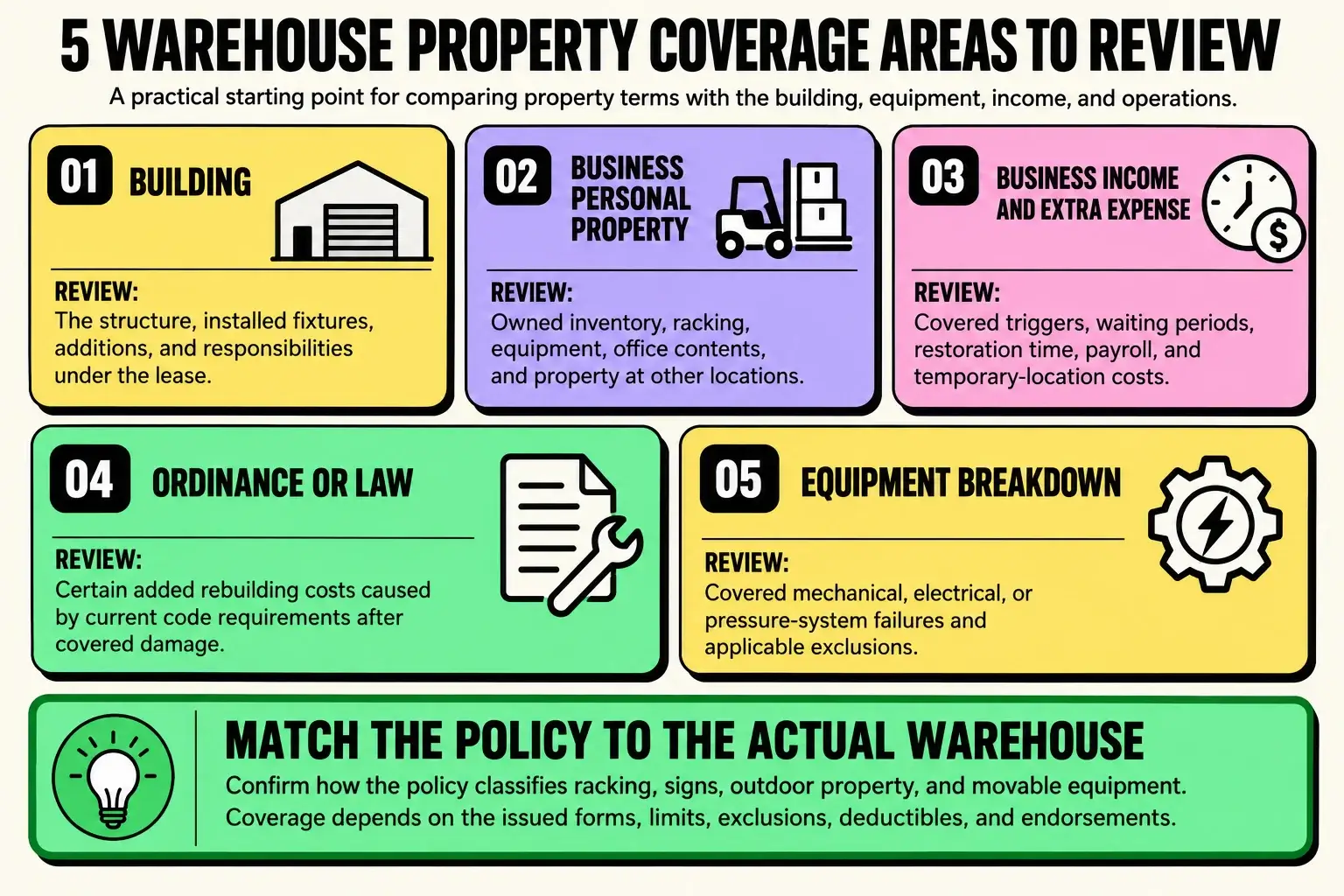
| Coverage area | What to verify for a warehouse |
| Building | Structure, permanently installed fixtures, additions, and responsibility under the lease |
| Business personal property | Owned inventory, racking, equipment, office contents, and property at other locations |
| Business income and extra expense | Covered triggers, waiting period, restoration period, payroll treatment, and temporary-location costs |
| Ordinance or law | Increased rebuilding costs caused by applicable code requirements after covered damage |
| Equipment breakdown | Covered mechanical, electrical, or pressure-system failures and applicable exclusions |
Do not assume anchored racking, signs, or movable equipment will be classified the same way under every policy.
Compare Causes of Loss and Exclusions
Commercial property forms may use named-peril coverage or a broader special form. A named-peril form responds only to listed causes of loss. A special form generally covers direct physical loss unless the cause is excluded or limited, but it is not “all-risk” protection without boundaries. Review exclusions involving flood, earth movement, water intrusion, wear and tear, mechanical breakdown, power interruption, vacancy, theft, and property in transit. Also confirm how wind or named-storm deductibles apply. The declarations and endorsements control, so “special form” is only the beginning of the comparison.
Review Valuation, Limits, and Coinsurance Together
Replacement cost generally measures the cost to replace covered property with property of comparable kind and quality, subject to policy conditions. Actual cash value generally reflects depreciation. The difference can be significant for older racking, forklifts, roofs, and building systems. Coinsurance provisions may reduce payment on a partial loss when the insured value falls below the percentage required by the policy. Review values at renewal and after adding equipment, expanding storage, or materially changing inventory. Seasonal peaks also matter. A limit based on an average month may not reflect the value present during the warehouse’s busiest period.
Separate Flood and Wind Questions
Standard commercial property insurance generally does not cover flood. FEMA explains that flood insurance is a separate policy that may cover a building, its contents, or both. A warehouse operator should check the specific address, lender requirements, building and contents limits, deductibles, valuation terms, waiting periods, and whether business income is included or excluded. Wind requires a separate check as well. Coverage may be included, excluded, or subject to a different deductible depending on the insurer and policy. The South Carolina Wind and Hail Underwriting Association is a market of last resort for eligible coastal property, but eligibility is location-specific. Use its official eligibility check rather than assuming every North Charleston address qualifies.
Customer-Owned Goods Need Their Own Analysis
A warehouse operator’s property policy usually focuses on property the operator owns. It should not be assumed to cover goods owned by customers. Warehouse legal liability coverage can address the operator’s legal liability for certain loss or damage to property held for others, subject to its terms. The warehouse receipt, storage agreement, service contract, liability limitations, and handling duties can affect the exposure. Compare the policy with contracts and realistic peak customer-goods values. Transit, cross-docking, temperature-controlled storage, and employee dishonesty may require separate treatment.
Match Business Income Coverage to Recovery Time
Physical repairs are only part of a warehouse shutdown. Replacement equipment may have long lead times, inventory may need to be replenished, and a temporary facility may require new handling or security arrangements. Business income and extra expense coverage can respond only when the policy’s covered-loss requirements are met. Estimate the restoration period using operational facts, not only a repair estimate. Review waiting periods, limits, payroll treatment, utility interruption, civil-authority provisions, and extended business income. Contractual penalties or lost customers are not automatically covered.
Check Common Warehouse Coverage Gaps
Several issues deserve attention before binding or renewing coverage:
- Vacancy: Some forms restrict coverage after a building meets the policy’s definition of vacant for a stated period.
- Mobile property: Forklifts, scanners, and equipment used away from the premises may need inland marine coverage.
- Mechanical systems: Equipment breakdown coverage may address certain failures excluded by ordinary property forms.
- Employee theft: Commercial crime coverage may be needed because property insurance does not address every dishonest act.
- Code-related costs: Ordinance or law coverage may help with certain added rebuilding expenses after covered damage.
- Unreported changes: New racking, automation, tenants, commodities, or storage heights can alter values and underwriting.
BOP or Commercial Package Policy?
A Business Owners Policy (BOP) is generally a standardized package for eligible operations. A Commercial Package Policy (CPP) offers more flexibility to combine coverage parts and tailor limits or endorsements. Specialized equipment, multiple sites, or complex contracts may call for more customization, but structure alone does not determine coverage quality. Benni Agency’s BOP versus CPP comparison explains the distinction in more detail. When reviewing a warehouse program, compare the actual property forms and separate policies, not only the package name.
Preparing for a Warehouse Insurance Review
Bring current building and equipment values, peak inventory figures, a property schedule, loss history, lease requirements, customer contracts, and details about sprinklers, construction, storage height, commodities, and refrigeration. Note any renovation, vacancy, or expansion planned during the policy term. Benni Agency’s Business & Commercial Insurance services include commercial property and related business coverage. A review should compare available insurer terms with the facility’s actual operations and contracts. Coverage remains subject to underwriting and the issued policy.