Your company may already deduct health insurance premiums or account contributions from employees’ pay before taxes. But payroll deductions alone don’t create a properly administered Section 125 plan. Employers also need a written plan, eligible participants, accurate records, controlled election changes, and current contribution limits. Mistakes in any of these areas can affect the intended tax treatment.
This guide is for business owners, HR teams, and payroll leaders who want to understand the 2026 rules and check whether their current setup still works as intended.
Key Takeaways
- A Section 125 plan is the written tax framework that allows eligible employees to pay for certain benefits with pre-tax income.
- For plan years beginning in 2026, the health FSA salary-reduction limit is $3,400.
- The 2026 dependent care assistance exclusion is generally $7,500, or $3,750 for married employees filing separately.
- Sole proprietors, partners, and more-than-2% S corporation shareholders generally cannot participate on the same pre-tax basis as eligible employees.
- Employees cannot change elections whenever they choose. The plan document and federal rules must support the request.
- Employers should keep plan documents, payroll deductions, enrollment records, employee communication, and testing aligned.
What a Section 125 Plan Actually Does
A Section 125 plan, often called a cafeteria plan, gives eligible employees a choice between taxable compensation and one or more qualified benefits. For example, an employee may choose to have part of their salary applied toward an eligible health insurance premium or flexible spending account before certain federal taxes are calculated. The employer may also reduce the amount of wages subject to certain payroll taxes.
The Section 125 plan is not the health insurance policy, FSA, HSA, or payroll system. It is the written tax arrangement that allows qualifying benefits to receive pre-tax treatment. That distinction matters. An employer can offer excellent health coverage, but pre-tax payroll deductions still need proper plan documents and administration. South Carolina employers are managing substantial benefit costs. Federal survey data pooling 2021 through 2023 estimates that average annual employer-sponsored premiums in the state were about $7,284 for single coverage and $20,619 for family coverage. Average employee contributions were approximately $1,592 for single coverage and $6,062 for family coverage. Those figures are not 2026 premium estimates, but they show why correct pre-tax administration can matter to both employers and employees.
What Changed for Section 125 Plans in 2026?
Employers should review annual limits before updating enrollment materials or opening employee elections. Two 2026 amounts deserve close attention.
The 2026 Health FSA Limit
For plan years beginning in 2026, employees may elect up to $3,400 in salary reductions for a health flexible spending arrangement. Employers offering a health FSA should confirm that this amount appears correctly in:
- The Section 125 plan document
- Employee enrollment materials
- The benefits administration platform
- Payroll deduction settings
- Employee confirmation statements
An employer may choose a lower plan limit, but employee salary-reduction elections cannot exceed the federal maximum. Employers should also confirm whether their health FSA permits a carryover or grace period. Those features must follow the applicable rules and the terms written into the plan.
The 2026 Dependent Care Assistance Limit
Beginning in 2026, qualifying employer-provided dependent care assistance can generally be excluded from an employee’s wages up to $7,500 per year. The limit is $3,750 for an employee who is married and files a separate tax return.
Employers with a dependent care FSA should update their plan materials, payroll system, and employee communications before accepting elections under the new amount. They should also explain that an employee’s usable exclusion may depend on earned income, filing status, spouse participation, and other tax factors.
Which Benefits Can Be Offered Through a Section 125 Plan?
A cafeteria plan may cover several types of qualified benefits, but not every payroll deduction is eligible for pre-tax treatment.
Common Qualified Benefits
Depending on the plan design, common benefits may include:
- Employee contributions toward employer-sponsored health insurance
- Dental and vision insurance premiums
- Health FSA contributions
- Dependent care assistance
- Certain employee HSA salary-reduction contributions
- Group-term life insurance within applicable tax limits
- Certain accident and health benefits
Employers may also use Section 125 payroll elections with qualifying tax-advantaged accounts, including health FSAs, dependent care FSAs, and employee HSA salary reductions. Each account has its own rules. A health FSA, HSA, HRA, and dependent care FSA should not be treated as interchangeable simply because they all have tax advantages.
Benefits That Usually Do Not Qualify
Employers should not assume that every voluntary benefit can be paid through a Section 125 plan. Benefits that generally cannot be offered as qualified cafeteria-plan benefits include:
- Long-term care insurance
- Educational assistance
- Transportation benefits
- Archer medical savings accounts
- Benefits that mainly defer compensation
- Cash benefits that do not meet the applicable qualified-benefit rules
Some insurance products may require closer review based on how the coverage and benefits are structured. Before adding a pre-tax payroll code, confirm that the underlying benefit qualifies and that the written plan includes it. Fixing an incorrect deduction after payroll has processed several months can be far more difficult than checking it at setup.
Who Can Participate in a Section 125 Plan?
Participant eligibility depends on both the tax rules and the employer’s written plan.
Eligible Employees
Common-law employees may generally participate when they meet the plan’s eligibility requirements. The document should clearly address matters such as:
- Eligible employee classes
- Waiting periods
- Entry dates
- Employment status
- Termination of participation
- Treatment during approved leave
Employers must follow those terms consistently. Allowing one employee to enter early or remain enrolled outside the written rules can create administrative and testing problems. Former employees may participate in limited circumstances, but a cafeteria plan cannot be maintained mainly for former employees.
Owners and Self-Employed Individuals
Business ownership creates additional restrictions. The following people generally cannot participate as employees in a Section 125 plan:
- Sole proprietors
- Partners in a partnership
- Members of an LLC taxed as a partnership
- More-than-2% shareholders of an S corporation
A more-than-2% S corporation shareholder is not treated as an employee for Section 125 purposes. That person generally cannot receive the same pre-tax cafeteria-plan treatment available to eligible common-law employees. A C corporation owner who is also a common-law employee may be treated differently, subject to the plan terms and nondiscrimination rules. Employers should confirm ownership before establishing deductions. This is especially important for family businesses where an owner, spouse, or relative may also be listed as an employee.
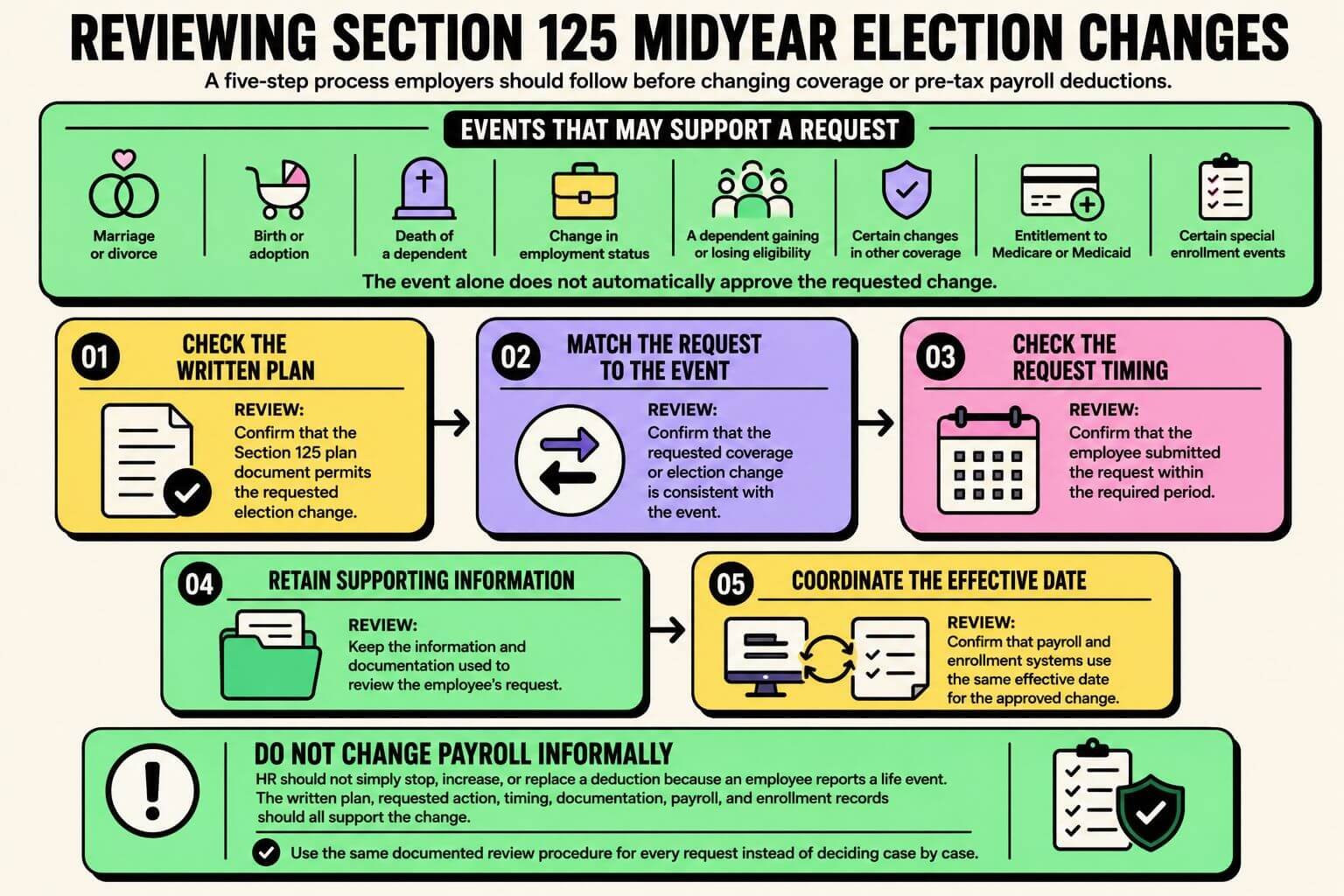
When Can Employees Change Their Elections?
Section 125 elections are generally made before the plan year or coverage period begins. Employees normally cannot increase, stop, or replace an election whenever they choose. A plan may permit certain midyear changes after events such as:
- Marriage or divorce
- Birth or adoption
- Death of a dependent
- A change in employment status
- A dependent gaining or losing eligibility
- Certain changes in other coverage
- Entitlement to Medicare or Medicaid
- Certain special enrollment events
The event alone does not automatically approve the request.
Before processing a change, the employer should check that:
- The written plan permits it.
- The requested change is consistent with the event.
- The employee submitted the request within the required period.
- Supporting information has been retained.
- Payroll and enrollment systems use the same effective date.
Suppose an employee gets married and asks to cancel medical coverage because they plan to join their spouse’s plan. HR should not simply stop the deduction. The employer should verify that the plan permits the change, confirm the requested action fits the event, and coordinate the effective date across all systems. A clear written procedure helps HR handle similar requests consistently instead of making decisions case by case.
What Employers Need to Maintain
A Section 125 plan needs ongoing attention. Adopting a document once does not protect the intended tax treatment if daily operations no longer follow it.
A Current Written Plan Document
The employer should maintain a written plan that identifies:
- Available benefits
- Eligibility rules
- Election procedures
- Plan year
- Contribution rules
- Permitted midyear changes
- Flexible spending account provisions
- Claims or administration procedures where applicable
- Amendment and termination terms
The document should be adopted before the plan becomes effective. Employers should not expect a document signed later to correct earlier deductions automatically. Review the plan whenever the company changes carriers, benefits, eligibility rules, account features, administrators, or payroll providers. Employers should also distinguish the Section 125 document from documents required for underlying health and welfare benefits. The cafeteria plan and the benefits offered through it may have related but separate documentation and disclosure requirements.
Accurate Payroll and Enrollment Records
Payroll, enrollment, and plan records should tell the same story. For each employee, the employer should be able to confirm:
- The benefit elected
- The election amount
- The effective date
- The payroll deduction
- Whether the deduction is pre-tax or after-tax
- Any later election change
- The reason and documentation for that change
Connected payroll and benefits administration systems can reduce manual differences between employee elections, effective dates, and deduction records. Technology still needs oversight. Employers should review deduction reports after open enrollment, new-hire enrollment, qualifying events, and payroll-system changes. A simple reconciliation can catch issues such as:
- An employee enrolled in coverage but missing a deduction
- A deduction continuing after coverage ended
- The wrong FSA amount entered in payroll
- A pre-tax code used for an after-tax benefit
- Different effective dates in the enrollment and payroll systems
Nondiscrimination Testing
Section 125 plans generally cannot favor highly compensated employees or other prohibited groups in ways that violate the applicable testing rules. The exact tests depend on the benefits and plan structure. Testing may examine eligibility, contributions, benefits, utilization, or concentration of benefits among certain employees. Employers should not wait until the final payroll of the year to think about testing. Earlier testing may provide time to review the results and discuss available corrections before the plan year ends.
A simple cafeteria plan may offer certain nondiscrimination safe-harbor protections when the employer meets the eligibility, contribution, and participation requirements. It is not the same as every other Section 125 plan, and the safe harbor is not automatic.
How to Review or Set Up a Section 125 Plan
Whether an employer is starting a new plan or reviewing an existing one, the process should follow a clear order.
Review the Existing Plan and Benefits
Begin by listing every benefit connected to a pre-tax payroll deduction. For each one, confirm:
- Does the benefit qualify?
- Is it listed in the plan document?
- Who is eligible?
- Are any owners participating?
- Do current contribution limits apply?
- Does the plan describe election changes correctly?
- Are account features reflected accurately?
A plan copied from an older document may contain outdated benefit names, administrators, limits, or eligibility terms. Employers should also compare the Section 125 plan year with the underlying benefit and account plan years. Different dates can create confusion during enrollment and administration.
Coordinate Payroll, Enrollment, and Administration
Next, confirm who is responsible for each part of the process. The employer, broker, payroll provider, carrier, FSA administrator, and enrollment vendor may all handle different pieces. A task should never be assumed to belong to another party. Create a simple responsibility list covering:
- Plan document updates
- Employee elections
- Payroll coding
- Eligibility changes
- Midyear requests
- Account administration
- Nondiscrimination testing
- Employee notices
- Record retention
Run a deduction audit before the first payroll under new elections. Review it again after any file-feed, payroll, or benefits-platform change.
Communicate the Rules to Employees
Employees need more than a list of available benefits. Enrollment materials should explain:
- Which elections are made pre-tax
- When elections become effective
- How long elections remain in place
- When changes may be requested
- Contribution limits
- Claim deadlines
- Carryover or grace-period rules
- What happens when employment ends
Clear instructions reduce last-minute questions and help employees make informed choices. Avoid promising that every employee will save the same amount in taxes. The result depends on wages, elections, tax circumstances, and the benefit involved.
Common Section 125 Mistakes Employers Should Avoid
Small administrative shortcuts can create bigger problems later.
Using Pre-Tax Deductions Without a Current Plan
A payroll code is not a substitute for a written plan.
What to do: Confirm that the plan was properly adopted and still reflects the benefits being offered.
Allowing an Ineligible Owner to Participate
Ownership restrictions are easy to miss when an owner also receives regular payroll.
What to do: Review the company’s tax structure and each participant’s ownership before approving pre-tax elections.
Applying Outdated Contribution Limits
Old amounts may remain in plan documents, enrollment platforms, or payroll systems.
What to do: Check annual limits before preparing enrollment materials and accepting elections.
Approving Midyear Changes Informally
An employee’s situation may sound reasonable but still fall outside the written plan or applicable rules.
What to do: Use a documented review process for every election-change request.
Letting Systems Fall Out of Sync
Enrollment may show one amount while payroll deducts another.
What to do: Reconcile elections and deductions after enrollment, life events, and system changes.
Offering an Ineligible Benefit Pre-Tax
Not every employee-paid product qualifies.
What to do: Verify the benefit’s tax treatment before assigning a pre-tax deduction code.
Waiting Too Long to Test
Late testing may leave little time to review an unfavorable result.
What to do: Set a testing schedule early in the plan year and repeat testing when workforce or participation patterns change significantly.
Giving Employees Vague Instructions
Employees may misunderstand election deadlines, account rules, or claim periods.
What to do: Provide plain-language instructions and direct employees to a reliable contact for questions.
Review Your Section 125 Setup Before the Next Plan Year
A Section 125 plan should be reviewed before renewal or open enrollment, especially when benefits, payroll providers, ownership, or employee eligibility have changed. Start by confirming that the written plan reflects the benefits currently offered. Then compare it with payroll deductions, enrollment records, 2026 limits, owner participation, midyear election procedures, and employee materials. Employers should also confirm when nondiscrimination testing will be completed. Testing earlier in the year may leave more time to address a concern before year-end.
Benni Agency helps employers review how plan documents, employee elections, payroll, and benefits administration work together. Employers who are unsure whether their current practices still match their plan can explore ongoing benefits compliance support.