Several employee benefits brokers may present similar plans, rates, and promises. The harder question is which broker will actually reduce HR work, explain costs clearly, support employees, and stay involved after enrollment.
Mount Pleasant employers should compare brokers based on their service model, relevant experience, compensation, technology, carrier access, and year-round support. This guide is for business owners and HR leaders who want a fair way to compare candidates and avoid choosing a broker based on price or presentation alone.
Key Takeaways
- Define your company’s cost, workforce, and HR-support needs before comparing brokers.
- Compare year-round service, not just the rates shown at renewal.
- Ask how the broker is paid and whether technology or consulting fees apply.
- Look for experience with employers similar to yours in size, industry, and workforce.
- Give every broker the same information and use a scorecard to compare their answers.
What Should You Decide Before Comparing Benefits Brokers?
Before speaking with brokers, identify what you need the relationship to improve. Start with the problems your team is already seeing. Renewal costs may feel unpredictable. Employees may struggle to understand their options. HR may be spending too much time correcting deductions, updating eligibility, or answering routine questions. Consider a few practical questions:
- What benefits problems take up the most HR time?
- Are employees satisfied with their current choices?
- Are premiums and out-of-pocket costs affordable?
- Does the company expect to hire or open another location?
- Are most employees salaried, hourly, remote, or spread across several sites?
- Does the current enrollment system connect properly with payroll?
- Which tasks should the broker handle instead of HR?
You should also decide what success would look like. One employer may want more predictable costs. Another may need faster onboarding or better employee communication. Clear goals make it easier to judge whether a broker’s recommendations fit your company or simply repeat the same approach offered to every client.
Why Does Mount Pleasant’s Workforce Matter When Choosing a Broker?
Mount Pleasant employers recruit within the broader Charleston County labor market. That includes professional services firms, healthcare employers, hospitality businesses, contractors, retailers, and growing local companies. According to the South Carolina Department of Employment and Workforce, Charleston County had 281,127 jobs in September 2025, the second-highest county employment total in the state. Its average weekly wage reached $1,363 during the third quarter of 2025, the highest among South Carolina counties. These figures show why compensation decisions cannot stop with salary alone. Benefits can influence how a company competes for workers across the region.
Different workforces may also need different plan structures and communication methods. A professional services firm may place more value on broad medical networks and disability coverage. A hospitality company with hourly turnover may focus on affordability, simple onboarding, and voluntary options. A contractor may need a process that works for employees who rarely sit at a computer. A broker does not need to make assumptions about local workers. They should ask about your actual workforce and explain how each recommendation fits it.
What Should a Benefits Broker Handle Year-Round?
A broker’s job should not begin and end with collecting quotes during renewal. A useful service model may include:
- Reviewing plan performance and costs
- Preparing renewal comparisons
- Explaining funding and contribution options
- Coordinating enrollment
- Supporting employee communication
- Managing eligibility questions
- Helping resolve carrier issues
- Assisting with payroll coordination
- Providing compliance guidance
- Reviewing the program throughout the year
Ask for a written explanation of what is included. Words such as “full service” can mean very different things from one firm to another. You should also know which work will be handled by the producer, an account manager, a service center, or a third-party technology provider. The people making the sales presentation may not be the people supporting your company after the agreement is signed.
Employee Support, Renewals, and Communication
Ask who employees contact when they cannot find an ID card, do not understand a deduction, or have trouble with enrollment. Will employees call the broker’s team, the carrier, or your HR department? How are urgent problems escalated? How soon should your team expect an acknowledgment or answer?
Renewal support should also be clearly defined. Ask when the broker normally begins reviewing data and when your company will receive its first analysis. You need enough time to compare choices, make contribution decisions, prepare employee materials, and complete enrollment without rushing. Communication support may include:
- Plan comparison guides
- Enrollment meetings
- Recorded explanations
- New-hire materials
- Employee notices
- Decision-support tools
- Support for employees with individual questions
The goal is not to remove HR from every conversation. It is to prevent HR from becoming the only place employees can get help.
Administration, Technology, and Payroll Coordination
A benefits platform can centralize elections, documents, new-hire enrollment, qualifying life events, and reporting. Software alone does not guarantee a smoother process. Ask who will:
- Configure the system
- Load plans and eligibility rules
- Connect it with payroll
- Test deductions
- Train HR
- Correct enrollment errors
- Update information after plan changes
- Support employees who cannot complete enrollment
You should also ask whether the platform is included in the broker relationship or billed separately. A broker that provides benefits administration should be able to explain both the software and the work required to operate it. This matters because a poorly configured platform can create duplicate records, incorrect deductions, missed elections, and more manual work. A useful system needs clear ownership behind it.
How Should You Compare a Broker’s Experience and Recommendations?
A long client list does not automatically mean a broker is the right fit for your company. Look for experience with employers that share some of your characteristics:
- Similar employee count
- Similar industry
- Hourly or salaried workforce
- Multiple locations
- Remote employees
- Seasonal hiring
- Fast growth
- Limited internal HR support
Ask the broker to describe how their work changed for different clients. A credible answer should explain differences in service, communication, contribution strategy, or administration. It should not reveal private client information. You should also pay attention to how recommendations are developed. Does the broker ask detailed questions before suggesting a plan? Do they explain disadvantages along with potential benefits? Are they willing to say that a particular option does not fit your workforce? Good advice should include trade-offs, not just a list of products.
Similar Employers, Licensing, and References
Confirm that the individuals handling insurance business hold the appropriate South Carolina licenses. Producer information can be checked through the South Carolina Department of Insurance’s online database. Ask for references from employers with similar needs. Useful reference questions include:
- Does the broker respond throughout the year?
- Are renewal choices presented early enough?
- Who handles employee questions?
- Was implementation organized?
- Were fees and responsibilities explained clearly?
- Does the service match what was promised?
You should also ask who will be assigned to your account. Learn each person’s role and how long they have worked with companies like yours. References cannot guarantee a good experience, but they can show whether the broker follows through after the sales process.
Plan Options, Carrier Access, and Trade-Offs
A broker should be able to compare more than one reasonable approach when your company’s needs call for it. Fully insured coverage may suit employers that want a familiar structure and predictable monthly premiums. Level-funded coverage may offer more claims visibility and possible financial advantages for some groups, but it introduces different risk and participation considerations. An ICHRA may work for an employer that prefers a defined contribution approach and wants employees to select individual coverage. It will not fit every workforce, so the broker should explain employee affordability, administration, enrollment, and market availability before recommending it.
The same principle applies to dental, vision, life, disability, accident, critical illness, and hospital coverage. Voluntary benefits can give employees added choices without requiring the employer to pay every premium, but the options still need clear communication and manageable administration. Ask each broker:
- Which carriers do you regularly work with?
- Are there carriers or plan types you do not handle?
- How do you decide which options reach the final comparison?
- Will you show premiums, networks, deductibles, contributions, and administration side by side?
- What disadvantages should we consider with each option?
The broker should help you understand the decision, not make it harder to compare.
What Should You Ask About Fees and Service Accountability?
Two broker proposals may look similar while including very different services and costs. Ask for a clear explanation of how the broker is paid. Compensation may involve carrier commissions, consulting fees, technology charges, implementation costs, or fees for optional services.
One payment model is not automatically better than another. What matters is whether the arrangement is explained clearly and whether you understand what is included. Ask questions such as:
- How is your firm compensated?
- Are any charges paid directly by our company?
- Are technology or enrollment fees separate?
- Are there additional implementation costs?
- Do carrier relationships affect the options you present?
- Which services are included throughout the year?
- Who is responsible for each part of implementation?
- What response times should our team expect?
- How are unresolved problems escalated?
Ask for important commitments in writing. That may include the service team, renewal calendar, communication support, reporting schedule, implementation responsibilities, and employee-support process. A clear agreement gives both sides a shared understanding of the relationship. It also gives your company something specific to review if service changes later.
How Can You Compare Broker Candidates Fairly?
Give every broker the same information and ask the same main questions. Prepare a basic company profile that includes:
- Number of eligible employees
- Employee locations
- Current plans
- Employer contributions
- Participation levels
- Latest renewal information
- Payroll and enrollment systems
- Common employee questions
- Current administration problems
- Hiring and growth plans
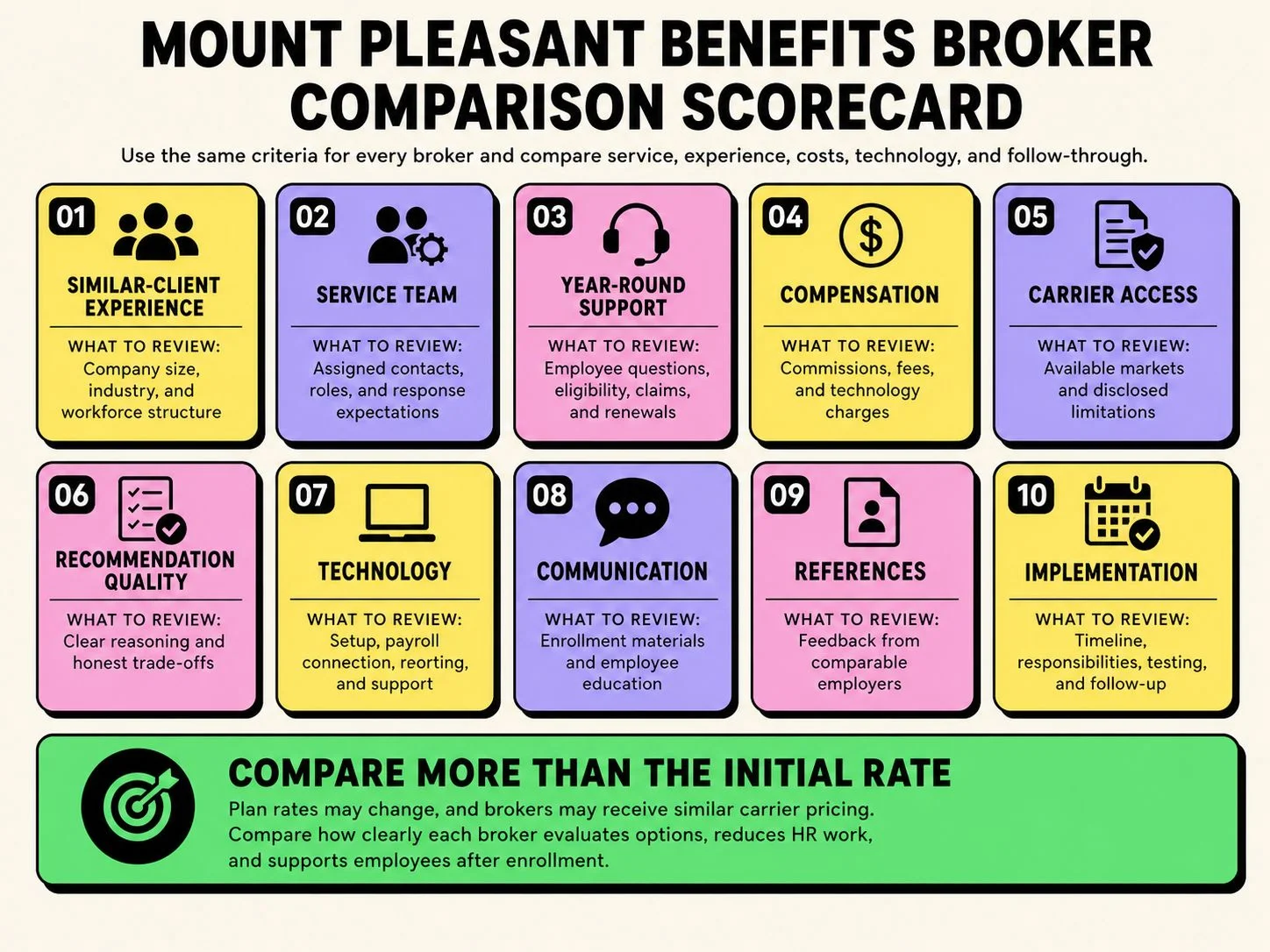
Then use a simple scorecard. Possible categories include:
Comparison Area | What to Review |
Similar-client experience | Company size, industry, workforce structure |
Service team | Assigned contacts, roles, response expectations |
Year-round support | Employee questions, eligibility, claims, renewals |
Compensation | Commissions, fees, technology charges |
Carrier access | Available markets and disclosed limitations |
Recommendation quality | Clear reasoning and honest trade-offs |
Technology | Setup, payroll connection, training, support |
Communication | Enrollment materials and employee education |
References | Feedback from comparable employers |
Implementation | Timeline, responsibilities, testing, follow-up |
Do not score candidates only on the lowest initial rate. Plan rates may change, and two brokers may receive similar carrier pricing. The larger difference may be how clearly they evaluate the options, how much work they remove from HR, and what happens when an employee needs help six months later.
Is It Time to Review Your Current Broker?
Choosing a broker does not have to begin with a formal proposal. Start by reviewing what is not working now. A comparison may be worth considering when:
- Renewal options arrive too late
- Costs rise without a clear explanation
- HR handles most employee questions alone
- Payroll or enrollment errors keep returning
- The same plan structure is recommended every year
- Fees and compensation are unclear
- Employee communication is limited
- Service drops after enrollment
Gather your current plan summaries, employer contribution details, employee counts, common support questions, and recent administration problems. Give each broker the same information and ask how they would improve planning, communication, implementation, and ongoing support. Benni Agency can help local employers review these issues without assuming every plan needs to be replaced. You can explore its Mount Pleasant benefits to understand the available coverage and administration options, then decide whether comparing brokers would be useful.