Your company has outgrown the health plan that once worked well. Employees now live in different markets, renewal costs are harder to predict, and HR is trying to support people with very different coverage needs. ICHRA may offer another path by letting the company set its contribution while employees choose individual plans.
But the numbers, local plan options, ACA rules, and employee experience all need to work together. This guide helps midsize employers decide what to review before comparing ICHRA with traditional group coverage.
Key Takeaways
- ICHRA lets an employer set a defined contribution while eligible employees choose qualifying individual health coverage.
- Employers should review employee locations, available plans, provider networks, prescriptions, and likely costs before setting an allowance.
- Companies with 50 or more full-time-equivalent employees must pay close attention to ACA affordability and employer-responsibility rules.
- Employee classes offer flexibility, but employers must follow federal class definitions and any applicable minimum-size requirements.
- Employee education, enrollment help, coverage verification, payroll coordination, and reimbursement administration are central to a successful rollout.
- ICHRA may suit a distributed workforce, but a strong group plan can still be the better choice for some employers.
What ICHRA Changes for a Midsize Employer
Traditional group health insurance asks the employer to select one or more plans for eligible employees. The company pays part of the premium, employees enroll in the selected coverage, and everyone works within the available carrier and network options.
ICHRA changes that arrangement. Instead of choosing the health plan, the employer establishes a monthly reimbursement allowance. Eligible employees purchase qualifying individual health insurance and submit proof of coverage before receiving tax-free reimbursements for approved expenses.
That change can give the company more control over its contribution. It can also give employees more choice. However, employees take on more responsibility for comparing plans, checking networks, and maintaining eligible coverage.
How the Reimbursement Model Works
The basic process usually looks like this:
- The employer determines which employees are eligible.
- The company sets a monthly reimbursement allowance.
- Employees buy qualifying individual coverage or use eligible Medicare coverage.
- Employees provide proof that their coverage is active.
- The administrator reviews eligible reimbursement requests.
- The employer reimburses approved amounts up to the available allowance.
Employers can decide whether the arrangement reimburses premiums only or premiums plus other eligible medical expenses. That decision affects cost, administration, and how valuable the benefit feels to employees.
What Employees Are Responsible For
Employees generally select and enroll in their own individual health plans. They may need to compare:
- Monthly premiums
- Deductibles and copays
- Provider networks
- Prescription drug coverage
- Maximum out-of-pocket costs
- Coverage for family members
Employees must also maintain qualifying coverage and provide the documentation required by the plan. For someone who has always enrolled in an employer-selected group plan, that can be a major change. Giving employees more options without offering decision support may create frustration rather than improve the benefit.
When ICHRA May Fit a Midsize Workforce
ICHRA deserves consideration when a traditional group plan no longer serves the full workforce well. This is often the case for companies with employees in several states, counties, or rating areas.
It may also help an employer move from an unpredictable percentage of group premiums to a contribution amount it can budget more clearly. Still, ICHRA should be evaluated against the current group plan, not treated as an automatic replacement.
Signs ICHRA May Be Worth Evaluating
ICHRA may be worth a closer look when:
- Employees are spread across different states or insurance markets.
- One group plan cannot offer useful networks in every location.
- Renewal increases have become hard to budget.
- The company is hiring quickly or entering new markets.
- Employees have widely different household and coverage needs.
- Group plan participation is difficult to maintain.
- The employer wants to define its contribution more clearly.
A company with employees in Charleston, Greenville, Columbia, and several out-of-state markets may find that individual coverage gives workers more local choices than one group plan. That does not guarantee lower costs or better coverage. It simply creates another model to compare.
Situations Where Group Coverage May Still Work Better
Traditional group insurance may remain the stronger option when:
- Most employees live in one area.
- The current plan has a broad, well-liked provider network.
- Employees prefer an employer-selected plan.
- The individual market has limited carrier or network choices.
- The company receives favorable group rates.
- The employer cannot provide enough enrollment support.
- The planned ICHRA allowance would leave employees paying too much.
Employee feedback matters here. A benefit may look financially sound on paper but still cause disruption if employees lose access to trusted doctors or struggle to choose coverage.
What Employers Must Check Before Making a Decision
An ICHRA analysis should begin with workforce data, not a generic reimbursement amount. Employers need to understand where employees live, what plans are available in those locations, and how different allowance levels would affect both the company and its workforce.
Review Employee Locations and Plan Availability
Individual health insurance is based partly on where the employee lives. Carrier participation, plan prices, and provider networks can differ by county and state.
South Carolina provides a useful example. The South Carolina Department of Insurance reports that Absolute Total Care and BlueCross BlueShield of South Carolina offer 2026 Marketplace plans statewide, while other participating insurers serve selected counties. An employee in one county may therefore see different choices from a coworker elsewhere in the state.
Before choosing ICHRA, review employee ZIP codes and available plans in each market. Do not rely on one statewide premium estimate. Employers needing a broader decision framework can also review when ICHRA fits different workforce structures.
Compare Networks, Prescriptions, and Employee Costs
Premiums are only one part of the comparison. An inexpensive individual plan may have a narrow network, a higher deductible, or different prescription coverage. Employees should be able to check whether their doctors, hospitals, and medications are included before enrolling. The employer should evaluate:
- Plan premiums after the proposed allowance
- Provider and hospital access
- Prescription formularies
- Deductibles
- Copays and coinsurance
- Maximum out-of-pocket limits
- Costs for spouses and dependents
This review can reveal whether an allowance that appears reasonable actually gives employees access to usable coverage.
Model More Than One Contribution Level
A single reimbursement estimate rarely tells the whole story. Employers should model several contribution levels and examine how each one affects:
- Total company spending
- ACA affordability
- Employee-only premiums
- Costs for older and younger workers
- Family coverage expenses
- Employees in different locations
- Participation and employee perception
ICHRA rules may allow contribution amounts to vary based on age or family size within permitted limits. Employers should verify that any variation follows the plan rules and is administered consistently.
ACA Affordability and Employee-Class Rules
Compliance becomes especially important for midsize companies because many are Applicable Large Employers under the Affordable Care Act.
A business is generally considered an Applicable Large Employer when it averaged at least 50 full-time employees, including full-time-equivalent employees, during the previous calendar year. For these employers, ICHRA design can affect employer shared-responsibility obligations, affordability testing, employee premium tax credits, notices, reporting, and documentation.
Why the 50-Employee Threshold Matters
An Applicable Large Employer cannot assume that offering any reimbursement amount will satisfy its ACA responsibilities. The arrangement must be reviewed for affordability, eligibility, employee classes, and other requirements. Employers should also understand how the offer affects workers who might otherwise qualify for Marketplace premium tax credits.
The IRS states that an employer-sponsored plan generally provides minimum value when it is expected to cover at least 60% of allowed benefit costs and includes substantial hospital and physician coverage. ICHRA affordability is tested differently from the minimum-value calculation used for a traditional group plan, so midsize employers should not treat the two analyses as interchangeable.
How ICHRA Affordability Is Tested
For Marketplace premium-tax-credit purposes, affordability considers the employee’s cost for applicable self-only individual coverage after the employer’s monthly ICHRA allowance. The 2026 affordability percentage is 9.96%. The calculation can depend on the employee’s location, age, household income, available plans, and allowance amount.
This is not a calculation employers should estimate casually. An allowance that is affordable for one employee may not produce the same result for another employee living in a different rating area. Applicable Large Employers should have a reliable process for affordability testing and related reporting.
How Employee Classes Can Be Used
ICHRA allows employers to define eligibility through permitted employee classes. Depending on the arrangement, these may include:
- Full-time employees
- Part-time employees
- Seasonal employees
- Salaried employees
- Hourly employees
- Employees in different geographic rating areas
- Employees covered by a collective bargaining agreement
- Employees in an approved waiting period
- Certain temporary employees placed through staffing firms
Classes cannot be invented simply to separate employees based on health needs or expected costs. Minimum class-size requirements may also apply when an employer offers traditional group coverage to one class and ICHRA to another. The exact requirement depends on the employer’s size and the classes being used.
ICHRA Compared With Traditional Group Coverage
Neither model is better in every situation. The right choice depends on workforce needs, local plan markets, budget goals, and the company’s ability to support employees.
Decision Area | ICHRA | Traditional Group Coverage |
Employer contribution | Employer sets a defined allowance | Employer usually pays a percentage or fixed amount |
Plan selection | Employees select individual plans | Employer selects the available group plans |
Provider networks | Vary by employee location and plan | Based on the employer’s selected carrier and plans |
Employee choice | Often broader, depending on the local market | Limited to plans selected by the employer |
Enrollment responsibility | Employees make more individual decisions | Enrollment is usually more guided and standardized |
Renewal exposure | Employer controls the allowance but must review market changes | Employer is directly affected by group renewal changes |
ACA analysis | Requires ICHRA affordability testing | Requires group-plan affordability and minimum-value review |
Premium tax credits | An ICHRA offer may affect eligibility | An affordable group-plan offer may affect eligibility |
Administration | Requires reimbursement and coverage verification | Requires group enrollment and carrier administration |
Multistate workforce | Can adapt to different individual markets | One group plan may not serve every location equally well |
The employee experience should carry as much weight as the employer budget. A financially predictable arrangement can still fail if workers cannot find suitable plans or understand how to use the benefit.
How to Design and Roll Out ICHRA
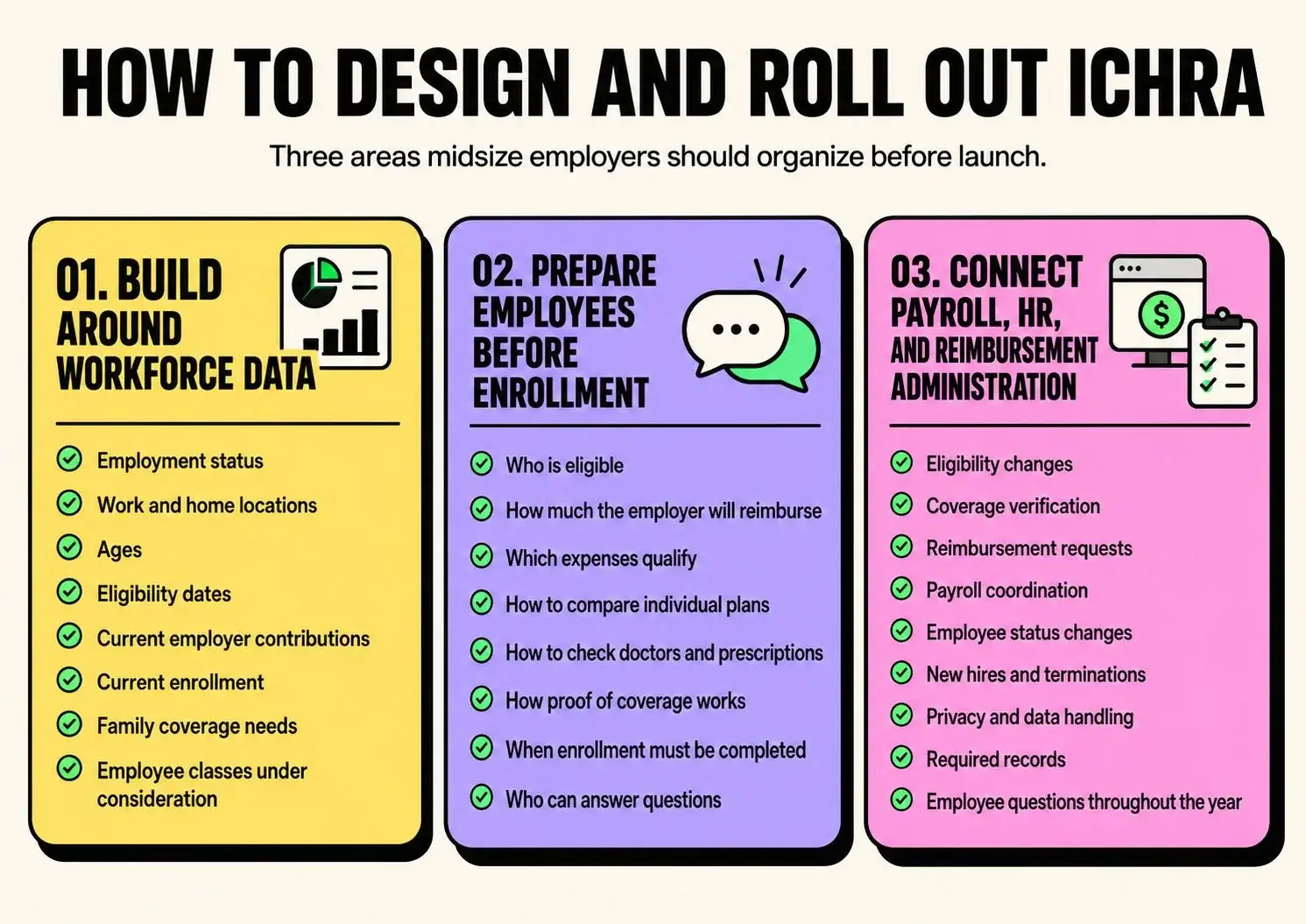
A successful ICHRA rollout requires more than announcing a reimbursement amount during open enrollment. The employer must coordinate plan design, affordability, employee communication, individual enrollment, payroll, coverage verification, and ongoing administration.
Build the Plan Around Real Workforce Data
Start with an accurate employee census that includes:
- Employment status
- Work and home locations
- Ages
- Eligibility dates
- Current employer contributions
- Current enrollment
- Family coverage needs
- Employee classes under consideration
Then review individual-market options and model contribution levels. The full process of setting up ICHRA should also cover plan documents, notices, eligibility rules, reimbursement procedures, and enrollment timing.
Prepare Employees Before Enrollment
Employees should know what is changing and what they need to do well before the new plan year begins. Communication should explain:
- Who is eligible
- How much the employer will reimburse
- Which expenses qualify
- How to compare individual plans
- How to check doctors and prescriptions
- How proof of coverage works
- When enrollment must be completed
- Who can answer questions
Employees currently eligible for ICHRA generally must receive written notice at least 90 days before the plan year begins. Newly eligible employees should receive notice by the date their eligibility starts. HealthCare.gov also explains how accepting or declining an ICHRA may affect Marketplace savings.
Connect Payroll, HR, and Reimbursement Administration
The employer needs a clear process for managing:
- Eligibility changes
- Coverage verification
- Reimbursement requests
- Payroll coordination
- Employee status changes
- New hires and terminations
- Privacy and data handling
- Required records
- Employee questions throughout the year
The right benefits administration tools can help connect these tasks and reduce manual work. Technology alone is not enough. Someone still needs to own the process, solve exceptions, and explain what employees should do when their circumstances change.
Questions to Ask Before Choosing an ICHRA Partner
A broker, administrator, or technology platform should be able to explain more than how reimbursements are submitted. Ask questions such as:
- Who performs and documents affordability calculations?
- Who reviews employee eligibility?
- Who verifies individual coverage?
- What help do employees receive when comparing plans?
- How are reimbursement records connected with payroll?
- What happens when an employee moves or changes classes?
- How are employee documents and personal information protected?
- What reporting support is included?
- Who handles employee questions after enrollment ends?
- What fees are charged beyond the base service?
Employers comparing ICHRA administration software should examine support, compliance workflows, payroll connections, reporting, and employee experience, not just the reimbursement feature.
Not Sure Whether ICHRA Fits Your Workforce?
The most useful ICHRA comparison uses actual workforce data. It should include employee locations, current employer contributions, available individual plans, provider networks, prescription coverage, ACA affordability, payroll processes, and the level of enrollment help employees may need. A company with workers across several states may reach a different conclusion from an employer whose team lives in one market and values its current group network.
The goal is not to choose ICHRA because it sounds more flexible. The goal is to determine which structure gives employees useful coverage while keeping the company’s benefits spending and administration manageable. Benni Agency can help employers compare existing group coverage with possible ICHRA plan options using real workforce and market information.