Small group vs. large group health insurance differs mainly in group size, premium rating, plan flexibility, and ACA duties. Small-group coverage usually serves employers with 1 to 50 employees, though some states set the limit at 100. Large-group plans often provide more room for plan design, funding choices, and rate negotiation.
For employers and HR teams, the right classification affects coverage options, costs, compliance, and benefits planning. This guide explains each difference so you can compare available plans and make a sound choice for your workforce.
Key Takeaways
- Group size sets the market. Small-group coverage usually applies to employers with 1 to 50 employees, though some states use a 100-employee limit.
- Pricing works differently. Small-group rates use regulated factors such as age, location, family size, and tobacco use. Large-group pricing may reflect claims, participation, industry, and plan design.
- Large groups get more plan flexibility. They may choose fully insured, level-funded, or self-funded coverage and offer more network, contribution, and benefit options.
- ACA duties depend on FTE count. Employers near 50 full-time employees, including full-time equivalents, should review ALE rules, reporting duties, affordability, and minimum-value standards.
- The best plan balances cost and employee needs. Compare premiums, deductibles, provider access, prescriptions, employer contributions, HR workload, and expected hiring before choosing coverage.
Key Differences Between Small Group and Large Group Health Insurance
The main differences between small-group and large-group health insurance involve employee count, premium rating, plan choice, funding methods, and employer duties. Small-group plans follow stricter rating rules and often come with set benefit designs. Large-group plans give employers more room to negotiate rates, adjust coverage, and consider self-funded arrangements.
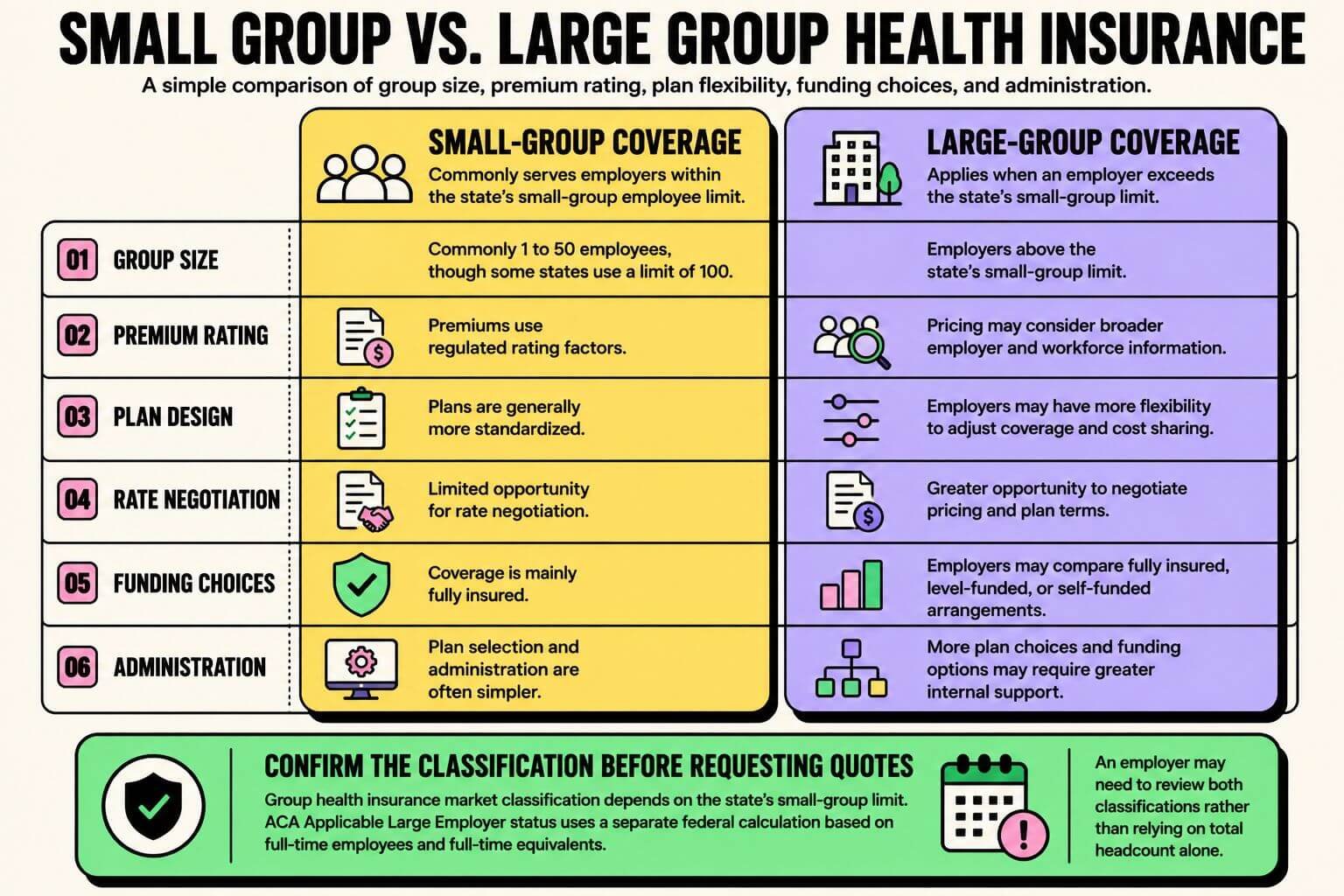
These differences affect your budget, employee choices, renewal planning, and administrative workload.
How Group Size Determines Small or Large Group Coverage
Your workforce size usually determines which insurance market your business enters. Most states define a small employer as a company with 1 to 50 employees, though some states allow businesses with up to 100 employees to use the small-group market. A company above its state’s limit enters the large-group market.
Employee counting rules can differ across insurance programs and ACA requirements. Your total headcount, full-time workforce, part-time hours, ownership structure, and state rules may affect the result. Review your employee numbers before requesting quotes, especially near the 50-employee mark. A correct classification helps prevent inaccurate pricing, plan changes, or compliance problems during enrollment.
What Qualifies as Small Group Health Insurance?
Small-group health insurance commonly covers businesses with 1 to 50 employees. Some states use a limit of 100. SHOP plans usually require at least one eligible employee besides an owner, partner, or certain family members. Employers must offer SHOP coverage to eligible full-time employees and meet applicable participation rules.
What Qualifies as Large Group Health Insurance?
Large-group health insurance applies once an employer exceeds its state’s small-group limit. In many states, that means more than 50 employees. This insurance classification is separate from ACA Applicable Large Employer status, which uses an average of at least 50 full-time employees, including full-time equivalents, during the prior year.
How Small and Large Group Health Insurance Costs Differ
Small-group and large-group plans use different methods to set premiums. Small-group carriers rely on regulated rating factors. Large-group carriers may review broader workforce and plan information, creating more room for negotiation and plan changes.
Your company should compare more than the monthly premium. Look at:
- Employer and employee contributions
- Deductibles, copays, and coinsurance
- Provider and hospital networks
- Prescription coverage
- Expected enrollment
- Renewal history
- Administrative fees
- Funding risk
One customer described the benefits process as smooth and manageable from start to finish. The team remained knowledgeable and responsive, helping the business review its options and find practical solutions without making the process feel overwhelming. Group size does not guarantee a lower price. KFF reported that average employer-sponsored family coverage reached $26,993 in 2025, with workers contributing an average of $6,850. Actual costs differ by plan, workforce, location, and contribution strategy
How Small-Group Premiums Are Rated
Small-group premiums can vary based on age, tobacco use, family size, and geographic area. Federal rules limit adult age variation to a 3-to-1 ratio and tobacco variation to 1.5-to-1, subject to state rules. A company’s past medical claims do not set individual small-group rates under these market-rating rules.
How Large-Group Premiums Are Underwritten
Large-group carriers may review employee demographics, participation, industry, location, plan design, and prior claims data. A larger risk pool can give employers more pricing options, yet poor claims performance may raise renewal costs. Employers can adjust contributions, networks, deductibles, or funding methods to manage the total plan expense.
How Plan Customization and Flexibility Compare
Small-group plans often offer a defined menu of carrier-approved options. Large groups may have greater control over benefits, cost sharing, networks, and funding. That extra control can help an employer build coverage around employee needs, but it requires closer review and ongoing plan management.
For example, a 20-person company may choose from several set plans offered by a carrier. A 200-person employer may request different deductibles, add multiple plan choices, select a narrower network, or explore self-funding. Employers should compare available group health insurance options based on workforce needs, budget, risk tolerance, and HR capacity. Focus on usable coverage, not the longest benefit list. Employees gain more value from plans they can afford and use locally.
Coverage Options for Small Groups
Small employers can offer one plan or several plans through an insurer or SHOP. Common choices vary by deductible, provider network, premium level, and employee cost sharing. The options are often easier to compare and administer, yet employers may have less control over custom benefits, carrier pricing, or contract terms.
Coverage and Funding Options for Large Groups
Large employers may choose fully insured, level-funded, or self-funded medical coverage. They may offer several health plans, adjust provider networks, set contribution tiers, and add benefits such as dental, vision, disability, or group universal life insurance. More choices can help serve employees with different needs, but they may increase reporting, vendor management, and enrollment work.
Which ACA Requirements Apply to Small and Large Employers?
ACA duties depend on your full-time employee and full-time-equivalent count, not your health insurance market label alone. A business can fall within its state’s small-group insurance market yet qualify as an Applicable Large Employer under federal rules.
Employers should check:
- Their average monthly workforce from the prior calendar year
- Full-time employees working at least 30 hours per week or 130 hours per month
- Part-time hours used in the FTE calculation
- Coverage affordability and minimum-value standards
- Annual ACA reporting duties
Reviewing these figures before renewal helps your HR team identify reporting duties, plan costs, and possible penalties. It can also prevent a company near 50 FTEs from relying on headcount alone.
Requirements for Small Employers
Employers below 50 full-time employees, including FTEs, are not subject to the ACA employer mandate. They may still offer group coverage through SHOP or another insurer. SHOP commonly requires coverage for all eligible full-time workers and 70% participation. Some qualifying employers with fewer than 25 FTEs may receive a tax credit.
Requirements for Applicable Large Employers
An Applicable Large Employer averaged at least 50 full-time employees, including FTEs, during the prior calendar year. ALEs face employer shared-responsibility and reporting rules. Each ALE member must file Forms 1094-C and 1095-C and provide coverage information to full-time employees. Penalties may apply when required coverage standards are not met.
Small Group vs. Large Group Health Insurance: Pros and Cons
Neither structure is automatically better. Your employee count determines the market, yet each structure brings different budget and plan-management effects.
| Group type | Pros | Cons |
| Small group | Simpler plan selection, regulated rating rules, easier administration, possible SHOP tax credit | Less rate negotiation, fewer custom plan features, costs may vary by employee age |
| Large group | More plan-design choices, broader funding options, stronger negotiating position | More compliance work, greater administrative demands, claims can affect future costs |
A small company may value predictable plan choices and a lighter HR workload. A larger employer may prefer several networks, contribution levels, or funding arrangements. The practical goal is to balance employee access, total cost, and administrative capacity, rather than judging the plan by premium alone.
How to Choose the Right Health Plan for Your Group Size?
Start by confirming your state’s group-size rules and calculating your ACA full-time-equivalent count. Next, compare plans using employee needs and total employer cost. Use this checklist:
- Review employee locations, ages, and family coverage needs
- Confirm preferred doctors, hospitals, and prescription access
- Compare premiums, deductibles, copays, and out-of-pocket limits
- Set an employer contribution your business can maintain
- Check carrier participation and enrollment rules
- Estimate the HR time needed for enrollment and reporting
- Review expected hiring before the next renewal
- Compare fully insured, level-funded, or self-funded options available to your group
One employer said the team made the benefits process feel simple and well organized for the entire staff. Clear explanations helped employees understand their options and gave the employer greater confidence during the decision-making process.
For example, a 45-person employer planning to hire ten workers should review current quotes and future ALE duties. Benni Agency can help compare plan structures, costs, networks, and employer contribution options based on the company’s current size and hiring plans.
Is Group Life Insurance Worth It for Your Small Business?
Group life insurance may be worth offering if you want a useful employee benefit without committing to a high monthly cost. It can give workers basic protection and make your benefits package more competitive. The best fit depends on your budget, employee interest, payroll setup, and the coverage options available in your market.
A common approach is to fund a modest base benefit and let employees purchase extra coverage. Review costs, tax rules, participation requirements, and continuation options before choosing a plan. A clear plan with simple enrollment and communication can provide real value to both your business and your employees.
One thought on “Small Group Vs Large Group Health Insurance”
Comments are closed.