Tow truck insurance differs from ordinary commercial auto insurance because the job involves more than driving a company vehicle. A towing operator may be responsible for a customer vehicle during transport, while it is stored on a lot, or both. The insurance program therefore has to account for those customer vehicles along with the company’s trucks, drivers, premises, contracts, storage practices, and workforce.
For North Charleston towing companies, the right coverage structure depends on the equipment and services actually provided, not a generic policy checklist. This guide is for towing company owners and operators who want to understand the main coverage questions to raise before requesting a quote or reviewing a renewal.
Key Takeaways
- Commercial auto liability addresses covered third-party injury and property-damage claims, but it should not be assumed to cover customer vehicles being towed or stored.
- On-hook towing coverage generally addresses customer vehicles during transport, while garage keepers coverage focuses on customer vehicles kept at a covered storage location.
- Towing services seeking placement on the South Carolina Highway Patrol rotation list must review Regulation 38-600 insurance and operating requirements by wrecker class.
- South Carolina workers’ compensation requirements are separate from towing insurance and can depend on employee count, exemptions, and the company’s actual workforce structure.
- Accurate truck, driver, service, storage-lot, claims, and contract information makes tow truck insurance quotes easier to compare on consistent terms.
Why Tow Truck Insurance Is Different
Every towing company needs to protect its own vehicles and address liability to other people and property. The distinctive exposure is the customer vehicle. A standard commercial auto policy may not provide the same protection for a customer vehicle being towed or stored that it provides for the towing company’s own truck. Coverage depends on:
- Policy wording
- Covered vehicles
- Endorsements
- Exclusions
- Limits
- Deductibles
- Services performed
That is why towing insurance programs commonly coordinate commercial auto coverage with on-hook towing coverage and, when customer vehicles are stored, garage keepers coverage. The goal is not to purchase every available coverage. It is to match insurance to the different handoff points in the operation:
- Vehicle pickup
- Loading
- Transport
- Recovery work
- Storage
- Release to the owner
- Roadside assistance
Each stage can create a different coverage question.
Core Coverages to Review
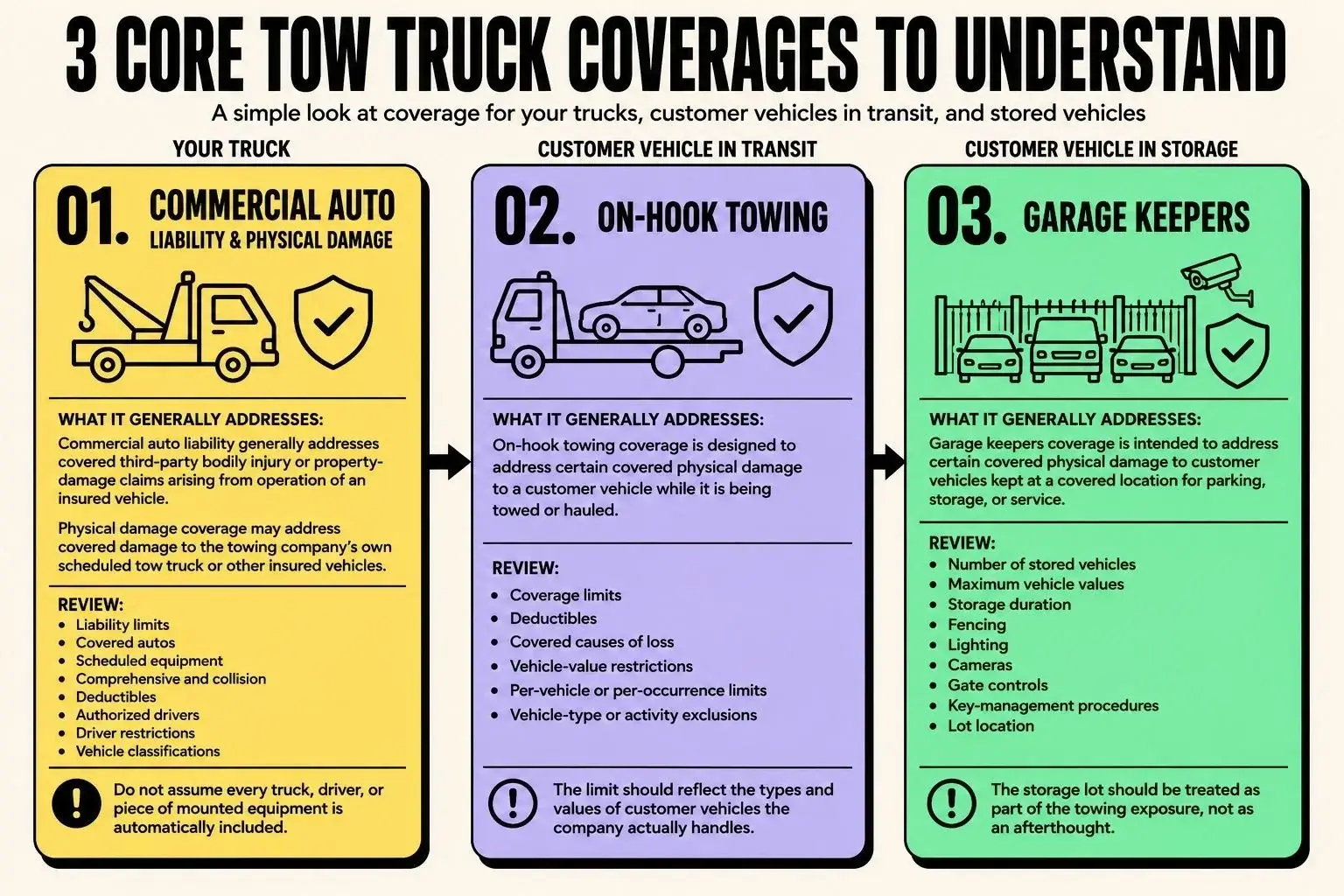
Commercial Auto Liability and Physical Damage
Commercial auto liability generally responds to covered third-party bodily injury or property damage arising from the operation of an insured vehicle. Physical damage coverage can address covered damage to the towing company’s own wrecker or other scheduled vehicles. Review:
- Liability limits
- Covered autos
- Scheduled equipment
- Comprehensive and collision coverage
- Deductibles
- Authorized drivers
- Driver restrictions
- Vehicle classifications
- Business-use limitations
Do not assume every truck, driver, or piece of mounted equipment is automatically included simply because a commercial auto policy exists.
On-Hook Towing Coverage
On-hook towing coverage is designed to address certain covered physical damage to a vehicle the towing company does not own while that vehicle is being towed or hauled. Review:
- Coverage limits
- Deductibles
- Covered causes of loss
- Vehicle-value restrictions
- Whether limits apply per vehicle or occurrence
- Exclusions for certain vehicle types or activities
The chosen limit should reflect the kinds and values of customer vehicles the company actually handles rather than an arbitrary standard amount.
Garage Keepers Coverage
Garage keepers coverage is intended to address certain covered physical damage to customer vehicles kept at a covered location for parking, storage, or service. Relevant underwriting details may include:
- Number of customer vehicles typically stored
- Maximum vehicle values
- Storage duration
- Fencing
- Lighting
- Cameras
- Gate controls
- Key-management procedures
- Lot location
- Other security practices
A storage lot should be treated as part of the towing exposure, not as an afterthought to the trucks themselves.
General Liability, Workers’ Compensation, and Excess Liability
General liability can address certain covered third-party claims that do not arise directly from operating a vehicle. Workers’ compensation and employers’ liability should be reviewed separately based on the company’s workforce structure and applicable South Carolina requirements. An umbrella or excess liability policy may also deserve discussion when customer contracts, municipalities, property owners, lenders, or other agreements require limits above the primary policies. The underlying policies and limits still have to meet the excess insurer’s requirements.
South Carolina Highway Patrol Rotation-List Requirements
A towing company seeking placement on the South Carolina Highway Patrol wrecker rotation list has additional requirements to review. The South Carolina Highway Patrol wrecker regulations explain Regulation 38-600, which addresses wrecker classes, insurance requirements, inspections, storage, applications, and other operating responsibilities. These rules are specific to rotation-list participation. They are not a complete insurance recommendation for every North Charleston towing business.
A towing company may also face separate insurance requirements from:
- Customer contracts
- Municipal agreements
- Property owners
- Lenders
- Commercial clients
- Other applicable rules
SCHP Rotation-List Insurance Minimums
| Wrecker Class | Vehicle Weight | Liability on Wreckers & Premises | In-Transit Coverage | Garage Keepers |
| Class A | 7,000 lbs. or less | $300,000 | $75,000 | $100,000 |
| Class B | 7,001 to 17,000 lbs. | $500,000 | $150,000 | $200,000 |
| Class C | Over 17,000 lbs. | $750,000 | $250,000 | $200,000 |
Insurance limits are only one part of the regulation. The rules also address annual applications, inspections, storage conditions, equipment, and other operational requirements. Confirm current SCHP wrecker rotation requirements with the South Carolina Department of Public Safety before relying on the table for an application or renewal.
North Charleston: Keep the Local Analysis Operational
A North Charleston address does not, by itself, determine a tow truck insurance limit or premium. The more meaningful questions are operational:
- Does the company participate in an SCHP rotation zone?
- Which wrecker classes does it operate?
- What types of customer vehicles are handled?
- Are vehicles stored after towing?
- How secure is the storage lot?
- What services are performed besides towing?
- What limits do contracts require?
- Are repossession or recovery services performed?
These details provide a more reliable basis for an insurance review than assumptions about local demand or pricing. For a broader overview of Benni Agency’s local services, see North Charleston business insurance.
What Affects Tow Truck Insurance Cost?
There is no dependable flat price for tow truck insurance. Premiums can vary based on factors such as:
- Truck type
- Truck value
- Number of vehicles
- Driver records
- Driving experience
- Claims history
- Towing services performed
- Customer vehicle values
- Storage exposures
- Coverage limits
- Deductibles
- Contract requirements
- Wrecker classifications
A price quoted in a national article or advertisement should not be treated as a North Charleston insurance quote. When comparing proposals, make sure they are based on the same operational information and comparable limits. A lower premium can sometimes reflect:
- Lower coverage limits
- Higher deductibles
- Narrower covered causes of loss
- Different vehicle schedules
- Different customer-vehicle coverage
- Different endorsements or exclusions
Price makes more sense when the underlying coverage terms are compared first.
Prepare for a More Useful Quote
Organizing information before requesting a quote can make proposals easier to compare accurately.
Vehicle Information
Prepare a vehicle schedule showing:
- Year
- Make
- Model
- VIN
- GVWR
- Wrecker class
- Current value
- Installed equipment
Driver Information
Have current driver information available, including motor vehicle records when requested by the insurer or broker. Changes in drivers should also be reported when required by the policy or insurer.
Service Details
Describe the actual services performed, including:
- SCHP rotation work
- Private-property towing
- Repossessions
- Roadside assistance
- Accident recovery
- Heavy recovery
- Customer vehicle storage
- Other specialized towing activities
A general description such as “tow truck company” may not provide enough information for accurate underwriting.
Storage Information
Prepare details about the storage lot, including:
- Address
- Capacity
- Security measures
- Fencing
- Lighting
- Cameras
- Gate controls
- Average number of stored vehicles
- Typical and maximum customer vehicle values
Current Insurance and Loss Information
Gather:
- Current declarations pages
- Vehicle schedules
- Policy endorsements
- Prior loss information
- Loss runs when available
- Existing deductibles
- Current coverage limits
Contract Requirements
Bring any insurance requirements contained in:
- Rotation-list applications
- Municipal contracts
- Commercial customer agreements
- Property leases
- Lender agreements
- Other towing contracts
This helps identify required limits and endorsements before proposals are compared.
Coverage Gaps to Check Before Renewal
Assuming Commercial Auto Covers Customer Vehicles
Commercial auto insurance should not automatically be treated as coverage for customer vehicles. Confirm how the policy responds while a customer vehicle is being:
- Loaded
- Towed
- Hauled
- Recovered
- Stored
Using an On-Hook Limit That Does Not Match the Vehicles You Tow
Compare the on-hook limit and deductible with the actual customer vehicles the business handles. A company towing higher-value vehicles may have a different exposure from one primarily handling older passenger vehicles.
Treating the Storage Lot as an Afterthought
Garage keepers coverage should reflect actual customer vehicle inventory and storage conditions. Review both average and maximum vehicle counts and values rather than relying solely on ordinary daily inventory.
Missing Hired or Non-Owned Auto Exposure
Ask how the insurance program responds if the company uses:
- Rented vehicles
- Leased vehicles
- Borrowed vehicles
- Other non-owned vehicles
Do not assume the existing commercial auto form automatically addresses every situation.
Overlooking Workforce Changes
A company’s workers’ compensation obligations can change as staffing changes.
Employee count, worker classification, and available exemptions should be reviewed rather than relying on assumptions made when the business first opened.
Workers’ Compensation: Confirm the Rule That Applies to You
The South Carolina Workers’ Compensation Commission employer FAQ states that, as a general rule, businesses regularly employing four or more employees in South Carolina must maintain workers’ compensation coverage. Part-time workers and family members count as employees for this general rule. The Commission also lists exemptions, so headcount alone does not provide a complete legal analysis. It also explains that paying someone through a 1099 does not, by itself, determine independent-contractor status or remove a potential workers’ compensation obligation. Towing companies should confirm the current rule when:
- Employee count changes
- Family members begin working in the business
- Contractors are added
- Driver relationships change
- The business grows
Do not assume a one-truck operation is automatically exempt based only on the number of tow trucks it owns.
How Benni Agency Can Help
Benni Agency provides business and commercial insurance for South Carolina businesses, including coverage areas that may form part of a coordinated towing insurance program. For a towing operation, the discussion should begin with:
- Trucks
- Drivers
- Wrecker classes
- Services performed
- Customer vehicle exposures
- Storage practices
- Claims history
- Workforce
- Contracts
- Required limits
Those facts can then be compared with available policy forms, exclusions, endorsements, limits, and deductibles. The goal is to understand how each part of the towing operation is insured rather than relying on a single “tow truck insurance” label.