Employers that sponsor a 401(k), group health plan, or another employee benefit plan may give certain people fiduciary responsibilities under federal law. Fiduciary liability insurance can help address covered claims alleging that those responsibilities were mishandled. It is not the same as an ERISA fidelity bond, and neither replaces careful plan governance. This guide explains who may be a fiduciary, what coverage may address, where exclusions commonly arise, and what Mount Pleasant employers should examine before choosing a policy.
Key Takeaways
- Fiduciary status depends on a person’s functions and authority, not only a job title.
- Policies may cover defense costs and covered losses from alleged fiduciary breaches, subject to their terms.
- Fiduciary liability insurance does not satisfy the separate ERISA fidelity-bond requirement.
- Coverage details such as insured plans, defense costs, exclusions, and retroactive dates deserve close review.
- Insurance works best alongside documented plan processes, assigned responsibilities, and regular oversight.
What Is Fiduciary Liability Insurance?
Fiduciary liability insurance is management liability coverage designed for claims involving the administration or management of employee benefit plans. Depending on the policy, insureds may include the sponsoring organization, the plan, and individual fiduciaries. Covered plans may include retirement and health or welfare plans, but employers should confirm the policy’s definitions and schedule of plans. The Employee Retirement Income Security Act of 1974 (ERISA) sets standards for many private-sector employee benefit plans. ERISA does not apply to every arrangement. Governmental and certain church plans, for example, are generally outside its scope. Employers should determine which rules apply to their specific plans with qualified benefits and legal professionals.
Who May Be an ERISA Fiduciary?
Fiduciary status is based on the authority a person has or exercises. Someone may be a fiduciary if that person has discretionary authority over plan management or administration, controls plan assets, or provides investment advice for compensation. The Department of Labor’s fiduciary guidance explains these functions and the related duties.
Depending on how a plan is operated, fiduciary roles may involve:
- Selecting or monitoring plan investments and service providers
- Interpreting plan terms when discretion is required
- Controlling or managing plan assets
- Serving on a benefits or retirement-plan committee
- Acting as a named fiduciary or plan administrator
Not every benefits-related decision is fiduciary in nature. Decisions to establish, amend, or terminate a plan are generally business, or “settlor,” functions. Fiduciary duties arise when eligible individuals carry out plan-management or administrative functions governed by ERISA.
What Fiduciary Liability Insurance May Cover
Coverage varies by insurer and policy form. A policy may respond to covered allegations involving imprudent investment selection, failure to monitor plan investments or service providers, conflicts of interest, misleading plan communications, or other breaches of fiduciary duty. It may also address certain errors in administering an insured plan when those errors fall within the policy’s definition of a wrongful act. Potential policy benefits may include defense costs, settlements, or judgments for covered claims. Some forms may also provide limited coverage for specified investigations, penalties where legally insurable, or correction-program expenses. Employers should not assume these features are standard. Sublimits, exclusions, consent requirements, and the way defense costs affect the overall limit can materially change the protection provided.
Common Exclusions and Coverage Gaps
Fiduciary liability policies are not designed to pay every benefits-related loss. Common limitations may involve deliberate fraud, criminal conduct, illegal personal profit, known circumstances, prior claims, bodily injury, property damage, or obligations to fund benefits. Final coverage depends on the actual allegations, facts, endorsements, and applicable law. Outside professionals, including recordkeepers, investment advisers, and third-party administrators, may not be insured under the employer’s policy.
Employers should review contractual risk allocation and verify that service providers maintain appropriate coverage for their own work. Administrative mistakes can also create overlap questions. An incorrect eligibility explanation or missed enrollment may fall under employee benefits liability coverage rather than, or sometimes alongside, fiduciary liability coverage. Benni Agency’s employee benefits liability insurance guide explains that distinction in more detail.
Fiduciary Liability Insurance vs. an ERISA Fidelity Bond
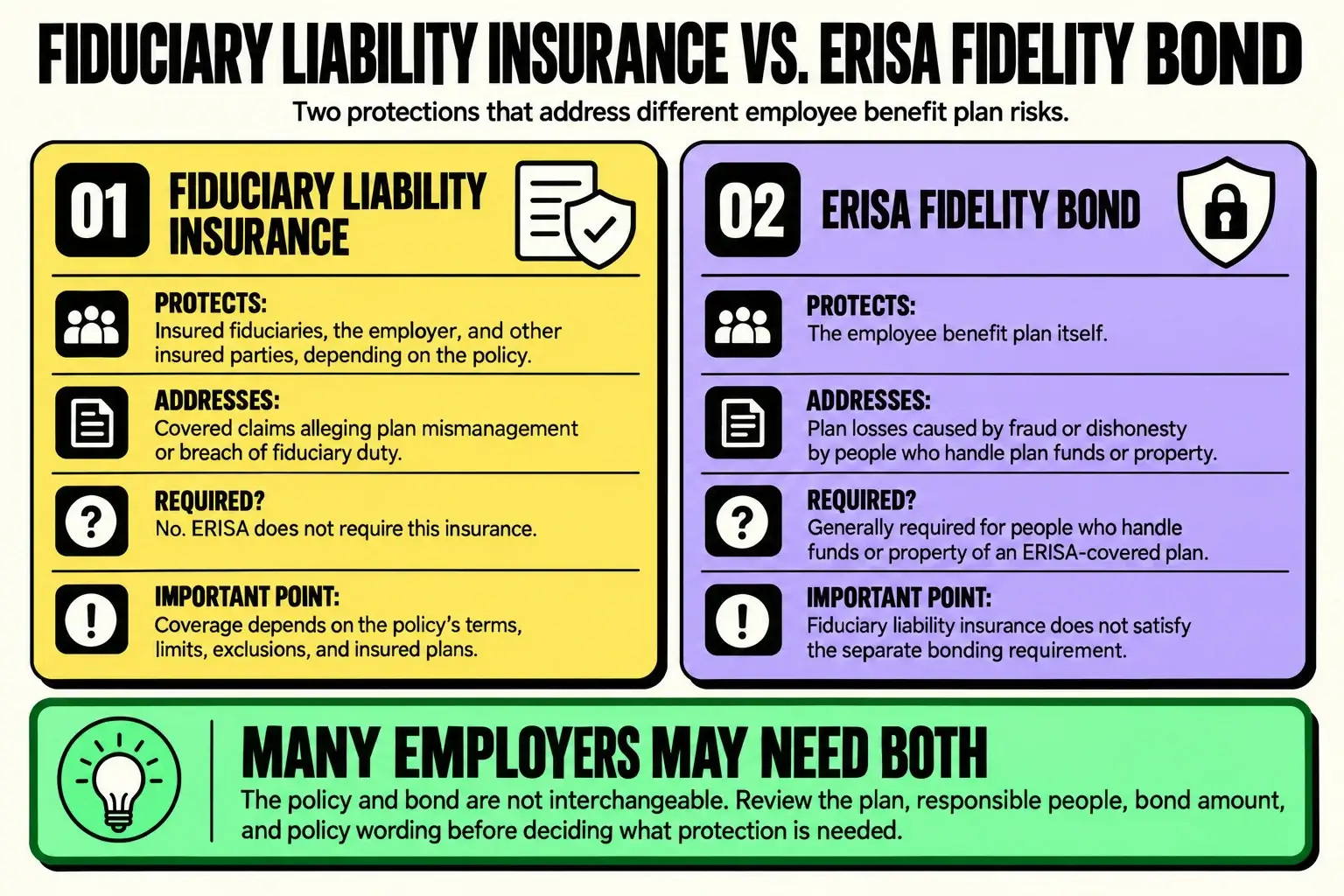
The two products protect against different risks. Fiduciary liability insurance generally protects insured fiduciaries and other insured parties against covered claims alleging breaches of fiduciary responsibility. It is not required by ERISA. An ERISA fidelity bond protects the plan from losses caused by fraud or dishonesty by people who handle plan funds or property. According to the Department of Labor’s ERISA bonding guidance, each plan official generally must be bonded for at least 10% of the funds handled in the preceding year, with a $1,000 minimum.
The usual maximum required amount is $500,000 per plan, or $1 million for qualifying plans that hold employer securities. Exceptions and special rules can apply. Carrying fiduciary liability insurance does not satisfy this bonding obligation. Employers may need both protections because one addresses alleged fiduciary breaches while the other addresses plan losses from fraud or dishonesty.
How to Evaluate Fiduciary Liability Coverage
Begin with the plans, people, and decisions that create the exposure. A useful policy review should address:
- Insureds: Are the employer, plan, committees, and individual fiduciaries included?
- Covered plans: Are all retirement and health or welfare plans correctly listed or defined?
- Limit structure: Do defense costs reduce the policy limit, and are sublimits present?
- Claims-made terms: What are the retroactive date, notice rules, and extended-reporting options?
- Investigations and corrections: Are covered regulatory matters or correction costs included, limited, or excluded?
- Exclusions: Could prior matters, funding obligations, professional services, or other policies create gaps?
- Service providers: What insurance and indemnification terms apply to outside plan professionals?
Premiums and available terms may depend on plan assets, participant counts, plan types, prior claims or investigations, governance practices, requested limits, and retention. A generalized price estimate cannot reliably show what a particular employer will pay.
Reduce Fiduciary Risk Beyond Insurance
Insurance responds only when a matter falls within the policy. Sound governance can reduce preventable errors and help demonstrate a prudent process. Employers can assign responsibilities in writing, document committee meetings, follow plan documents, monitor investments and service providers, review fees, protect plan data, and keep participant communications organized. Outsourcing tasks does not automatically remove an employer’s fiduciary responsibilities. The selection and monitoring of a service provider may itself be a fiduciary function. Employers should understand who holds discretion, what is delegated, and how performance is reviewed.
Reviewing Coverage in Mount Pleasant
The federal fiduciary framework does not change because an employer operates in Mount Pleasant, but the right insurance arrangement remains specific to the employer’s plans and existing coverage. A review should coordinate fiduciary liability with the ERISA bond, employee benefits liability, directors and officers liability, employment practices liability, and any relevant cyber or crime coverage. Benni Agency’s Mount Pleasant insurance and employee benefits page outlines local support, while its business and commercial insurance services include fiduciary liability coverage. Employers can use a policy review to identify which plans and individuals are insured, how limits operate, and where another policy or contract may affect protection.