Broker proposals can look very similar at first. You may see the same carriers, similar plan options, and promises of responsive service. The real differences often appear later, when your team needs help with billing, enrollment, payroll deductions, or an employee question.
To choose a North Charleston benefits broker, compare more than premiums. Look at plan strategy, account service, administration, technology, compensation, and proof of past work. This guide is for local employers and HR leaders who want a clear way to compare brokers and avoid another difficult renewal.
Key Takeaways
- Define your needs before comparing brokers. Review your workforce, budget, renewal date, current plans, and recurring service problems.
- Compare more than insurance quotes. Look at plan strategy, account service, enrollment support, administration, technology, and compensation.
- Ask who will handle your account. The daily service team matters more than the person leading the sales presentation.
- Request proof for major claims. Verify licensing, review relevant references, and ask how service commitments will be tracked.
- Use one scorecard for every candidate. A consistent process makes different proposals easier to compare.
Start With What Your Company Needs
Before requesting quotes, write down what your company needs from a broker. Start with the basic facts:
- Number of eligible employees
- Full-time and part-time employee structure
- Office, remote, and field locations
- Current benefit plans
- Employer contribution amounts
- Renewal date
- Payroll and HR systems
- Enrollment process
- Employee communication needs
Then list the problems your team is already dealing with. Are eligibility changes taking too long? Do payroll deductions fail to match employee elections? Are managers answering benefit questions that should go to the broker? Does renewal arrive without enough time to review the options?
These details give brokers a clearer picture of your company. They also make it harder for a broker to offer a standard proposal that ignores how your business operates. Give every broker the same information. You will get a fairer comparison and fewer proposals built from different assumptions.
What to Compare Between Benefits Brokers
A useful proposal is only one part of the decision. You need to understand how the broker develops recommendations and what happens after you choose a plan.
Plan Strategy and Market Access
A broker should ask about your workforce, budget, goals, and current problems before recommending a plan. The discussion may include:
- Traditional group health insurance
- Employer contribution approaches
- HSA-compatible plans
- Dental and vision coverage
- Voluntary benefits
- Different employee classes
- Carrier networks
- Individual Coverage Health Reimbursement Arrangements, or ICHRAs
- Other funding structures when they fit the company
No single plan structure works for every employer. An ICHRA may make sense for a company that wants to offer individual-plan reimbursements, but it may create new communication or administration needs. A traditional group plan may be familiar to employees, yet network choices or contribution costs may limit its fit.
Ask each broker to explain why the recommendation fits your company. The answer should connect to your employee population, budget, locations, and internal capacity. You should also ask which carriers and plan structures the broker can evaluate. A broad discussion does not always mean the broker has equal access to every option.
Account Service and Year-Round Support
The person presenting the proposal may not be the person managing your account. Ask for the names and roles of the people who will handle:
- Eligibility changes
- Billing questions
- Employee issues
- Carrier escalations
- New-hire enrollments
- Terminations
- Renewal preparation
- Plan reviews during the year
Find out who your main contact will be and who steps in when that person is unavailable. Ask how quickly the team normally responds and how unresolved issues are tracked. A promise of “great service” does not tell you who owns a problem or when you should expect an update.
Year-round service matters. Benefits work continues after open enrollment. Employees get married, have children, move, leave the company, and ask questions about their coverage. Your broker’s service model should account for that work.
Enrollment, Administration, and Technology
Benefits technology can help, but software alone will not fix a weak process. Ask the broker how enrollment information will move between employees, carriers, payroll, and your HR system. Clarify who checks the data and who handles corrections. Review how the broker supports:
- Enrollment setup
- Employee education
- New-hire elections
- Payroll deductions
- Eligibility files
- Billing reconciliation
- Qualifying life events
- Carrier corrections
- Employee questions
A polished enrollment platform may look helpful during a demonstration. The stronger test is what happens when an employee’s deduction is wrong or a carrier does not show the correct coverage.
Ask for a practical example. Who notices the problem? Who contacts the carrier? Who updates payroll? Who tells the employee what is happening? Clear ownership can save your HR team from chasing several vendors for one answer.
Compensation, Licensing, and References
Ask each broker how the firm is paid. Compensation may come through carrier commissions, separate fees, or a combination of payment methods. Ask which services are included and whether implementation, technology, consulting, or administration carries an added charge.
The goal is not to find one ‘correct’ payment model. The goal is to understand what the company pays for and whether compensation could affect the recommendations you receive. You should also:
- Verify the broker’s South Carolina insurance license
- Ask about professional experience
- Request references from employers with similar needs
- Check whether the broker has worked with a company of your size
- Ask whether the reference had similar enrollment or administration needs
A reference from a large national company may not tell a 40-person North Charleston business much about daily service. Look for examples that resemble your company’s size, workforce, or internal HR setup.
Questions to Ask Before You Choose
Use the same core questions during every broker interview. Consistent questions make the answers easier to compare.
Who Will Handle the Account After the Sale?
Ask:
- Who will be our main contact?
- Will the person presenting today stay involved?
- Who handles billing and eligibility problems?
- Who answers employee questions?
- What happens when an issue needs to be escalated?
- Is there a backup contact?
- How are open issues recorded and followed?
Listen for clear names, roles, and steps. Vague answers may mean the service structure has not been defined.
What Happens Outside Renewal Season?
Ask:
- How often will we review the plan during the year?
- What reports will you provide?
- How do you help with employee communication?
- Who manages carrier problems?
- How do you support new hires and employee changes?
- What happens if we add a location or employee class?
- When does renewal planning begin?
A broker should be able to describe the work between enrollments, not only the renewal presentation.
How Will Results Be Reviewed?
Ask how the broker measures its own work.
Possible measures may include:
- Response times
- Open service issues
- Enrollment completion
- Billing corrections
- Employee communication activity
- Renewal preparation
- Progress on agreed priorities
Not every result can be reduced to one number. Still, the broker should be able to show what was completed, what remains open, and what the company should prepare for next.
Red Flags That Deserve a Closer Look
One concern may not rule out a broker. Several warning signs together should lead to more questions. Watch for these issues:
- Recommendations come before discovery. The broker starts discussing plans without learning how your workforce operates.
- The conversation focuses almost entirely on premiums. Cost matters, but a low quote does not explain administration, service, or employee support.
- No daily service team is identified. You meet the salesperson but cannot learn who will manage the account.
- Compensation is unclear. The broker avoids explaining commissions, fees, or added costs.
- Technology claims stay vague. You see a platform demonstration but receive no explanation of payroll files, corrections, or issue ownership.
- Every company receives the same recommendation. The broker promotes one plan model without discussing trade-offs.
- References do not match your business. The examples come from companies with very different employee counts or service needs.
- There is no transition plan. The broker cannot explain what information, forms, or system work will be needed after the decision.
A strong broker should be comfortable explaining both the advantages and limits of a recommendation.
Compare Final Proposals on the Same Scorecard
Presentations can make two very different service models look equal. A simple scorecard keeps the decision focused on what your company needs. Rate each broker from one to five across areas such as:
- Plan strategy
- Carrier and market access
- Account-team experience
- Year-round service
- Employee support
- Enrollment and administration
- Payroll or HR system coordination
- Compensation clarity
- References
- Transition planning
- Understanding of your workforce
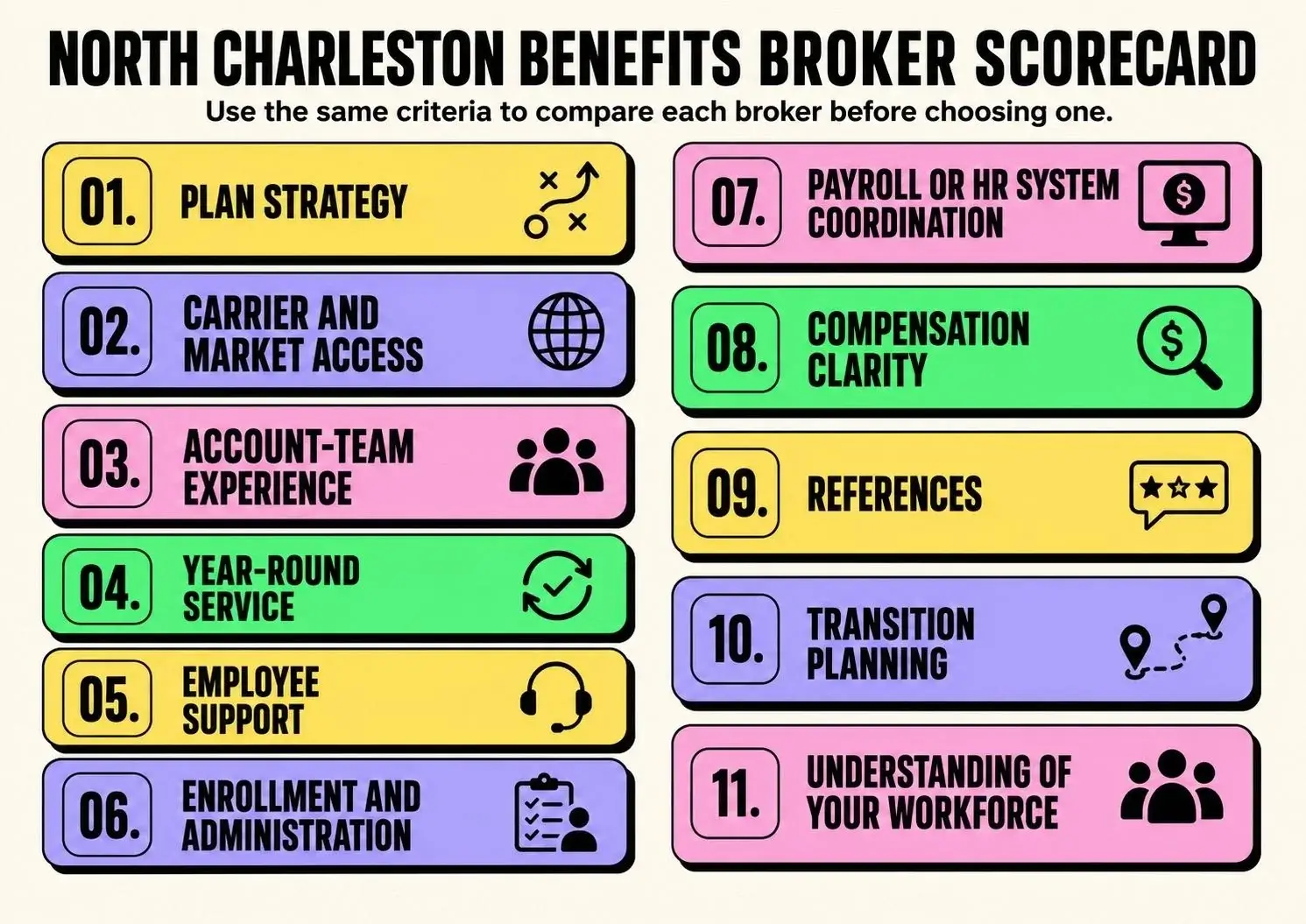
You do not need a complicated procurement process. A basic spreadsheet can work. Ask the people involved in the decision to score the brokers separately before discussing the results. This can reveal where the group agrees and where someone heard a promise differently.
Price should remain part of the review. It should not erase weak service, unclear responsibilities, or a recommendation that does not fit your employees.
What Local Experience Should Mean in North Charleston
A nearby office does not automatically prove that a broker understands local employers. North Charleston businesses may employ office teams, healthcare workers, hospitality staff, production employees, technical specialists, drivers, and shift-based workers. Those groups may need different enrollment schedules, communication methods, network choices, and employee support.
May 2025 data from the U.S. Bureau of Labor Statistics shows that office and administrative support represented 11.7% of Charleston-area employment. Food preparation and serving represented 11.5%, while transportation and material moving represented 8.1%.
That mix matters. A benefits meeting held during office hours may work for an administrative team but miss employees working shifts or moving between locations. A broker should ask:
- How do your employees receive company information?
- Can they attend live enrollment meetings?
- Do they have regular computer access?
- Are employees spread across several work locations?
- Which provider networks are practical for them?
- How much benefit education do they need?
The right approach to North Charleston benefits can vary based on employee schedules, locations, contribution goals, and the amount of enrollment help your company needs. Local knowledge should lead to better questions and a more workable process. It should not be limited to adding the city name to a proposal.
A Practical Next Step Before Your Next Renewal
Choosing a broker does not have to start with a full proposal or a decision to switch. Begin by reviewing your current plan, renewal date, employee count, contribution approach, and the service problems your team already handles. Look at what happens between renewals.
Who manages eligibility changes, billing questions, enrollment problems, and employee requests? Where are payroll, HR, or managers filling gaps that should have a clear owner? That review gives you a better list of questions for every broker you interview. It may show that the main issue is plan design, account service, technology, employee communication, or a mix of several problems.
Benni can review the current setup with North Charleston employers and explain the available trade-offs without assuming that every company needs the same plan. A brief conversation can help you identify what to compare before your next renewal.