Independent contractors often have more control over when, where, and how they work, but health coverage usually comes with more personal responsibility. Unlike W-2 employees, contractors generally arrange their own insurance instead of automatically receiving employer-sponsored benefits. Health insurance for 1099 employees may come from the ACA Marketplace, eligible family coverage, or another individual policy.
Employers may also want to support contractors with healthcare costs. However, worker classification, plan eligibility, and tax treatment can affect what type of arrangement is appropriate. This guide is for independent contractors and employers who want to understand how contractor health coverage works and what to review before choosing an approach.
Key Takeaways
- 1099 contractors generally arrange their own health insurance rather than automatically joining an employer plan.
- Coverage may come from Marketplace plans, eligible family coverage, private individual insurance, Medicaid, or CHIP.
- Businesses should confirm worker classification and plan eligibility before offering contractor health support.
- ICHRA and QSEHRA are employee-focused arrangements and should not automatically be extended to true independent contractors.
- Eligible self-employed contractors may qualify for the self-employed health insurance deduction or an HSA.
- Contractors should compare total costs, provider access, prescriptions, and possible Marketplace savings before enrolling.
How Does Health Insurance for 1099 Employees Work?
A 1099 contractor typically secures health coverage independently rather than enrolling automatically in the company’s employee health plan. Freelancers, consultants, and other qualifying self-employed individuals can generally shop for individual coverage through the Health Insurance Marketplace.
Depending on the contractor’s situation, coverage may come from an ACA Marketplace plan, a spouse or family member’s eligible plan, or another individual policy. Marketplace applicants may also qualify for financial assistance based on household information and applicable eligibility rules. For businesses, health benefits can also intersect with worker classification. Employers should confirm that a worker is properly classified before creating a contractor benefit arrangement.
What Is a 1099 Contractor, and How Is That Different From a W-2 Employee?
A 1099 contractor is generally self-employed, while a W-2 employee works as an employee of the business. Worker status is not determined simply by the form a company issues. The actual working relationship, including control, financial arrangements, and other factors, can matter.
Independent Contractor vs. Employee Status
A worker does not automatically become an independent contractor because a company calls the person one or issues Form 1099-NEC. Employers should look at how the person actually performs work and how the relationship operates. This distinction matters because employees and contractors generally handle taxes, benefits, and health coverage differently. Employers that are unsure about classification should resolve that question before deciding how to structure benefits.
Why Benefits Can Matter in Worker Classification
Providing a benefit does not automatically make a contractor an employee. However, employee-type benefits such as insurance, retirement benefits, vacation pay, or sick pay can be relevant to the overall relationship. Employers should therefore avoid treating health coverage as a simple add-on. Classification, plan eligibility, and the proposed payment structure should be reviewed together.
What Health Insurance Options Are Available to 1099 Contractors?
Independent contractors have several potential paths to coverage. The best fit can depend on income, household needs, location, preferred providers, prescriptions, and whether other coverage is available.
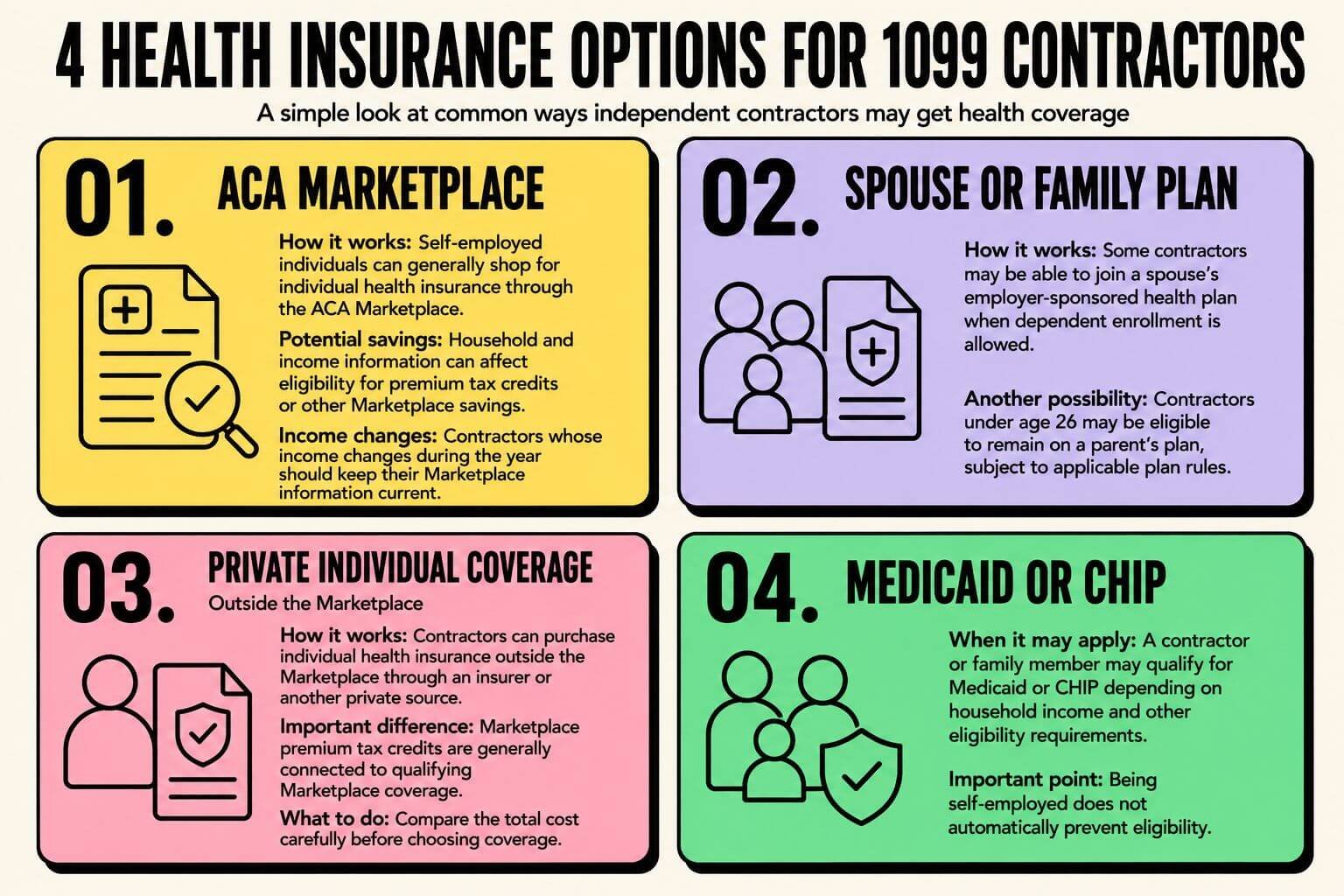
ACA Marketplace Health Insurance
Self-employed individuals can generally shop for individual health insurance through the ACA Marketplace. Household and income information is used to determine whether a person qualifies for premium tax credits or other savings. Contractors whose income changes during the year should keep their Marketplace information current. This is especially important for freelancers and business owners whose earnings may vary from month to month.
Coverage Through a Spouse or Family Member
Some contractors can join a spouse’s employer-sponsored health plan if the plan permits dependent enrollment. Contractors under age 26 may also be eligible to stay on a parent’s plan, subject to applicable plan rules.
Individual Coverage Outside the Marketplace
Contractors can purchase individual insurance outside the Marketplace through an insurer or other private source. However, Marketplace premium tax credits are generally connected to qualifying Marketplace coverage, so the total cost should be compared carefully.
Medicaid or CHIP When Eligible
Depending on household income and other eligibility requirements, a contractor or family member may qualify for Medicaid or CHIP. Self-employment alone does not automatically prevent eligibility.
Can a Business Offer or Help Pay for Health Insurance for 1099 Contractors?
Businesses that depend on contractors may want to help with healthcare costs. Employers often feel uncertain here because they want to support valuable workers without creating an arrangement that conflicts with classification or plan rules.
Group Health Plan Eligibility Depends on the Plan
Employers should not assume a contractor can automatically join the same group plan offered to W-2 employees. Plan eligibility, carrier requirements, and worker classification should be reviewed first.
ICHRA and QSEHRA Rules Apply to Employees
An Individual Coverage HRA can reimburse eligible employees for individual health insurance premiums and other qualifying medical expenses. Employers comparing alternatives to traditional group insurance can learn about Individual Coverage HRA options. A true independent contractor, however, should not automatically be treated as eligible for an employee ICHRA or QSEHRA. Employers should keep employee benefit arrangements separate from contractor support unless eligibility has been properly confirmed.
Review Payment and Tax Treatment Before Funding Coverage
If a company wants to provide financial support for a contractor’s healthcare costs, it should review how the payment will be structured and reported.
“One customer described receiving clear explanations and patient support throughout the benefits process. That kind of guidance can matter when employers are worried about making the wrong choice, since having questions answered clearly can make a complicated benefits decision feel more manageable.”

Employers can also consider professional benefits consulting support when they need help comparing workforce benefit options before creating an arrangement.
Can 1099 Contractors Deduct Health Insurance Premiums?
Some self-employed contractors may qualify for a self-employed health insurance deduction, but IRS requirements and limitations apply. Contractors should not assume every premium payment automatically qualifies.
Self-Employed Health Insurance Deduction
Eligible self-employed individuals may be able to deduct qualifying health insurance premiums for themselves and certain family members, subject to applicable rules and limits. The IRS provides Form 7206 guidance for calculating the self-employed health insurance deduction. Contractors should review the current requirements or work with a tax professional when their situation is unclear.
Health Savings Accounts
Contractors who meet HSA eligibility requirements may use a Health Savings Account for qualified medical expenses. According to the IRS 2026 HSA contribution limits, the limit is $4,400 for self-only coverage and $8,750 for family coverage. Having 1099 income alone does not make someone HSA-eligible. The contractor must satisfy the applicable coverage and eligibility requirements.
Marketplace Premium Tax Credits
Self-employed contractors purchasing qualifying Marketplace coverage may also be eligible for a premium tax credit based on factors such as household income, family size, and available coverage. The IRS provides Premium Tax Credit guidance covering eligibility and tax reporting. Contractors with changing income should pay attention to these rules because final income can affect the amount of credit allowed.
What Should a 1099 Contractor Compare Before Choosing Health Insurance?
Choosing a plan based only on its monthly premium can create unpleasant surprises later. Contractors should compare the total cost and coverage details before enrolling. Important factors include:
- Monthly premium
- Deductible
- Out-of-pocket maximum
- Copayments and coinsurance
- Doctor and hospital network
- Prescription coverage
- Family coverage needs
- Marketplace savings
- HSA eligibility
A lower-premium plan may require more spending when care is needed, while a higher-premium plan may offer a lower deductible or better provider access. Contractors should think about expected healthcare use and full-year costs rather than focusing only on the monthly price.
What Should Employers Check Before Offering Benefits to 1099 Contractors?
Employers should confirm worker classification before deciding how to provide health-related support. Calling someone a contractor or issuing a 1099 does not, by itself, settle the classification question. Businesses should review:
- Worker classification: Does the relationship reflect true independent work?
- Plan eligibility: Does the carrier or plan allow the proposed participation?
- Benefit structure: Is the arrangement intended for employees or appropriate for contractors?
- Tax treatment: How should payments or financial support be handled?
- Administration: Does the arrangement remain consistent with the contractor relationship?
Companies with W-2 employees can review employer health insurance contributions to understand how traditional employee coverage costs may be shared. They can also review group health insurance differences when considering how workforce size affects benefit decisions.
How Can Employers and Contractors Choose the Right Health Coverage Approach?
The right approach depends on who needs coverage, how the worker is classified, and which options are available. A true independent contractor may find that an individual Marketplace policy offers useful flexibility, particularly when premium tax credits are available. Employers should take a different path. Before offering or helping fund contractor health benefits, businesses should confirm plan eligibility, tax treatment, and worker classification. Employee programs such as ICHRA or QSEHRA should not automatically be applied to independent contractors. A benefits professional can help employers compare coverage structures and explain the differences in plain language. Contractors can compare premiums, provider networks, deductibles, Marketplace savings, and tax considerations before enrolling.
“One customer shared that the benefits process felt seamless for the entire staff because the team explained each step clearly and answered questions in an easy-to-understand way. That experience speaks to an important concern people often have with health benefits: they want enough information to feel confident in their decision without feeling confused or pressured.”

For businesses working with both employees and contractors, Benni Agency can help evaluate health insurance and employee benefit options while keeping each workforce group and its coverage needs clearly defined.