Charleston businesses face a storm-risk question that a standard property policy may not answer by itself: which policy responds to wind, flood, and a forced closure after a coastal storm? The answer depends on the property, insurer, endorsements, deductibles, and the actual cause of damage. Flood and storm surge, for example, are usually handled differently from wind damage.
This guide explains the coverage decisions worth confirming before hurricane season. It is for Charleston business owners, property managers, and operations leaders responsible for protecting commercial property. This is general educational information, not legal, tax, or individualized insurance advice. Coverage depends on the policy language, insurer, property location, and facts of a loss.
Key Takeaways
- Commercial property insurance may cover wind damage, but coastal policies can limit wind coverage or place it under a separate policy or endorsement.
- Flood and storm surge are generally separate coverage issues. Standard commercial property insurance commonly does not cover flood damage.
- A wind, hurricane, or named-storm deductible may be different from the regular property deductible, so review the declarations page and endorsements carefully.
- Business income and extra expense coverage can be important after a covered loss, but the trigger, waiting period, limits, and period of restoration are policy-specific.
- A pre-season review should compare building and contents values, wind and flood coverage, deductibles, business-income limits, and claim-reporting procedures.
Why Storm Coverage Needs a Separate Review in Charleston
Charleston’s coastal setting makes it important to separate the cause of loss rather than treating every storm-related claim as the same event. A hurricane can produce:
- Wind
- Wind-driven rain
- Storm surge
- Inland flooding
- Power loss
- Restricted access
Those conditions may involve different policies, deductibles, exclusions, or endorsements.
The South Carolina Department of Insurance hurricane preparedness guidance identifies strong winds, storm surge, rainfall, and flooding as distinct hurricane-related risks. That distinction is a useful starting point when reviewing commercial property coverage before storm season. For a broader look at commercial property, liability, and related business coverage, review Benni Agency’s commercial insurance coverage options. Businesses can also use Benni Agency’s Charleston insurance resources to review the wider local commercial-insurance context.
What a Commercial Property Policy May Cover, and What It May Not
Commercial property coverage can help repair or replace covered buildings, tenant improvements, equipment, furniture, inventory, and other business personal property after a covered cause of loss. The actual protection depends on:
- Policy form
- Endorsements
- Limits
- Valuation method
- Deductibles
- Exclusions
Some policies use a broader “special causes of loss” form, while others list specific covered causes of loss. A label such as “all risk” should not be interpreted to mean every possible type of damage is covered. Before a Charleston storm, two questions deserve especially clear answers:
- Is wind covered under the primary property policy?
- Is separate flood coverage in place?
Water from a burst pipe is not the same cause of loss as water entering from rising water, storm surge, or overflowing waterways. The latter is generally a flood-insurance issue.
Wind and Hail Coverage
Wind coverage may be included, limited, excluded, or placed separately depending on the commercial property policy and location. The South Carolina Wind and Hail Underwriting Association, often called the Wind Pool, is a residual market that makes wind and hail property insurance available in eligible coastal areas when coverage cannot be obtained in the regular market.
Eligibility is location- and property-specific. Businesses can use the SCWHUA eligibility tool as a starting point and should confirm requirements with the insurer or a licensed insurance professional. A Charleston property owner should not assume that wind coverage is automatically included simply because commercial property insurance is in force.
Flood and Storm Surge Coverage
Standard commercial property insurance commonly excludes flood. Businesses that need protection from flood damage generally obtain a separate National Flood Insurance Program policy or a private flood policy. According to FloodSmart commercial flood insurance information, commercial flood insurance may cover a business building and its contents. NFIP limits can be up to:
- $500,000 for building coverage
- $500,000 for contents coverage
Those limits, deductibles, covered property, exclusions, and private-market options should be compared with the property’s actual values and operations. Storm surge also deserves separate attention. The South Carolina Department of Insurance flood guidance explains that water entering from storm surge is generally treated as a flood-insurance matter rather than wind damage. NFIP policies usually have a 30-day waiting period, subject to exceptions. That makes it important to review flood coverage well before a storm is approaching.
Business Income and Extra Expense Coverage
Physical repairs are only one part of a serious storm loss. Business income coverage may help with lost income and continuing normal operating expenses after a covered direct physical loss. Extra expense coverage may help with certain additional costs incurred to reduce the interruption or continue operations. However, these protections are not automatic in every shutdown scenario. Review the policy for:
- Covered cause-of-loss requirements
- Waiting periods
- Period of restoration
- Coverage limits
- Sublimits
- Exclusions
- Off-site utility interruption
- Civil-authority restrictions
- Temporary relocation expenses
For example, an evacuation order does not automatically mean business income coverage will respond. The policy’s civil-authority wording, physical-damage requirements, time limits, and other conditions matter.
Storm and Hurricane Deductibles: What to Check
A commercial property policy may have one deductible for most covered losses and another for wind, hurricane, or named-storm events. The amount is not standardized. A storm deductible may be expressed as a fixed dollar amount or as a percentage, depending on the policy. More importantly, the policy controls:
- When the special deductible is triggered
- Which property it applies to
- How the amount is calculated
- Whether separate wind coverage has its own deductible
The declarations page and endorsements are the best places to confirm the actual deductible before a loss.
| Review Item | Why It Matters | Where to Verify |
| All-other-perils deductible | This is often the deductible used for non-storm property claims. | Declarations page |
| Wind, hurricane, or named-storm deductible | It may use a different amount or calculation than the regular deductible. | Declarations page and endorsement |
| Event trigger | The policy defines the weather event and conditions that activate the special deductible. | Endorsement language |
| Building and contents values | Coverage adequacy and some deductible calculations may depend on insured values. | Property schedule and valuation documentation |
Knowing that a storm deductible exists is not enough. Business owners should understand what it could mean in actual dollars based on their insured property values.
Storm-Readiness Checklist for Commercial Property
Before hurricane season, use a written review instead of relying only on last year’s renewal conversation.
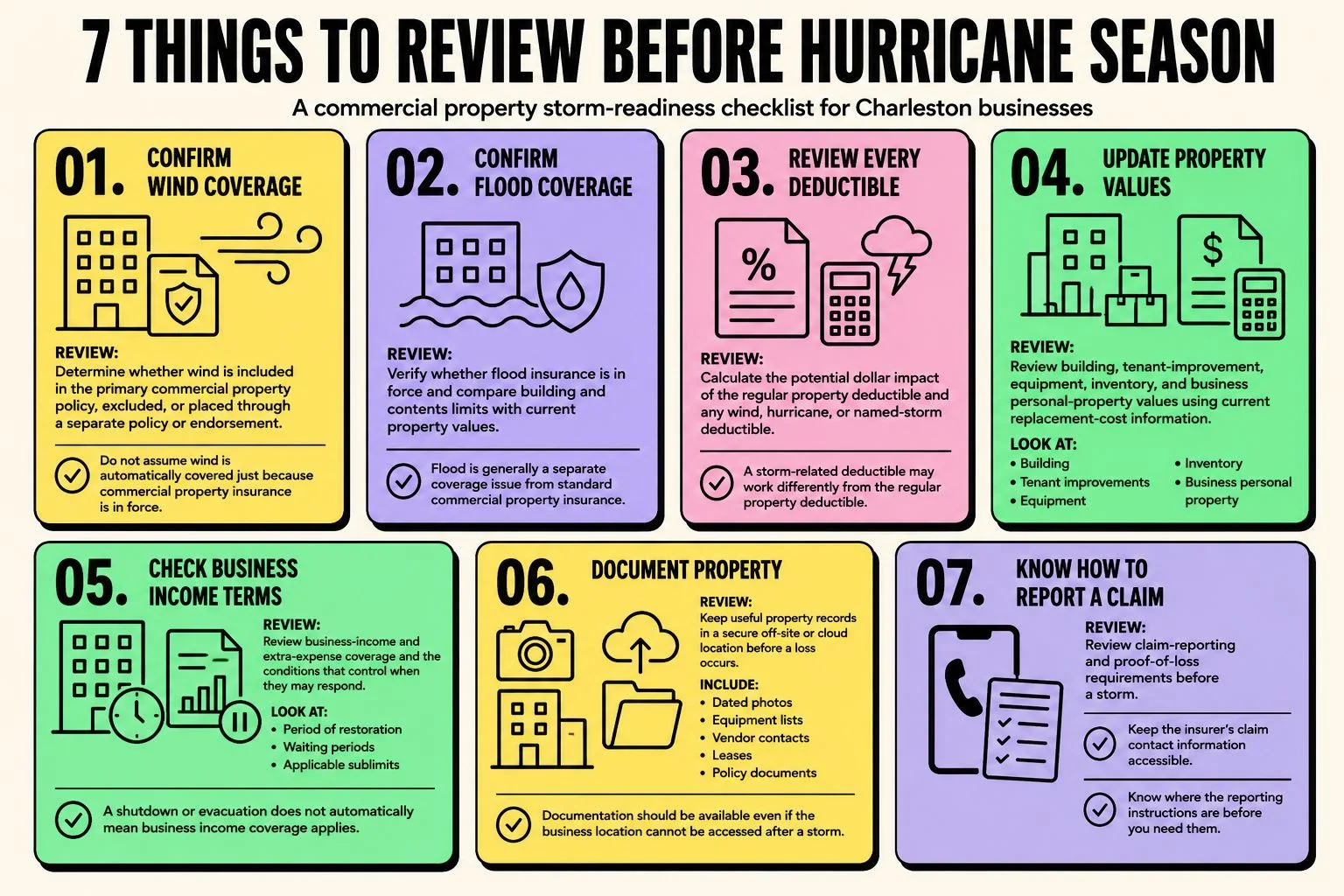
- Confirm wind coverage. Determine whether wind is included in the primary property policy, excluded, or placed through a separate policy or endorsement.
- Confirm flood coverage. Verify whether flood insurance is in force and compare building and contents limits with current property values.
- Review every deductible. Calculate the potential dollar impact of the regular property deductible and any wind, hurricane, or named-storm deductible.
- Update property values. Review building, tenant-improvement, equipment, inventory, and business personal-property values using current replacement-cost information.
- Check business income terms. Review business-income and extra-expense coverage, the period of restoration, waiting periods, and applicable sublimits.
- Document property before a loss. Keep dated photos, equipment lists, vendor contacts, leases, and policy documents in a secure off-site or cloud location.
- Know how to report a claim. Review claim-reporting and proof-of-loss requirements and keep the insurer’s claim contact information accessible.
Businesses can also review Ready.gov business preparedness resources for broader operational planning before severe weather.
Build a Coordinated Coverage Plan
A storm plan is strongest when wind, flood, commercial property, and business interruption coverage are reviewed together. A property policy may address one cause of damage while a flood policy addresses another. Neither policy should be assumed to cover every operational cost connected with a closure. Benni Agency can help business owners review current commercial coverage documents and identify questions to raise with the insurer before storm season. Any coverage recommendation should be based on:
- Property location
- Building and contents values
- Business operations
- Lease obligations
- Lender requirements
- Current endorsements
- Deductibles
- Actual policy terms
The goal is not simply to confirm that a property policy exists. It is to understand which policy may respond to each major storm exposure and where additional review may be needed.
One thought on “Charleston Commercial Property Storm Coverage Guide”
Comments are closed.