Builders risk insurance protects construction projects while work is underway, but the property at risk changes significantly between site preparation, framing, finish work, and occupancy. That makes each construction milestone a useful time to confirm that the policy still matches the project.
For Charleston contractors, developers, and property owners, wind and flood questions may require additional attention because of the area’s coastal exposures. This guide explains what to review at each stage. Actual coverage depends on the policy form, endorsements, project contract, insurer requirements, and facts of any loss.
Key Takeaways
- Builders risk generally protects covered construction property rather than third-party liability or a contractor’s entire business operation.
- Materials in transit or temporary storage should not be assumed covered without checking the policy’s territorial provisions, sublimits, and conditions.
- As a project progresses, the amount and type of property exposed to loss changes, making milestone reviews useful.
- Wind and flood need separate attention on Charleston-area projects because applicable coverage and deductibles can depend on the site and policy.
- Builders risk is temporary coverage, so the handoff to permanent property insurance should be coordinated before a termination event occurs.
What Builders Risk Insurance Is Designed to Cover
Builders risk, sometimes called course of construction insurance, is property insurance designed for buildings and other covered property while construction or major renovation is underway. There is no single universal builders risk form, and many policies are written using inland marine forms rather than standard commercial property forms.
Depending on the specific policy, covered property may include:
- The building or structure under construction
- Materials and fixtures that will become part of the completed project
- Covered materials temporarily stored away from the project site
- Covered materials while in transit
- Certain temporary structures or property used as part of the construction
Off-site storage, transit, temporary works, and particular categories of equipment can have separate limits or conditions. They should be confirmed rather than assumed to be included. Builders risk is also different from liability insurance. It generally addresses covered physical loss to construction property, while third-party bodily injury and property-damage claims are handled through liability coverage.
A contractor’s mobile tools and equipment may also require separate contractors’ equipment or inland marine protection. Construction contracts often determine which party is responsible for arranging builders risk and which project interests need to be protected. Owners, general contractors, subcontractors, lenders, and others may have interests that need to be addressed through the policy or related contract requirements. Businesses working on projects in the area can also review Benni Agency’s commercial insurance options for Charleston businesses for the broader local insurance relationship.
Why Builders Risk Questions Change as Construction Progresses
The insurance policy does not necessarily change automatically every time construction reaches a new stage. What changes is the property exposed to loss and the practical significance of particular provisions. Early in construction, there may be limited installed property but substantial site work and materials awaiting use. During framing and rough-in, the project becomes more exposed to weather, theft, fire, and damage to materials or systems. By finish work, flooring, cabinetry, mechanical systems, fixtures, and other higher-value property may be installed.That progression makes construction milestones useful review points for the policy limit, covered property, deductibles, endorsements, sublimits, storage locations, transit exposures, and project completion date.
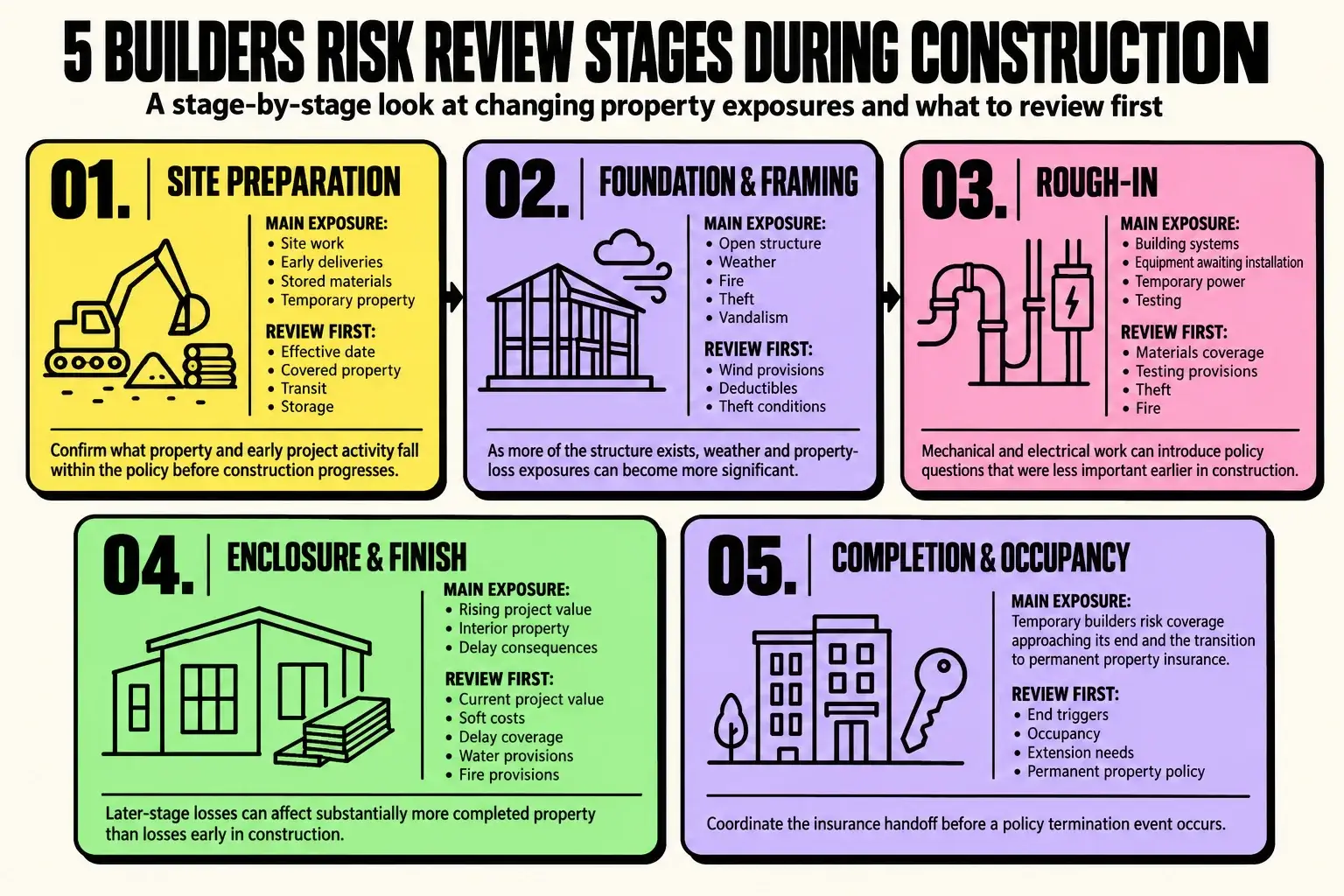
Builders Risk Coverage by Project Stage
1. Pre-Construction and Site Preparation
Before vertical construction begins, work may involve excavation, grading, foundations, temporary structures, stored materials, and early deliveries. Do not assume every form of site work is automatically insured under builders risk. Land, landscaping, excavation expenses, temporary works, and other property can be treated differently depending on the form.
At this stage, verify:
- The policy’s effective date
- What site work qualifies as covered property
- Whether materials delivered before vertical construction are covered
- Off-site storage and transit provisions
- Applicable temporary-structure coverage
- Contract and lender insurance requirements
The policy should be in place before the project reaches the point at which covered property or work needs protection. Coverage cannot ordinarily be applied retroactively to a known loss that happened before the policy became effective.
2. Foundation and Framing
Once framing begins, a larger portion of the completed project exists while the structure may remain open to weather. Wind, rain, fire, theft, vandalism, and damage to partially completed work may become more significant considerations, but whether a particular loss is covered depends on the policy’s covered causes of loss, exclusions, deductibles, and conditions.
This is a useful stage to confirm:
- Wind and hail treatment
- Hurricane or named-storm provisions, when applicable
- Theft and vandalism provisions
- Materials stored in or around the structure
- Temporary protection requirements
- Any special deductible applying to a coastal project
3. Rough-In and Systems Installation
Electrical, plumbing, HVAC, and other building systems are typically added during rough-in. More materials and equipment may also be stored on the site awaiting installation. Temporary electrical service, heating, welding, testing, and other construction activities can introduce coverage questions that were less important earlier in the project.
Review whether the policy adequately addresses:
- Materials awaiting installation
- Theft or vandalism involving covered project property
- Temporary storage
- Fire-related losses
- Testing or commissioning activities
- Any separate limits or endorsements affecting mechanical or electrical equipment
Testing deserves particular attention on projects involving complex mechanical, electrical, or specialized systems because some builders risk forms treat testing exposures differently.
4. Enclosure Through Finish Work
After the exterior walls and roof are substantially complete, the nature of the exposure changes again. Interior finishes, flooring, cabinetry, fixtures, appliances, HVAC equipment, and other installed property can increase the amount at risk. A covered fire, water loss, or storm event late in construction can therefore affect significantly more completed work than the same event early in the project.
This is also a useful point to review the current project value. Major change orders or increases in construction cost may need to be reported according to the policy’s terms. Projects concerned about financial consequences from a covered construction delay should also review whether soft costs or delay-in-completion coverage has actually been included. These protections are not something to assume from the words “builders risk” alone; definitions, covered expenses, waiting periods, sublimits, and triggering losses can vary.
5. Substantial Completion and Occupancy
Builders risk temporary coverage. The exact termination point is controlled by the policy rather than by one universal construction milestone. Depending on the form, coverage can be affected by events such as:
- Policy expiration
- Completion of construction
- Occupancy
- The building being put to its intended use
- Transfer of ownership or another interest
- Abandonment of construction
- Another termination condition stated in the policy
That makes the transition from builders risk to permanent property insurance an important part of project closeout. If construction runs beyond the expected completion date, extension availability should be reviewed before the existing term expires. An extension is not automatic, and its availability, underwriting requirements, premium, and duration depend on the insurer and policy.
Stage-by-Stage Builders Risk Snapshot
| Project Stage | Main Property or Exposure Questions | Review First |
| Site preparation | Site work, early deliveries, stored materials, temporary property | Effective date, covered property, transit and storage |
| Foundation and framing | Open structure, weather, fire, theft, vandalism | Wind provisions, deductibles, theft conditions |
| Rough-in | Building systems, equipment awaiting installation, temporary power and testing | Materials coverage, testing provisions, theft and fire |
| Enclosure and finish | Rising project value, interior property, delay consequences | Current value, soft costs, delay coverage, water and fire provisions |
| Completion and occupancy | Termination of temporary coverage and handoff to permanent insurance | End triggers, occupancy, extension needs, permanent property policy |
Charleston Wind and Flood Questions to Review
Charleston’s location makes wind and flood especially important coverage questions, but the correct treatment depends on the exact project address.
Wind and Hail
South Carolina law defines a specific coastal area for the state’s wind and hail insurance system. In Charleston County, that statutory area includes designated islands and other specifically described portions of the county; it does not simply mean every property in Charleston County receives identical treatment. The South Carolina Wind and Hail Underwriting Association, commonly called the Wind Pool, operates as a residual property insurance market for eligible property in the legislatively designated coastal area when wind and hail coverage cannot be obtained through the standard market.
For a Charleston-area construction project, confirm:
- Whether the site falls within the applicable coastal territory
- How wind and hail are insured
- Whether a separate wind policy is involved
- Whether hurricane, named-storm, or percentage deductibles apply
- Whether the construction phase changes any underwriting requirements
Do not assume a project’s builders risk policy automatically includes the same wind protection as its future permanent property policy.
Flood During Construction
Flood deserves a separate review because builders risk forms can exclude, limit, or separately endorse flood coverage. The National Flood Insurance Program can insure eligible buildings while they are under construction, including in some circumstances before they are fully walled and roofed. FEMA’s rules, however, impose important construction-stage conditions.
For a structure that is not yet walled and roofed:
- NFIP eligibility can end if construction stops for more than 90 continuous days.
- Certain structures with a lowest floor below the applicable base flood elevation are not covered until the building reaches the required walled-and-roofed condition.
- Materials and supplies intended for construction generally must be inside an enclosed building on the premises or adjacent premises to qualify under the applicable NFIP provision.
- If the building has fewer than two rigid exterior walls and a fully secured roof at the time of loss, FEMA states that the applicable building deductible is twice the deductible that otherwise would apply to the completed building.
NFIP rules are different from private builders risk forms. A project team should therefore determine whether flood is addressed through the builders risk policy, an endorsement, NFIP coverage, private flood insurance, or another arrangement appropriate to the project and lender requirements.
Common Builders Risk Exclusions and Limitations to Review
There is no universal builders risk policy, so an exclusion appearing in one form should not automatically be attributed to another.
Common areas that deserve specific review include:
- Flood and earth movement: These may be excluded, limited, or addressed separately.
- Faulty workmanship, design, or materials: Forms differ on the exclusion itself and whether resulting damage to other covered property is protected.
- Wear, deterioration, and other gradual causes: Builders risk generally focuses on covered physical-loss events rather than ordinary deterioration.
- Contractor tools and mobile equipment: These may require separate contractors’ equipment or inland marine coverage.
- Third-party liability: Bodily injury and third-party property-damage claims ordinarily belong under liability coverage rather than builders risk.
- Mechanical breakdown and testing: Treatment can vary considerably depending on the form and endorsements.
- Soft costs and delay: Coverage should be confirmed specifically, including what expenses qualify and what type of covered loss must trigger the delay.
- Ordinance or law: Additional rebuilding expense caused by applicable codes should not be assumed covered without reviewing the policy.
Policy wording and endorsements ultimately determine how these issues apply to a particular project.
A Builders Risk Review Checklist for Each Construction Milestone
Instead of waiting until a claim or final handoff, review these questions when a project reaches a major milestone:
- Has the project value changed?
Include significant approved change orders and other reportable increases according to the policy terms. - Where is the property now?
Check materials at the job site, temporary storage locations, and items in transit. - Have new activities started?
Testing, hot work, temporary heating, equipment commissioning, or occupancy can create new policy questions. - Do the deductibles still make sense for the exposure?
Review wind, named-storm, flood, theft, and other applicable deductibles rather than looking only at the overall policy limit. - Have the schedule or completion date changed?
A delayed project can create an expiration problem if an extension is needed. - Are all required project interests addressed?
Check the construction contract, lender requirements, and policy documents for the parties and interests that need to be recognized. - Is the handoff to permanent insurance scheduled?
Do not wait until after occupancy or another termination trigger to determine when builders risk ends.
Coordinating Builders Risk With Other Commercial Insurance
Builders risk is focused on the construction project itself. It does not replace the rest of a contractor’s, developer’s, or property owner’s insurance program. Depending on the organization and project, separate policies may address third-party liability, employee injuries, business vehicles, contractors’ tools and mobile equipment, professional services, or other exposures.
Once construction is complete, the permanent property may ultimately be insured through a standalone commercial property policy or a package arrangement, depending on the organization and its eligibility. Benni Agency’s Charleston BOP vs. CPP comparison explains two common commercial package structures without replacing a project-specific coverage review.
Where Benni Agency Can Help
A builders risk review should connect the construction schedule with the actual policy, contract requirements, site location, project value, and planned transition to permanent insurance. Benni Agency provides business and commercial insurance services and serves Charleston businesses with commercial insurance options that include commercial property and inland marine-related coverage. For a construction project, the appropriate coverage structure depends on the specific property, contract, lender requirements, construction activities, location, insurer underwriting, and policy terms. Review those details with the issuing insurer or a licensed insurance professional before relying on coverage for a particular exposure.