A power outage can shut down a Charleston business even when the building itself is untouched. Whether business interruption insurance responds depends on what caused the outage, where the physical damage occurred, and which endorsements are attached to the policy. Standard business income coverage often requires covered direct physical loss or damage at the insured premises. An outage caused by damage to off-site utility property may require separate utility-services coverage. The policy language, schedule, limits, and facts of the loss control the answer.
Key Takeaways
- A power outage by itself does not automatically trigger business income coverage.
- Damage at your premises and damage to off-site utility property are usually treated differently.
- Utility-services time-element coverage may extend business income protection to certain off-premises interruptions.
- Overhead lines, waiting periods, sublimits, spoilage, and covered causes of loss should be checked separately.
- Flood, wind, equipment breakdown, and civil-authority losses can involve different coverage triggers.
Start With One Question: Where Did the Covered Damage Occur?
For many business income claims, the key question is not simply, “Did the power go out?” It is, “What covered physical damage caused the shutdown?”
If wind damages your roof, electrical system, or other covered property at the described premises and operations must stop, business income coverage may apply, subject to the policy terms.
The analysis changes when your building is undamaged but a substation, transformer, transmission line, or other utility property away from the premises is damaged. Standard commercial property forms commonly restrict or exclude losses caused by off-premises utility failure. A utility-services endorsement may be needed to extend coverage to that situation.
How Utility-Services Coverage Can Change the Answer
Utility-services coverage is not one universal form. Policy wording varies by insurer, and direct-damage coverage and time-element coverage address different losses.
Utility-services time-element coverage can extend business income or extra expense coverage when a selected utility service is interrupted because covered physical damage occurs to qualifying utility property away from your location.
Utility-services direct-damage coverage addresses covered physical damage to your own property caused by a qualifying utility interruption. A business worried about refrigerated inventory, for example, should not assume a time-element endorsement automatically covers spoiled stock.
Check:
- Which services are scheduled: power, communications, water, or others.
- Which utility property is included.
- Whether overhead transmission lines are included or excluded.
- Which causes of loss can trigger coverage.
- Whether a waiting period applies.
- Whether the endorsement has its own limit or sublimit.
Read the endorsement schedule, not just the endorsement title. Two businesses can both have “utility interruption coverage” but materially different protection.
A Practical Power-Outage Coverage Framework
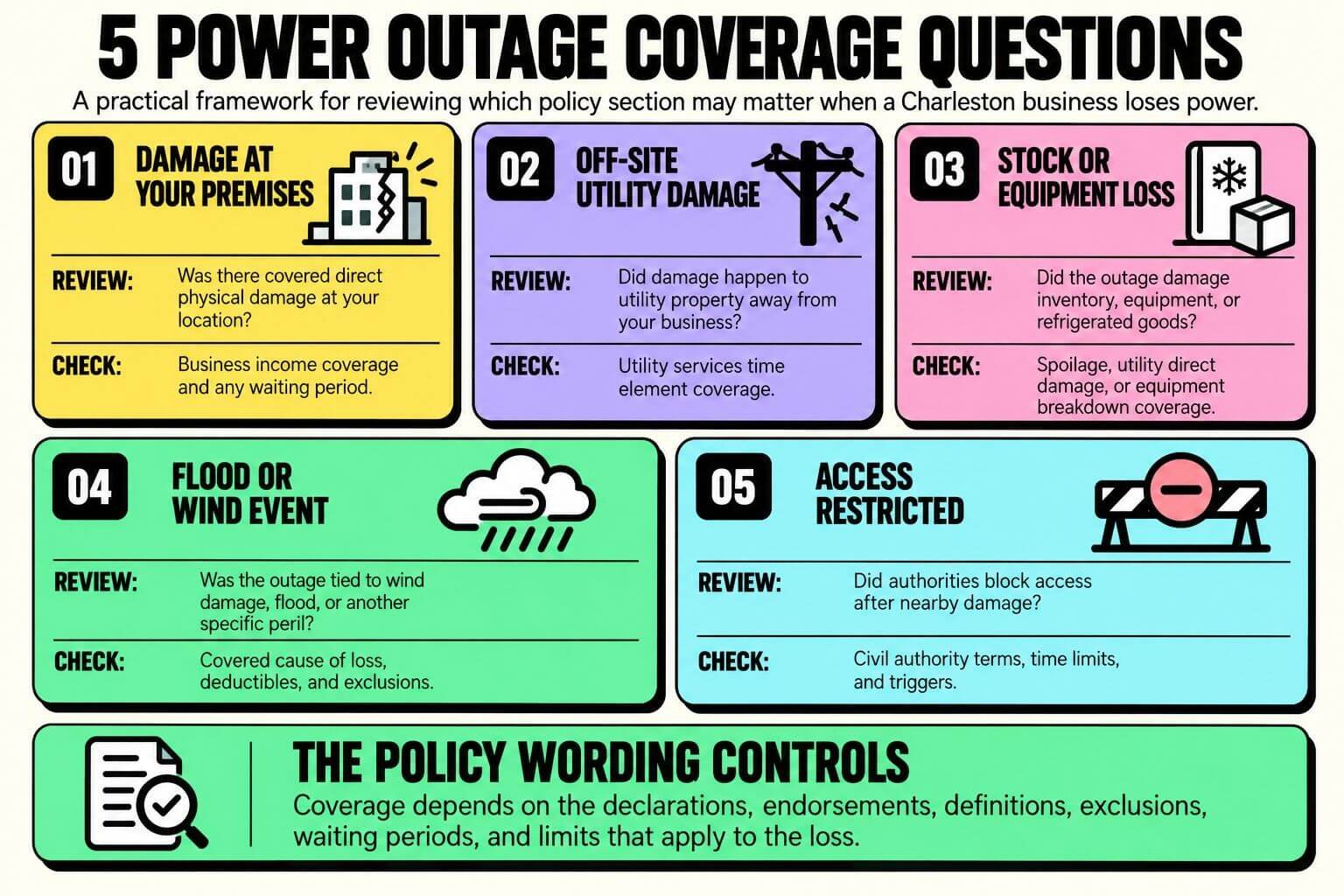
| Outage scenario | Coverage question to review |
| Covered damage occurs at your premises | Does the business income form respond to that property loss? |
| Off-site utility equipment is damaged | Is utility-services time-element coverage attached and properly scheduled? |
| An outage damages stock or equipment | Is direct-damage, spoilage, or equipment-breakdown coverage relevant? |
| Flood damages a substation or your premises | Is flood excluded under the property form, and is separate flood coverage involved? |
| Authorities restrict access after nearby damage | Do the policy’s civil-authority requirements apply? |
This framework does not determine coverage. It identifies which policy section or endorsement deserves attention first.
Charleston Storm Risk: Keep Wind, Flood, and Power Separate
A Charleston storm can create several insurance questions at once. Wind may damage the building. Flood or storm surge may affect property or nearby infrastructure. Utility damage may interrupt power while your own building remains intact.
Those causes should not be blended together. The South Carolina Department of Insurance explains that commercial property policies generally do not include flood coverage and that flood policies do not include business-interruption financial losses.
A covered wind event and a flood event can therefore lead to different coverage results during the same storm. Benni Agency’s Charleston commercial property storm coverage guide explains the broader wind, flood, deductible, and closure questions separately.
Waiting Periods and Limits Matter
Even when coverage applies, the amount payable can depend on time and limits.
Business income forms may use a waiting period before covered income loss begins. Utility-services endorsements can have separate waiting periods, limits, or sublimits. Extra expense may also be treated differently from lost income.
Do not assume the largest number on the declarations page is available for a utility interruption. Check the endorsement schedule and ask how its limit interacts with the broader business income limit.
What to Check Before an Outage
Review the actual declarations, coverage forms, and endorsements. Confirm:
- Business income and extra expense coverage for the correct location.
- Utility-services time-element coverage, if purchased.
- The utilities and utility property listed on the schedule.
- Treatment of overhead transmission lines.
- Waiting periods and utility-specific limits.
- Spoilage or equipment-breakdown coverage where relevant.
- Wind, named-storm, flood, and civil-authority terms.
For businesses using a Business Owners Policy, some issues may be handled through BOP-specific endorsements. Benni Agency’s Charleston BOP add-ons guide covers related questions without replacing a policy-specific review.
What to Do After the Power Goes Out
Protect people first and follow instructions from emergency officials and the utility. Then notify your insurer or agent promptly and preserve documentation.
Record when service stopped and returned. Photograph physical damage. Save utility notices, repair invoices, temporary-storage or generator receipts, and records of spoiled property. Track closure hours, lost sales, continuing expenses, and extra costs.
Business income claims often require financial records showing normal operations and the effect of the interruption. Keep important records away from the affected location or in a secure cloud system. Ready.gov provides business preparedness guidance covering power outages, continuity planning, communications, and recovery.
Review the Policy Before the Next Storm
The most useful time to discover a missing utility endorsement is before an outage. A broker can help organize declarations, forms, and schedules and identify questions to take to the insurer.
Benni Agency’s Charleston business and commercial insurance page explains the local commercial-insurance services available to Charleston businesses. Coverage availability, terms, limits, and pricing depend on the insurer, policy form, underwriting, and the business’s actual exposures.