A cyber incident can interrupt operations, expose customer or employee information, and create legal and financial work at the same time. Charleston businesses do not need to be large or technology-focused to face that risk. Any organization that uses email, cloud software, online banking, payment systems, or outside vendors has an exposure. This guide explains the main threats, South Carolina breach-notification duties, common cyber insurance features, and practical questions to review before buying or renewing coverage.
Key Takeaways
- Ransomware, stolen credentials, phishing, and third-party access remain important business risks.
- South Carolina’s breach law may require notice when specified personal information is acquired and misuse or material harm is likely.
- General liability and Business Owners Policies should not be assumed to provide broad cyber protection.
- Cyber policies can combine first-party response coverage with third-party liability coverage, subject to their terms.
- Security controls, an incident-response plan, and careful policy review should work together.
Why Cyber Risk Deserves a Separate Review
Attackers often look for an accessible route rather than a famous company. A reused password, unpatched application, compromised vendor account, or convincing payment request can be enough. The 2026 Verizon Data Breach Investigations Report found ransomware in 48% of the breaches it analyzed. The report also highlights the growing use of generative AI to support familiar attack techniques. Local relevance should come from a company’s operations, not assumptions about Charleston as a whole. A restaurant accepting card payments, a medical practice holding health information, a professional firm storing client files, and a contractor relying on cloud scheduling may have different data, systems, contracts, and interruption risks. Each needs an exposure review based on actual operations.
Common Cyber Threats Facing Businesses
Ransomware and Data Extortion
Ransomware can encrypt files or disrupt systems. Attackers may also copy data and threaten to publish it. Response work may include containment, forensic investigation, system restoration, legal review, communications, and notification. Paying a demand does not guarantee that data will be restored or deleted.
Business Email Compromise and Phishing
An attacker may impersonate an executive, vendor, customer, or financial institution to obtain credentials or redirect a payment. Because fraudulent messages can look polished, employees should verify unusual requests through a known phone number or another trusted channel.
Vendor and Cloud-Service Incidents
A breach can begin outside the company. Payroll platforms, software providers, managed service providers, and other vendors may hold data or have system access. Contracts, access permissions, incident-notification duties, and the cyber policy’s treatment of dependent business interruption all deserve review.
Payment-System and Credential Theft
Compromised payment systems or customer accounts can create investigation, contractual, and notification issues. The response depends on the information involved, how it was protected, what the investigation finds, and which legal or payment-card requirements apply.
What South Carolina’s Breach Law Requires
South Carolina Code Section 39-1-90 applies to a person conducting business in the state that owns or licenses data containing personal identifying information. Notice to an affected South Carolina resident is required when covered information that was not rendered unusable was acquired, or is reasonably believed to have been acquired, by an unauthorized person and illegal use occurred, is reasonably likely, or creates a material risk of harm. The statute calls for notice in the most expedient time possible and without unreasonable delay, while allowing time for legitimate law-enforcement needs and measures necessary to determine the breach’s scope and restore system integrity.
A company maintaining covered data for someone else must notify the owner or licensee immediately after discovering qualifying unauthorized acquisition. The facts matter. The data elements, encryption or redaction, evidence of acquisition, risk of harm, residency, and other laws can change the response. Businesses should involve qualified legal counsel when evaluating notification obligations. This is general information, not legal advice.
What Cyber Liability Insurance May Cover
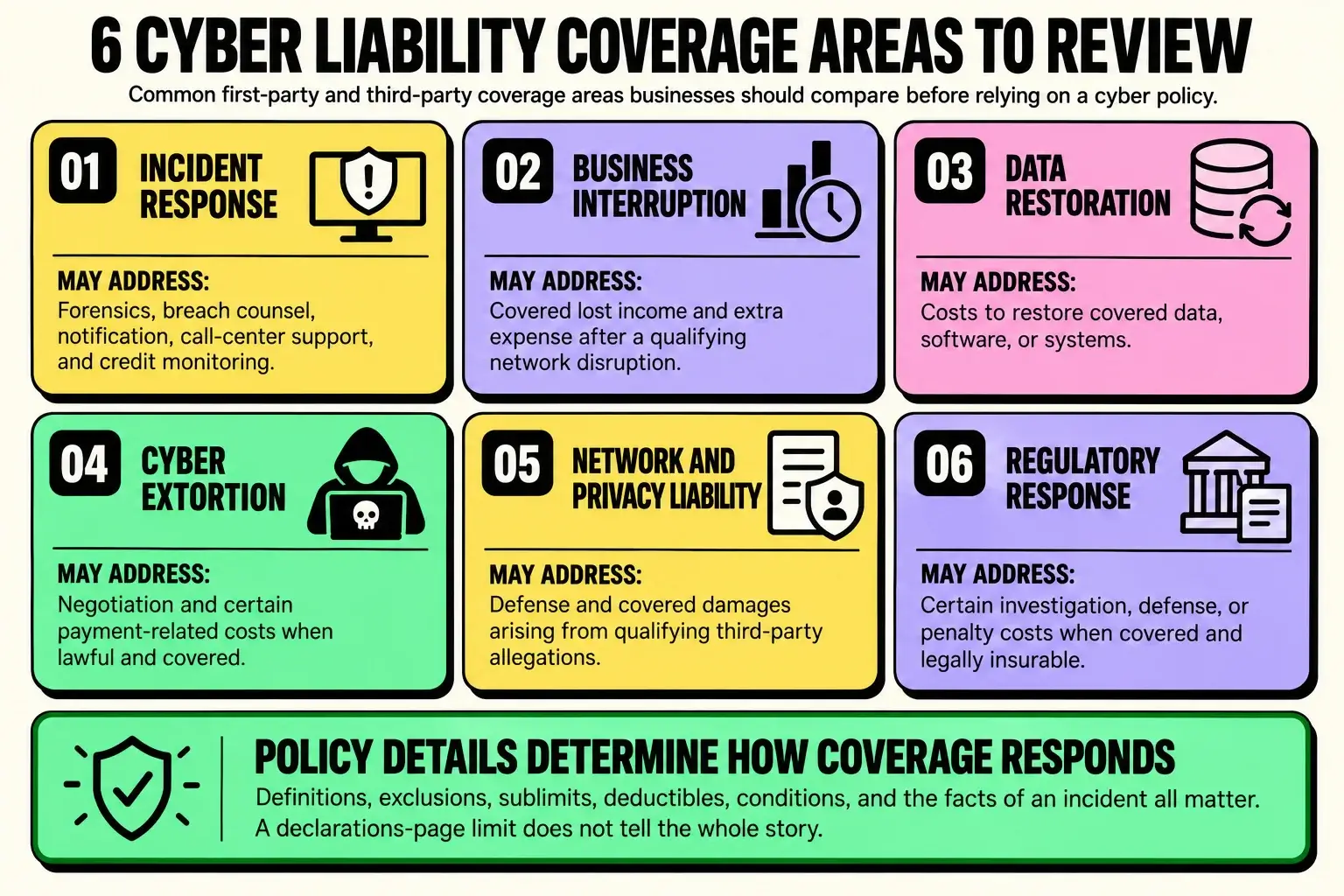
Cyber insurance is not standardized. Coverage depends on the policy’s definitions, exclusions, sublimits, retention, conditions, and the facts of the event. A review commonly separates two groups of coverage:
| Coverage area | What it may address |
| Incident response | Forensics, breach counsel, notification, call-center support, and credit monitoring |
| Business interruption | Covered lost income and extra expense after a qualifying network disruption |
| Data restoration | Costs to restore covered data, software, or systems |
| Cyber extortion | Negotiation and certain payment-related costs when lawful and covered |
| Network and privacy liability | Defense and covered damages arising from qualifying third-party allegations |
| Regulatory response | Certain investigation, defense, or penalty costs when covered and legally insurable |
Social engineering and funds-transfer fraud need special attention. They may be excluded, covered under a separate crime policy, or subject to a smaller cyber sublimit. A declarations-page limit alone does not show how the policy will respond.
Why General Liability or a BOP May Not Be Enough
Commercial general liability primarily addresses specified third-party bodily injury, property damage, and personal or advertising injury claims. It should not be treated as a dependable answer for ransomware, electronic data restoration, privacy response, or network interruption. Benni Agency’s article on general liability gaps Charleston businesses can miss explains where separate coverage reviews may be needed. A Business Owners Policy may offer a limited cyber endorsement, but scope varies. Compare any endorsement with a standalone cyber option, including incident-response services, business interruption, vendor-triggered events, exclusions, and sublimits.
A Practical Cyber Risk-Reduction Checklist
Insurance supports risk transfer, but it does not replace basic controls. Businesses should consider these steps:
- Use multifactor authentication for email, financial, administrative, and remote-access accounts.
- Patch operating systems, applications, network devices, and firmware promptly.
- Maintain tested backups that attackers cannot easily alter or delete.
- Train employees to report suspicious messages and verify unusual payment requests.
- Limit access according to job responsibilities and remove access promptly when roles change.
- Inventory sensitive data and delete records that no longer need to be retained.
- Review vendor security, access, contracts, and incident-notification procedures.
- Keep an incident-response plan and contact list available when normal systems are offline.
Questions to Ask Before Buying or Renewing Coverage
Start with the systems, data, vendors, revenue dependencies, and transfer limits the business actually has. Then ask:
- Which events trigger coverage, and which exclusions are most relevant?
- Are social engineering and funds-transfer fraud covered, and at what limits?
- What waiting period and calculation method apply to business interruption?
- Are vendor outages and cloud-service incidents included?
- Must the insured use approved breach counsel, forensic firms, or negotiators?
- Which security controls were represented in the application?
- What notice steps must the insured follow after discovering an incident?
Benni Agency’s Charleston insurance and benefits page identifies cyber liability as one of the commercial coverage areas local businesses can review. Policy selection should follow a fact-specific discussion with a licensed insurance professional.