You can have benefits software and still watch HR spend hours fixing deductions, chasing enrollment forms, updating the same employee information in several systems, and answering questions employees should be able to resolve quickly.
Broker partner technology can improve employee benefits results by reducing manual administration, improving enrollment, keeping benefits data better connected, and giving employers clearer information about what is working. The technology matters, but the way it is set up and supported matters just as much. This article is for employers and HR teams that want to reduce benefits administration problems and know what better technology should actually improve.
Key Takeaways
- Broker partner technology should reduce manual benefits work, not move the same work into another system.
- Good technology can improve enrollment, onboarding, payroll coordination, carrier data, employee access, and reporting.
- Employers should track administration time, correction rates, enrollment completion, processing time, and support needs.
- Better results depend on clear responsibilities between the employer, broker, and technology partner.
- Even a strong platform still needs accurate data, careful setup, and human benefits support.
What Is Broker Partner Technology?
Broker partner technology is the combination of benefits software and the people responsible for setting it up, connecting it to other systems, and helping the employer use it correctly. Depending on the company, that may include:
- Online benefits enrollment
- Employee self-service
- Eligibility management
- Payroll connections
- HRIS connections
- Carrier data feeds
- Reporting
- New-hire administration
- Life-event changes
- Employee communication
The software is only one part of the setup. A broker may also help the employer choose the platform, define eligibility rules, coordinate implementation, review data, work with carriers, and determine who handles problems after enrollment. That is where benefits administration technology becomes more useful. The goal isn’t simply to put benefits online. The goal is to make the full process easier to manage.
How Technology Improves Employee Benefits Results
The clearest improvements usually show up in the work HR does every day. Technology should remove unnecessary steps, make information easier to find, and reduce the number of times someone has to fix the same problem.
Reduces Manual HR Work
Benefits administration can become surprisingly manual. HR may receive an employee update, enter it into an HR system, make another change in the benefits platform, notify payroll, and confirm the update with a carrier.
Every extra handoff creates another chance for something to be missed. A better setup can reduce repeated data entry and automate parts of routine administration. HR can spend less time moving information between systems and more time dealing with issues that actually need a person. The question employers should ask is simple: What work disappears when we use this technology? If the answer is “not much,” the setup may need another look.
Improves Enrollment and Onboarding
Enrollment technology can make it easier for employees to review benefits, make elections, and complete required steps without relying on paper forms or long email chains. It can also help HR see who has completed enrollment and who still needs attention. The process shouldn’t stop there. Once an employee makes an election, the information may also need to reach payroll, the carrier, and other systems.
Employers trying to streamline benefits enrollment should look at that full path, not just whether employees can make elections online. The same applies to new hires. A good process should help employees understand what they need to do while giving HR a clear way to track progress.
Keeps Payroll and Carrier Data Better Aligned
An employee can make the correct benefit election and still have a problem if the payroll deduction or carrier record doesn’t match. That is why system connections and reconciliation matter.
Technology may help move data between benefits, payroll, HR, and carrier systems. But employers should confirm what is actually connected. Some updates may still require files, manual review, or follow-up. A useful setup makes those responsibilities clear. HR should know:
- Where the original employee data comes from
- Which systems receive updates automatically
- Which changes require manual action
- Who checks for discrepancies
- Who fixes a problem when records don’t match
The goal is not to assume every system communicates perfectly. It is to make errors easier to prevent and find.
Gives Employees Better Access to Benefits Information
Employees often go to HR because they can’t find basic information about their benefits. They may want to know what they elected, what coverage costs, when coverage begins, or where to find plan information. A well-configured platform can give employees easier access to those details without requiring HR to answer every routine question.
That doesn’t mean technology should replace human help. Employees will still have questions about plan choices, family situations, eligibility, claims, or unusual circumstances. Good technology handles straightforward tasks while giving employees a clear path to a person when they need one.
Gives Employers Better Reporting
Benefits data should help employers make decisions, not sit inside a system where nobody uses it. Reporting can help HR and leadership review enrollment status, participation, costs, administrative problems, and other patterns.
That matters because benefits are a meaningful employer expense. The U.S. Bureau of Labor Statistics reported that private-industry employers in the South Atlantic region, which includes South Carolina, spent an average of $12.37 per employee hour on benefits in March 2026. Benefits represented 28.6% of total compensation costs in the region. Better reporting doesn’t automatically lower those costs. It can give employers a clearer picture of how a significant part of compensation is being administered and where questions deserve closer attention.
What Results Should Employers Measure?
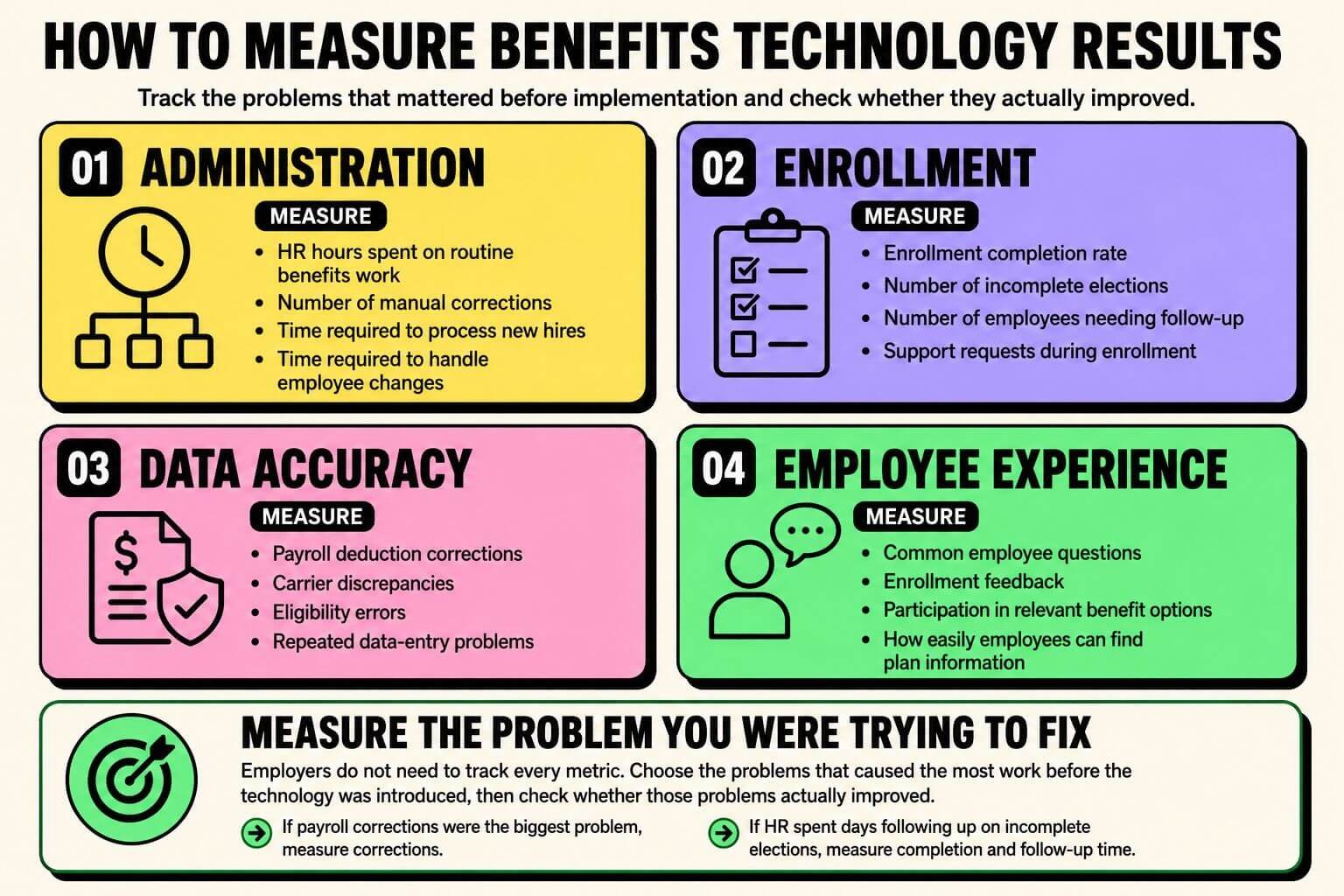
A long feature list doesn’t tell you whether benefits technology is helping. Look at what changed after implementation. Useful measures can include:
Administration
- HR hours spent on routine benefits work
- Number of manual corrections
- Time required to process new hires
- Time required to handle employee changes
Enrollment
- Enrollment completion rate
- Number of incomplete elections
- Number of employees needing follow-up
- Support requests during enrollment
Data accuracy
- Payroll deduction corrections
- Carrier discrepancies
- Eligibility errors
- Repeated data-entry problems
Employee experience
- Common employee questions
- Enrollment feedback
- Participation in relevant benefit options
- How easily employees can find plan information
Employers don’t need to track every metric. Choose the problems that caused the most work before the technology was introduced. Then check whether those problems actually improved. If payroll corrections were the biggest problem, measure corrections.
If HR spent days following up on incomplete elections, measure completion and follow-up time. Measure the problem you were trying to fix.
Broker, Employer, and Technology Partner: Who Handles What?
Technology works better when everyone knows what they own. Many administration problems happen because a task falls between two teams. The employer thinks the broker handles it. The broker thinks the platform handles it. The platform expects the employer to supply or verify something. Clear roles can prevent that confusion.
Task | Employer | Broker | Technology or Admin Partner |
Benefit strategy | Provides goals and approves decisions | Advises on options | Supports setup |
Eligibility rules | Confirms workforce information | Advises on plan rules | Configures system |
Platform setup | Reviews requirements | Coordinates process | Configures and tests |
Payroll coordination | Provides payroll details and validates results | Helps coordinate | Supports connection or data process |
Employee communication | Supports workforce communication | Provides benefits guidance | Provides platform tools |
Exceptions and errors | Reports and verifies issues | Helps resolve or escalate | Investigates system or data issues |
Reporting | Reviews results | Helps interpret findings | Provides available reports |
The exact division varies by arrangement, so employers should confirm responsibilities before implementation. Day-to-day benefits administration also continues after open enrollment. Eligibility changes, employee questions, payroll updates, terminations, and carrier issues all need an owner.
Where Broker Partner Technology Makes the Biggest Difference
Technology becomes especially useful when several people or systems have to act on the same employee change. Three situations deserve particular attention.
Open Enrollment and New Hires
Open enrollment puts a large amount of benefits activity into a short period. Employees need information. Elections need to be collected. HR needs to know who has finished. Payroll deductions need to be correct. Carrier records need to match. Technology can organize that work and make progress easier to track. New hires create the same issue on a smaller scale throughout the year. A consistent online process can help HR avoid recreating the enrollment process every time someone joins the company.
Life Events and Year-Round Changes
Benefits work doesn’t end when open enrollment closes. Employees get married, have children, lose other coverage, change employment status, or leave the company. Those events can affect eligibility, elections, deductions, and carrier records. A good administration process gives HR a clear way to make the change and determine where the updated information needs to go. This is also where unclear ownership becomes expensive in terms of time. A simple employee change can turn into several emails and manual updates when systems and responsibilities aren’t coordinated.
ICHRA and More Complex Benefit Structures
Some benefit arrangements create additional administration needs. With an Individual Coverage Health Reimbursement Arrangement, employees may choose individual health insurance rather than enrolling in one traditional employer group health plan. That can increase the need for clear eligibility processes, employee education, reimbursement administration, and coordination. Strong technology can support ICHRA administration, but the platform still needs to fit the employer’s actual process. Technology without clear support can simply create another place for employees and HR to get stuck.
When Benefits Technology Does Not Improve Results
Adding technology doesn’t guarantee easier benefits administration. Sometimes a new system creates more work. Common problems include:
- The platform doesn’t fit the employer’s workflow
- Employee or eligibility data is inaccurate from the start
- Payroll or carrier connections don’t work as expected
- HR still enters the same information in several places
- Implementation is rushed before enrollment
- Nobody checks data after it moves between systems
- Employees don’t know where to get help
- Reports are available but aren’t useful to the employer
- Nobody clearly owns exceptions and corrections
Before blaming the platform, look at the process around it. For example, automating an inaccurate eligibility file only moves incorrect information faster. An enrollment portal also won’t help much if employees don’t understand their choices or HR still has to manually rebuild elections somewhere else. Technology works best when it removes a real administrative problem.
Questions to Ask Before Choosing a Broker Technology Partner
Employers don’t need to become benefits software experts. They do need to ask enough questions to understand what they are getting. Before changing a system or selecting a broker based partly on technology, ask:
- Can we keep our current payroll or HRIS system?
- Which systems connect directly, and which require files or manual work?
- Who handles implementation and testing?
- Who checks payroll deductions after enrollment?
- Who checks carrier data?
- Who fixes discrepancies?
- Where do employees go when they need help?
- What reporting will HR receive?
- What happens if we change carriers or payroll providers?
- Are there technology, implementation, or ongoing administration fees?
Ask for specific answers. “We integrate with payroll” is less useful than knowing what information moves, how often it moves, who reviews it, and what happens when something fails.
Is Your Benefits Technology Reducing HR Work?
If HR is still entering employee information in several systems, correcting deductions after enrollment, tracking down carrier discrepancies, or answering the same questions repeatedly, the problem may not be a lack of technology. The way the systems and responsibilities are set up may be the bigger issue. Start by mapping what happens when an employee enrolls, becomes eligible, changes coverage, or leaves the company. Look for places where information has to be entered again, someone manually checks another system, or nobody clearly owns the next step.
Benni Agency helps employers review these types of benefits administration workflows and identify where technology, process changes, or clearer responsibilities may reduce unnecessary work. You don’t necessarily need a new platform. Sometimes the better first move is understanding what isn’t working in the setup you already have. If your current process creates more manual work than expected, a benefits consulting review can help identify the problem before you decide what should change.