Setting up a Health Reimbursement Arrangement (HRA) gives employers a structured way to help employees pay for healthcare while maintaining greater control over benefit spending. Instead of committing to the same insurance premium for every employee, an employer can establish an allowance and reimburse eligible healthcare expenses according to the rules of the chosen HRA.
The process involves more than selecting a reimbursement amount. Employers need to choose the right HRA, define employee eligibility, prepare required documents, create a reimbursement process, and explain the benefit clearly. This guide is for employers, business owners, and HR teams that want to understand how to set up an HRA for a business in 2026 and avoid common implementation mistakes.
Key Takeaways
- Choose the right HRA: QSEHRA, ICHRA, integrated HRAs, and Excepted Benefit HRAs follow different eligibility, coverage, and contribution rules.
- Set a clear budget: Decide how much the organization will reimburse and confirm whether federal contribution limits apply.
- Prepare proper documents: Establish eligibility, reimbursable expenses, claim procedures, notices, and effective dates before launch.
- Create a reliable reimbursement process: Eligible expenses should be substantiated, reviewed, documented, and reimbursed according to the written plan.
- Review the arrangement regularly: Employers should monitor eligibility, reporting duties, federal limits, employee communication, and plan updates.
What Is an HRA and How Does It Work for an Employer?
A Health Reimbursement Arrangement is an employer-funded health benefit that reimburses employees for eligible healthcare expenses under an established plan. Depending on the HRA type, eligible expenses may include insurance premiums, deductibles, prescriptions, office visits, and other qualified medical costs. Employees generally do not fund an HRA through payroll deductions. The employer determines how much money is available for reimbursement, subject to any limits that apply to the arrangement.
The process usually works like this: an employee incurs an eligible expense, submits documentation, and receives reimbursement up to the available allowance after the expense is verified. This approach can make healthcare spending more predictable for employers while giving employees greater flexibility. However, HRA rules vary by arrangement, so choosing the correct structure is the first important decision.
Which Type of HRA Should You Set Up?
The right HRA depends on the employer’s current health benefits, workforce structure, budget, and goals.
Qualified Small Employer HRA (QSEHRA)
A Qualified Small Employer Health Reimbursement Arrangement (QSEHRA) is available to qualifying employers that generally have fewer than 50 full-time-equivalent employees, are not Applicable Large Employers, and do not offer a group health plan. A QSEHRA may reimburse eligible employees for qualified medical expenses, including qualifying individual insurance premiums.
For 2026, the maximum permitted benefit is $6,450 for self-only reimbursement and $13,100 when family reimbursements are available. Employers considering a QSEHRA should review employee eligibility, annual limits, insurance requirements, documentation, and employee notices before launch.
Individual Coverage HRA (ICHRA)
An Individual Coverage HRA (ICHRA) allows employers to reimburse employees for qualifying individual health coverage and eligible medical expenses. Employers of different sizes can use an ICHRA, and it does not have the same annual contribution cap as a QSEHRA. Employers considering this approach can learn more about how an Individual Coverage HRA works with employee eligibility, individual coverage, and employer contributions.
ICHRA rules also permit certain employee classes when determining eligibility and benefit design. According to IRS guidance on Health Reimbursement Arrangements, an HRA may be integrated with individual health insurance coverage or Medicare when applicable federal conditions are satisfied. Because reimbursement and individual insurance must work together correctly, understanding these rules early can reduce confusion for employers and employees.
Group Coverage HRA and Excepted Benefit HRA
Employers that already provide group health insurance may use certain HRAs to supplement existing coverage. An integrated HRA may reimburse eligible out-of-pocket medical expenses connected with the employer’s group plan. An Excepted Benefit HRA can also reimburse certain healthcare expenses under specific federal requirements. These options may suit organizations that want to help employees manage deductibles or other medical costs without replacing their existing group health plan.
How Do You Set Up an HRA for Your Business?
A clear setup process helps employers make the major decisions in the right order.
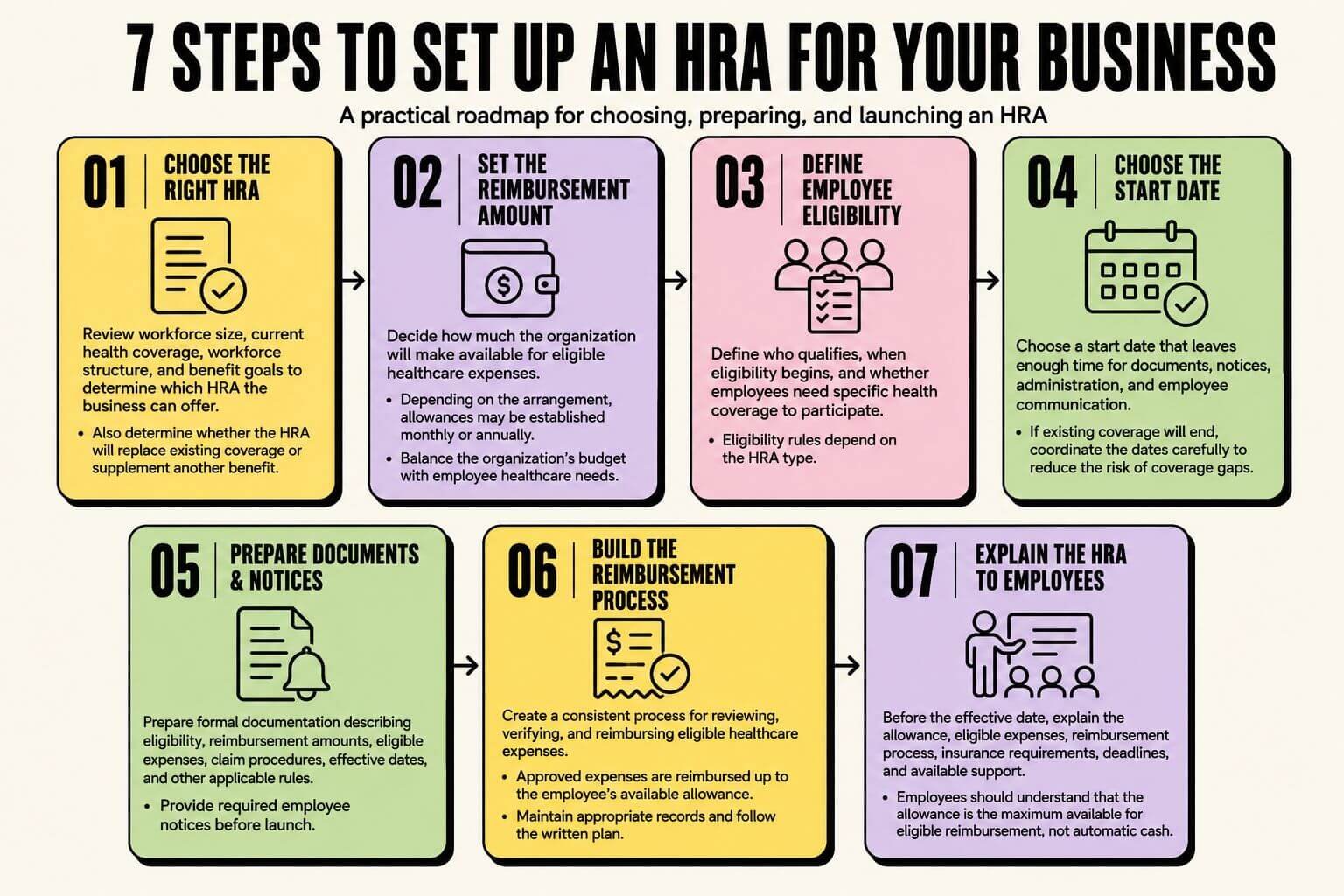
Step 1: Confirm Which HRA Your Business Can Offer
Start by reviewing your number of full-time-equivalent employees, current health coverage, workforce structure, and benefit goals. For example, an employer generally cannot offer a QSEHRA during months when it also offers a traditional group health plan. An ICHRA follows different rules and may be used by employers of different sizes when federal requirements are satisfied. Employers should also determine whether the HRA will replace current health coverage or supplement another benefit.
Step 2: Decide How Much the Employer Will Reimburse
Next, determine how much the organization will make available for eligible expenses. An HRA can help employers control spending because the reimbursement allowance is established in advance. Depending on the arrangement, allowances may be set monthly or annually. Employers comparing funding strategies may also want to understand how employer health insurance contributions work.
Comparing traditional premium contributions with a fixed HRA allowance can make budgeting decisions easier to evaluate. Some HRAs have federal contribution limits, while others provide greater flexibility. The final amount should balance the organization’s budget with employee healthcare needs.
Step 3: Decide Which Employees Will Be Eligible
Eligibility rules depend on the HRA type. A QSEHRA generally must be offered on the same terms to eligible employees, subject to permitted exclusions. An ICHRA provides more flexibility through approved employee classes. Employers should clearly explain who qualifies, when eligibility begins, and whether employees need specific health coverage to participate. Clear eligibility rules reduce uncertainty and help employees understand what they need to do next.
Step 4: Choose the HRA Start Date and Coordinate Existing Coverage
Choose a start date that gives the organization enough time to prepare documents, provide notices, establish administrative procedures, and communicate with employees. If the HRA will replace existing group coverage, coordinate the dates carefully to reduce the risk of coverage gaps. Employees who need individual insurance may also require time to obtain qualifying coverage before participation begins. A planned transition helps employees understand when current coverage ends, when the HRA starts, and what actions are required.
Step 5: Create the Required HRA Plan Documents and Notices
An HRA requires formal documentation explaining employee eligibility, reimbursement amounts, eligible expenses, claim procedures, effective dates, and other applicable rules. Employers also need to provide required notices. Missing or unclear notices can leave employees unsure about coverage requirements or reimbursement procedures. For ICHRAs, the U.S. Department of Labor provides an official Individual Coverage HRA Model Notice explaining information eligible employees should receive. Clear documents give employers and employees a dependable reference point when questions arise.
Step 6: Set Up Expense Verification and Reimbursement
Create a consistent process for reviewing and reimbursing eligible healthcare expenses. Employees generally submit documentation showing that an expense qualifies. The request is reviewed, and the approved amount is reimbursed up to the available allowance. Employers should maintain appropriate records and avoid treating HRA allowances as unrestricted cash payments. A consistent verification process also gives employees confidence that reimbursement requests will be handled fairly and according to established rules.
Step 7: Introduce the HRA to Employees
Employees are more likely to use an HRA correctly when they understand how it works. Before the effective date, explain the allowance amount, eligible expenses, reimbursement process, insurance requirements, deadlines, and available support. Employees should also understand that an allowance represents the maximum amount available for eligible reimbursement, not automatic cash.
“One customer shared that the benefits process felt seamless for the entire staff because each step was explained clearly and questions were answered in an easy-to-understand way. This shows why communication matters. When employees know what happens next, a new benefit can feel less intimidating.”

Clear communication can reduce confusion and help prevent reimbursement delays.
Should You Administer the HRA Yourself or Use an Administrator?
Employers need a reliable way to manage plan documents, employee notices, reimbursement requests, substantiation, records, and ongoing compliance. Internal administration gives an organization direct control, but staff must understand the rules and manage documentation consistently. Organizations that want to simplify enrollment, communication, and benefit workflows may consider benefits administration technology. An outside administrator or benefits advisor may also assist with reimbursements, recordkeeping, notices, and employee support.
“One customer described the experience as smooth and manageable from beginning to end, with knowledgeable and responsive guidance helping turn a complicated benefits process into a clearer path forward. That support can reduce the uncertainty employers often feel when managing unfamiliar benefit requirements.”

The best approach depends on internal resources, workforce needs, benefit complexity, and the organization’s comfort with administration.
Can Business Owners Participate in an HRA?
Whether a business owner can participate depends on the business structure, ownership status, tax treatment, and HRA type. Different rules may apply to sole proprietors, partners, S corporation shareholders, and owners who are treated as employees. For example, a more-than-2% S corporation shareholder generally cannot participate in a QSEHRA as an eligible employee. Employers should confirm owner eligibility before including an owner in the arrangement.
What Should You Do After the HRA Starts?
Employers should continue monitoring the HRA throughout the plan year. Ongoing responsibilities may include:
- Processing eligible reimbursements
- Tracking employee eligibility
- Maintaining required records
- Updating notices and plan documents
- Reviewing annual federal limits
- Evaluating allowance amounts
Certain arrangements also have reporting duties. For example, the permitted QSEHRA benefit generally must be reported on an eligible employee’s Form W-2 using Box 12, code FF. Regular reviews can help employers identify administrative problems before the next plan year.
Common HRA Setup Mistakes Employers Should Avoid
Common HRA mistakes include:
- Choosing the wrong HRA type: Check employer eligibility and existing coverage first.
- Using outdated contribution limits: Verify federal limits before setting allowances.
- Keeping incompatible coverage: Some HRAs cannot operate alongside certain group plans.
- Skipping required notices: Provide required information within applicable timeframes.
- Reimbursing expenses without substantiation: Follow documented verification procedures.
- Assuming every owner qualifies: Ownership and tax treatment can affect participation.
Employers reviewing HRA administration may also benefit from understanding employee benefits liability risks. Benefit mistakes can create concern for HR teams and employees when coverage or reimbursements are affected. Careful setup makes an HRA easier to understand, administer, and maintain.