A damaged load and a damaged trailer are two different losses, and one policy may not cover both. Charleston-area motor carriers should separate motor truck cargo coverage, trailer interchange coverage, commercial auto liability, and physical damage when reviewing insurance. The right structure depends on the freight, equipment ownership, operating authority, contracts, and policy wording. This guide explains those distinctions, the federal and South Carolina filing rules, common coverage gaps, and the information to gather before requesting a quote.
Key Takeaways
- Federal cargo filings generally apply to household-goods carriers, not most general-freight carriers.
- Liability minimums depend on vehicle weight and the commodities being transported.
- Cargo insurance protects covered freight; trailer interchange protects certain non-owned trailers.
- Loading, theft, refrigeration, and unattended-vehicle terms deserve a close policy review.
- Limits should reflect actual shipment and equipment values, not a generic default.
Why Cargo and Trailer Coverage Need Separate Attention
Motor truck cargo insurance generally addresses covered loss or damage to freight accepted for transportation. Trailer interchange insurance addresses physical damage to a non-owned trailer in the carrier’s possession under a written interchange agreement. Commercial auto liability responds to covered bodily injury or property damage claims involving others, while physical damage coverage protects scheduled tractors and owned trailers against covered causes of loss.
In drayage and intermodal work, one incident could damage the cargo, non-owned equipment, and another person’s property. Each part may fall under a different coverage form, limit, deductible, or exclusion.
Federal Liability and Cargo Filing Requirements
The Federal Motor Carrier Safety Administration’s current filing chart lists minimum public-liability requirements according to carrier type, vehicle weight, and commodity. For for-hire property carriers, the listed federal minimums include:
| Operation | Minimum public liability |
| Non-hazardous property, GVWR under 10,001 pounds | $300,000 |
| Non-hazardous property, GVWR 10,001 pounds or more | $750,000 |
| Certain hazardous materials | $1,000,000 |
| Specified explosives, poison gas, or radioactive materials | $5,000,000 |
These are regulatory floors. A broker, shipper, lender, terminal, or customer contract may require higher limits or specific endorsements. FMCSA lists no federal cargo filing requirement for the general-freight categories above. Its cargo filing requirement applies principally to for-hire household-goods carriers. Even when no federal cargo filing is required, a contract may still require motor truck cargo insurance. Carriers should compare the contract with the policy itself because a certificate of insurance summarizes coverage but does not change the policy. FMCSA also identifies the MCS-90 endorsement, or the surety equivalent MCS-82, for applicable for-hire and interstate motor carriers. The MCS-90 concerns public financial responsibility for certain motor-carrier liabilities. It is not cargo insurance or a substitute for the underlying commercial auto policy.
South Carolina Intrastate Requirements
A carrier operating only within South Carolina may be subject to a separate state process. The current SCDMV Certificate of Compliance application distinguishes Class E-L carriers of designated extremely low-value commodities from Class E-LC property carriers requiring cargo coverage. It also lists public-liability minimums based on gross vehicle weight rating and commodity.
Before covered intrastate operations begin, the application directs the insurance company, not the agent, to file Form E for liability and Form H when cargo insurance is required. It states that an ACORD certificate is not accepted in place of those filings. Carriers with both interstate and intrastate operations should confirm every applicable registration and filing obligation instead of assuming one process satisfies the other.
What Trailer Interchange Insurance Covers
A written trailer interchange agreement transfers possession of a trailer between parties without transferring ownership. Trailer interchange insurance can cover physical damage to that non-owned trailer while it is in the insured carrier’s custody, subject to the policy’s covered causes of loss, limit, deductible, and exclusions.
The written agreement is important. A leased, rented, or casually borrowed trailer may not qualify. Some operations instead need coverage for non-owned trailers, and policy terminology varies. Confirm:
- Whether a written interchange agreement applies
- When custody begins and ends
- Whether coverage applies while the trailer is detached or stored
- The trailer’s replacement or stated value
- Covered causes of loss, exclusions, and deductible
Vehicle-transport operations can review Benni Agency’s auto hauler insurance risk checklist for related questions about equipment, cargo, and non-owned-trailer exposure.
Motor Truck Cargo Limits and Common Gaps
Cargo limits should begin with the highest realistic value on one vehicle, not the average load. A $100,000 limit may be inadequate when occasional shipments exceed it, while a broad limit may still leave a gap if the commodity or cause of loss is excluded.
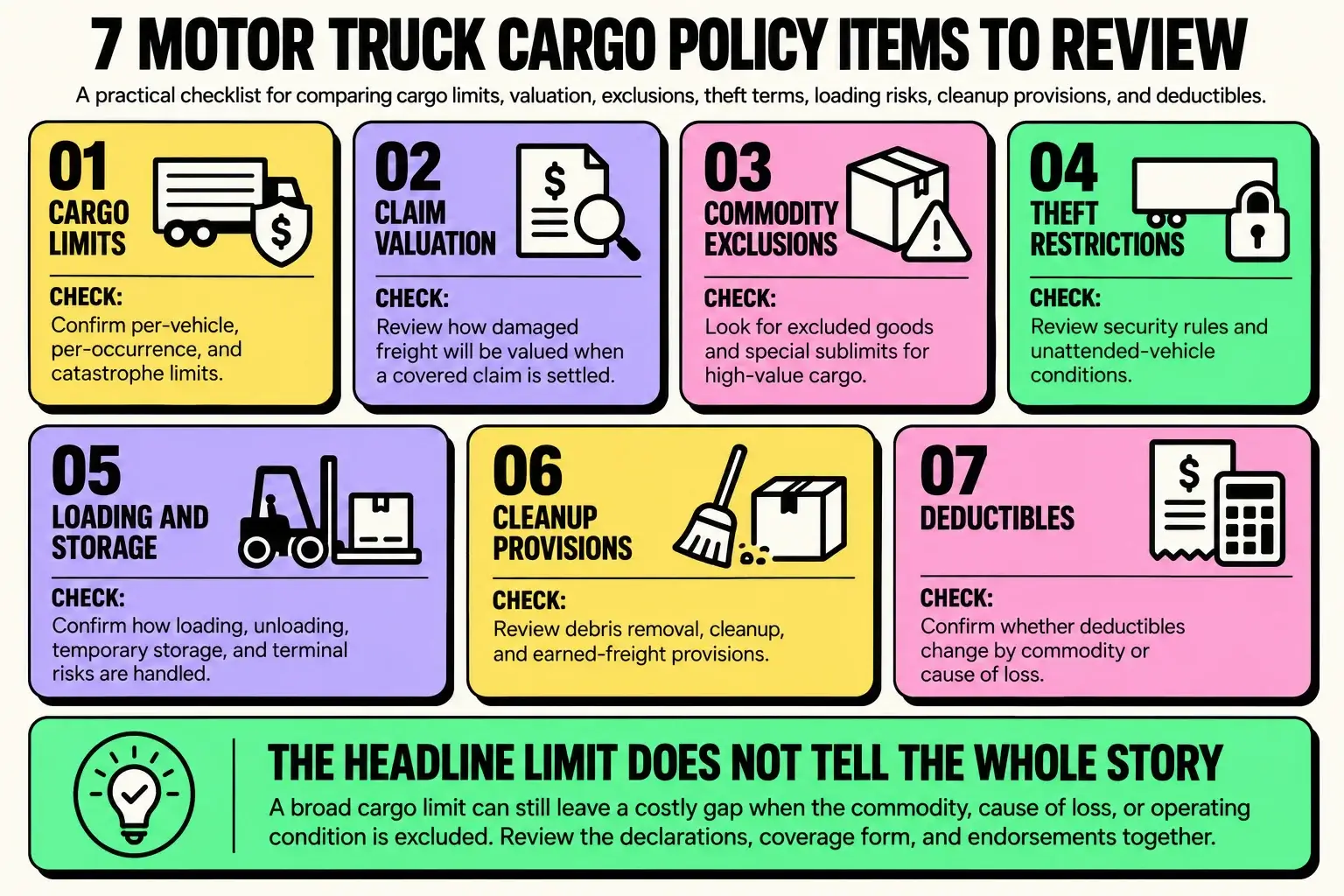
Review the declarations, coverage form, and endorsements for:
- Per-vehicle, per-occurrence, or catastrophe limits
- How damaged freight is valued when a claim is settled
- Commodity exclusions or sublimits for high-value goods
- Theft protections, security requirements, and unattended-vehicle restrictions
- Loading, unloading, temporary storage, and terminal exposures
- Debris removal, earned freight, or cleanup provisions
- Deductibles that vary by commodity or cause of loss
Refrigerated operations need a separate check. Spoilage caused by refrigeration-unit breakdown may require a specific endorsement, and temperature records or maintenance conditions may affect a claim. Coverage depends on the issued form, so the label “cargo insurance” alone is not enough.
Other Policies a Trucking Operation May Need
Cargo and trailer coverage are only part of a trucking insurance program. Commercial auto liability, physical damage, general liability, workers’ compensation, umbrella or excess liability, and non-trucking liability may also be relevant. Each serves a different purpose. Owner-operators leased to another motor carrier should review the lease and both parties’ policies. Terms such as “bobtail” and “non-trucking liability” are sometimes used loosely, but the coverage form controls. Driver classification, dispatch status, ownership, and contractual responsibility can change which policy may respond.
Benni Agency’s business and commercial insurance services provide a starting point for reviewing commercial auto and related coverage.
Preparing for a Cargo and Trailer Insurance Quote
A complete submission helps an insurer evaluate the operation accurately. Gather:
- An equipment schedule with VINs, values, ownership, and financing details
- A driver list, license information, and available motor vehicle records
- Commodities hauled and the highest value on one vehicle
- Operating radius, states entered, and interstate or intrastate authority
- Details about drayage, terminals, storage, and unattended equipment
- Written trailer interchange, shipper, broker, lease, and lender requirements
- Current declarations, endorsements, and loss runs
Compare proposals using the same facts. A lower premium can reflect a higher deductible, lower limit, restricted commodity, narrower theft protection, or missing endorsement. For Charleston-area operations, the Charleston insurance and employee benefits page connects this specialized review to Benni Agency’s broader local commercial-insurance support.
Coverage is subject to underwriting and the terms, conditions, exclusions, and endorsements of the issued policy. This guide is general information, not legal advice or a guarantee that a claim will be covered.