Restaurant insurance does not have one standard price. A counter-service café, a full-service restaurant with a bar, and a catering company may operate in the same area while presenting very different risks to an insurer. For Mount Pleasant restaurant owners, the more useful question is not simply, “What does restaurant insurance cost?” It is, “What information will an insurer use to price my operation?”
This guide explains the main quote factors, the coverages that can contribute to total premium, and the records worth preparing before renewal. It provides general educational information, not individualized insurance, legal, or tax advice.
Key Takeaways
- Restaurant insurance costs depend on the actual operation, including sales, payroll, cooking methods, alcohol activity, property values, delivery, claims history, limits, and deductibles.
- Restaurants often need several coverage parts rather than one policy, including liability, property, workers’ compensation, liquor liability, auto, cyber, and other specialized protection.
- South Carolina’s 2026 liquor-liability rules can affect specified alcohol-serving restaurants, but documented mitigation measures may reduce the required aggregate for qualifying licensees.
- Mount Pleasant’s coastal setting makes wind, named-storm deductibles, roof characteristics, and separate flood coverage important property-insurance considerations.
- The best way to compare restaurant insurance prices is to use the same operating information, limits, deductibles, valuations, and coverage assumptions across every proposal.
Why Restaurant Insurance Costs Vary
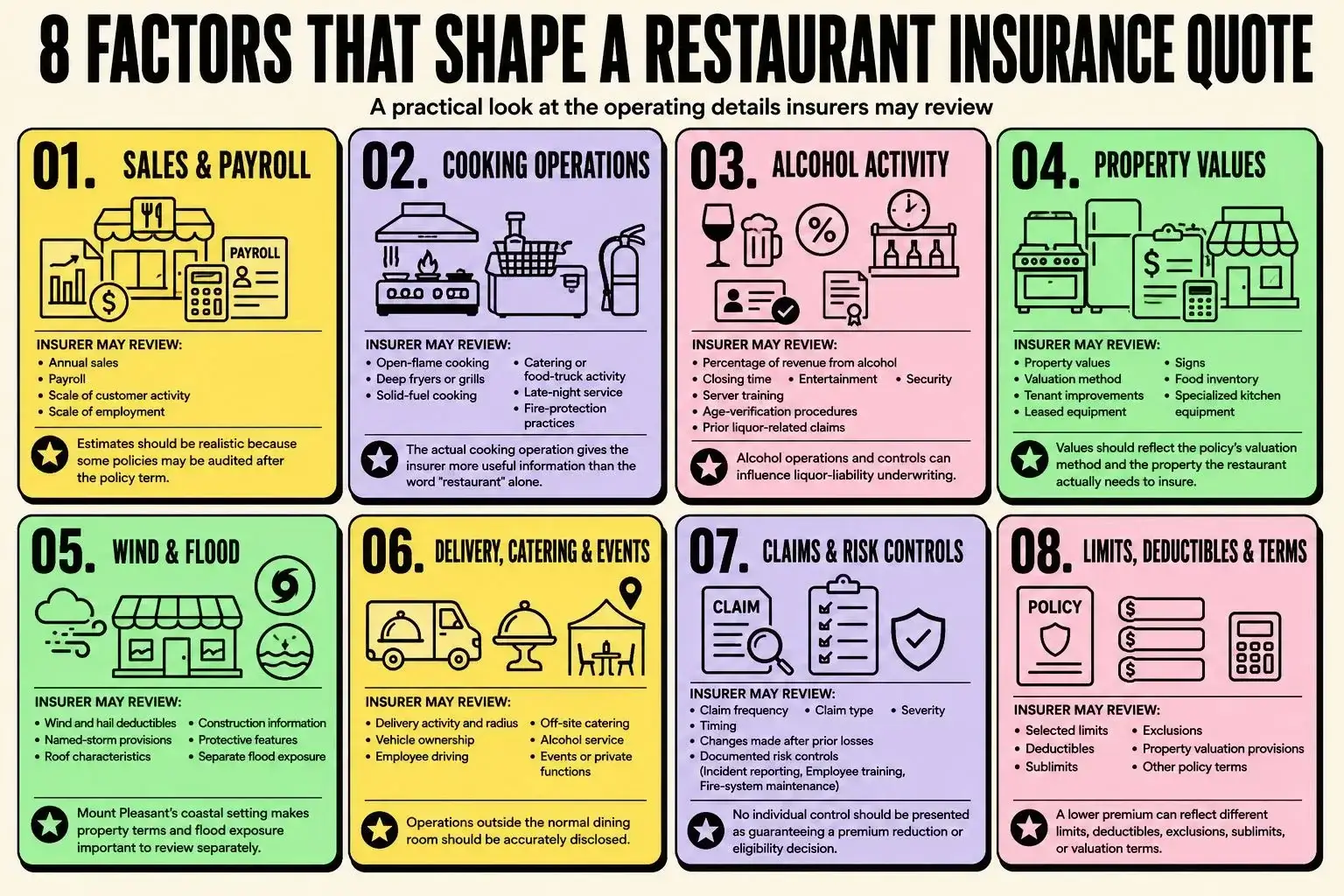
An insurer prices the restaurant it is being asked to cover, not the restaurant industry in the abstract. The application may consider annual sales, payroll, seating capacity or square footage, cooking methods, alcohol receipts, operating hours, delivery activity, property values, prior losses, selected limits, and deductibles. Those details can differ substantially even between restaurants located only a short distance apart. Published national averages can therefore be misleading. They may reflect a particular seller’s customers, policy mix, states, restaurant types, and coverage limits. A restaurant purchasing only general liability cannot be compared fairly with an operation buying property, business income, workers’ compensation, liquor liability, cyber, commercial auto, and several other coverages. The most useful cost estimate is a quote based on complete, current operating information and comparable coverage terms.
What Coverages Make Up a Restaurant’s Total Insurance Cost?
Restaurant insurance is usually built from several policies or coverage parts rather than one universal restaurant policy. Not every operation needs every option, and policy wording, eligibility, limits, and pricing vary by insurer.
General Liability
Commercial general liability may respond to covered third-party bodily injury, property damage, and certain personal or advertising injury claims. For a restaurant, that could include a customer slipping on a wet floor or the business damaging property it does not own. Product-related bodily injury claims may also fall within products-completed operations coverage, subject to the policy’s terms and exclusions. Premium inputs may include sales, customer traffic, seating, event activity, prior claims, limits, and deductibles. A lease or contract can also require particular limits or additional-insured status.
Commercial Property and Business Income
Commercial property insurance can cover scheduled buildings and business personal property against covered causes of loss. For restaurants, insured property may include cooking equipment, refrigeration systems, furniture, tenant improvements, food inventory, signs, and point-of-sale equipment. An insurer may review the building’s construction, roof, utilities, fire protection, property values, occupancy, claims history, and selected causes of loss. Business income coverage is related but separate. It may help with covered income loss and continuing expenses when operations are suspended because of covered direct physical loss, subject to policy limits, waiting periods, exclusions, and definitions.
Business Owners Policy or Commercial Package Policy
A Business Owners Policy, or BOP, commonly combines property and liability coverage for eligible operations. A Commercial Package Policy, or CPP, can provide greater flexibility when an operation has multiple locations, higher property values, specialized exposures, or coverage needs that do not fit an insurer’s BOP program. Neither policy name tells an owner everything about protection or price. Compare the actual forms, limits, deductibles, endorsements, exclusions, business-income terms, and property valuation. Benni Agency’s guide to BOP and CPP differences provides a closer comparison of these two structures.
Workers’ Compensation
Workers’ compensation premiums are commonly based on payroll assigned to applicable job classifications, together with applicable rates, experience information, and carrier or state rules. Restaurant payroll can involve kitchen, service, management, administrative, and delivery duties, which makes accurate job descriptions and payroll records important. As a general rule, the South Carolina Workers’ Compensation Commission employer FAQs state that businesses regularly employing four or more employees in South Carolina must maintain workers’ compensation coverage.
Part-time workers and family members count toward that general threshold, although statutory exemptions and individual circumstances can affect the result. Restaurants should therefore confirm how the rule applies to their actual workforce instead of relying only on a basic headcount.
Liquor Liability
General liability policies often restrict or exclude liquor liability for businesses engaged in selling or serving alcohol. An alcohol-serving restaurant may therefore need separate liquor liability insurance or an applicable endorsement. For policies issued beginning January 1, 2026, South Carolina Code Section 61-2-145 generally requires specified on-premises licensees that remain open after 5 p.m. to sell alcohol to maintain at least a $1 million annual aggregate limit, unless they qualify for the state’s risk-mitigation program. The per-occurrence limit must be at least 50% of the applicable required aggregate.
The South Carolina Department of Revenue liquor liability guidance identifies qualifying mitigation measures. These can include stopping alcohol service by midnight, completing approved alcohol-server training, deriving less than 40% of total sales from alcohol, and using a qualifying forensic identification system during specified late-night hours. Reductions can be combined when requirements are met, but a permanent licensee’s required annual aggregate cannot fall below $300,000. Eligibility must be documented with SCDOR rather than assumed from operating practices alone.
Commercial Auto and Hired and Non-Owned Auto
Restaurants may need commercial auto insurance when they own vehicles used for delivery, catering, errands, or other business purposes. When employees use personal vehicles or the restaurant rents vehicles, hired and non-owned auto liability may also be relevant. That coverage does not replace physical damage coverage for an employee’s personal vehicle and remains subject to policy terms.
Vehicle type, driver history, operating radius, use, ownership, garaging, selected limits, and prior claims can all affect the quote. Restaurants should also disclose delivery activity even when orders come through third-party delivery platforms because contractual arrangements do not automatically eliminate every restaurant exposure.
Restaurant-Specific Optional Coverages
Depending on the operation, additional coverage may be worth discussing. Equipment breakdown can address certain covered mechanical, electrical, or pressure-system breakdowns involving refrigeration, HVAC systems, ovens, or other essential equipment. Spoilage coverage may address certain covered food-inventory losses, while cyber insurance may address payment-system incidents, data breaches, ransomware, and related response expenses.
Employment practices liability can address certain covered employment allegations. Crime insurance can address specified theft, employee dishonesty, or funds-transfer exposures. Umbrella or excess liability may provide additional limits over qualifying underlying policies. Adding coverage can increase total premium, but removing coverage solely to lower price can create a different problem: an exposure the restaurant intended to insure may remain uninsured. Coverage decisions should begin with the restaurant’s actual operations and contracts.
The Main Factors That Shape a Restaurant Insurance Quote
Sales, Payroll, and Business Size
Sales and payroll are common insurance rating exposures. They also help an underwriter understand the scale of customer activity and employment. Estimates should be realistic because certain policies may be audited after the policy term. Material differences between estimated and actual exposures can result in additional premium or another policy adjustment.
Food Service Model and Cooking Operations
How food is prepared can affect property and liability underwriting. Open-flame cooking, deep fryers, grills, solid-fuel cooking, catering operations, food trucks, and late-night service can present different risk characteristics. Underwriters may request information about hood and duct cleaning, automatic fire-suppression systems, extinguishers, inspections, and grease-management practices. Accurate documentation gives the insurer a clearer picture than simply describing the operation as a “restaurant.”
Alcohol Sales, Hours, and Controls
The percentage of revenue from alcohol, closing time, entertainment, security, server training, age-verification procedures, and prior liquor-related claims can influence liquor-liability underwriting. In South Carolina, some of those practices can also affect the statutory aggregate required under the 2026 mitigation program. However, qualifying for a lower statutory requirement does not automatically mean that lower limit is appropriate for the restaurant’s contracts or risk profile. The legal requirement and the insurance-limit decision should be reviewed separately.
Property Values and Valuation Method
Restaurant equipment and improvements should be insured using values that reflect the policy’s valuation method. Insuring property below its replacement cost can create valuation or coinsurance problems after a covered loss. Owners should maintain a current inventory and understand whether the quote uses replacement cost, actual cash value, or another settlement method. Tenant improvements, leased equipment, outdoor property, signs, food stock, and specialized kitchen equipment may need additional attention.
Wind and Flood Exposure
Mount Pleasant’s coastal setting makes commercial property terms especially important to review. Wind and hail deductibles, named-storm provisions, roof characteristics, construction information, and protective features can affect both the property quote and the amount the restaurant retains after a covered loss. Flood requires a separate review.
Standard commercial property insurance generally does not cover flood. Restaurants should review whether separate flood insurance is appropriate through the National Flood Insurance Program or the private market.
The FEMA Flood Map Service Center is the official public source for flood-hazard mapping information.A flood-zone designation alone, however, does not determine every insurance need or price.
Delivery, Catering, Events, and Other Operations
Delivery, catering, special events, private functions, valet services, live entertainment, and seasonal operating changes can alter a restaurant’s exposure. The insurer may need details such as delivery radius, vehicle ownership, employee driving, off-site catering locations, alcohol service, and event activities. These operations should be accurately disclosed on the application and compared with applicable exclusions and endorsements.
Claims History and Risk Controls
Insurers may review the frequency, type, severity, and timing of previous claims. They may also ask what changed after a prior loss. Documented practices such as incident reporting, floor inspections, employee training, temperature logs, fire-system maintenance, and driver screening can help an underwriter understand the operation. No individual control should be assumed to guarantee a premium reduction, eligibility decision, or claim outcome.
Limits, Deductibles, and Policy Terms
Higher limits may increase premium because the insurer is accepting more potential financial responsibility. Increasing a deductible can sometimes lower premium by shifting more of a covered loss to the restaurant. That tradeoff should be evaluated against available cash, property values, leases, contracts, and realistic claim severity. A lower quote can also result from narrower coverage, smaller sublimits, different exclusions, or different valuation provisions. That is why the lowest premium does not necessarily represent the least expensive option after a loss.
A Better Way to Compare Restaurant Insurance Quotes
Restaurant owners should place proposals side by side rather than comparing premium totals alone.
| Review Area | What to Compare |
| Business details | Named insureds, locations, described operations, sales, and payroll |
| Liability | Per-occurrence limits, aggregates, products coverage, exclusions, and endorsements |
| Property | Limits, valuation method, coinsurance, equipment, improvements, and inventory |
| Business income | Limit or calculation method, waiting period, covered triggers, and restoration terms |
| Deductibles | Standard property, wind, hail, named-storm, auto, and other applicable deductibles |
| Liquor liability | Required limits, selected limits, separate policy or endorsement, and exclusions |
| Workers’ compensation | Employee classifications, estimated payroll, and applicable experience information |
| Commercial auto | Covered autos, symbols, drivers, hired/non-owned auto, and physical damage |
| Optional coverages | Equipment breakdown, spoilage, cyber, crime, EPLI, umbrella, or excess |
| Contract requirements | Additional insured, waiver of subrogation, certificates, and required limits |
| Policy restrictions | Exclusions, sublimits, warranties, and protective-safeguard conditions |
If two quotes do not use the same exposures and coverage assumptions, their premiums are not directly comparable.
How Restaurant Owners Can Manage Premiums Without Creating Blind Spots
Cost management starts with accurate information rather than simply removing coverage. Before renewal, reconcile annual sales, alcohol receipts, payroll, vehicles, property values, locations, operating hours, and services. Make sure employee duties and restaurant operations are described accurately, particularly delivery, catering, entertainment, late-night operations, and events. Organize fire-suppression inspection records, hood-cleaning documentation, employee training records, driver information, and incident reports so the insurer receives a complete picture of the operation. Review current loss runs for accuracy and document corrective action taken after recurring incidents.
Deductible alternatives can also be compared, but the restaurant should select an amount it could realistically fund after a covered loss. Most importantly, compare policy terms alongside premium. Exclusions, property valuation, sublimits, contract obligations, and required endorsements can materially affect the value of a proposal. Operational changes should be reported when they occur rather than automatically waiting until renewal. Adding a bar program, delivery service, vehicle, location, renovation, or new late-night schedule may require a policy review. Workers’ compensation policies are also commonly audited. Benni Agency’s workers’ compensation payroll audit checklist explains records a carrier may request during that process.
What to Prepare Before Requesting a Restaurant Insurance Quote
A well-organized submission can reduce unnecessary back-and-forth and make different proposals easier to compare. Prepare the restaurant’s legal entity name, ownership information, years in operation, and all insured locations. Include an accurate description of the food-service model, cooking methods, delivery, catering, entertainment, and other significant activities. Current and projected gross sales should generally separate food and alcohol receipts. Payroll should be organized by employee duties or classification when possible. Alcohol-serving restaurants should have current license information, service hours, training documentation, and any mitigation-program records that may apply. Property information should include building and roof details when requested, square footage, fire-protection systems, equipment, improvements, furniture, signs, and inventory values.
If vehicles are involved, prepare the vehicle schedule, drivers, uses, operating radius, and garaging information. Also gather current policies, limits, deductibles, endorsements, certificates, available currently valued loss runs, and contracts containing insurance or indemnification requirements. Mount Pleasant restaurant owners who want help reviewing these inputs can explore Benni Agency’s business and commercial insurance services in Mount Pleasant. That page serves the broader local commercial-service intent, while this guide remains focused on the factors that influence a restaurant insurance quote.