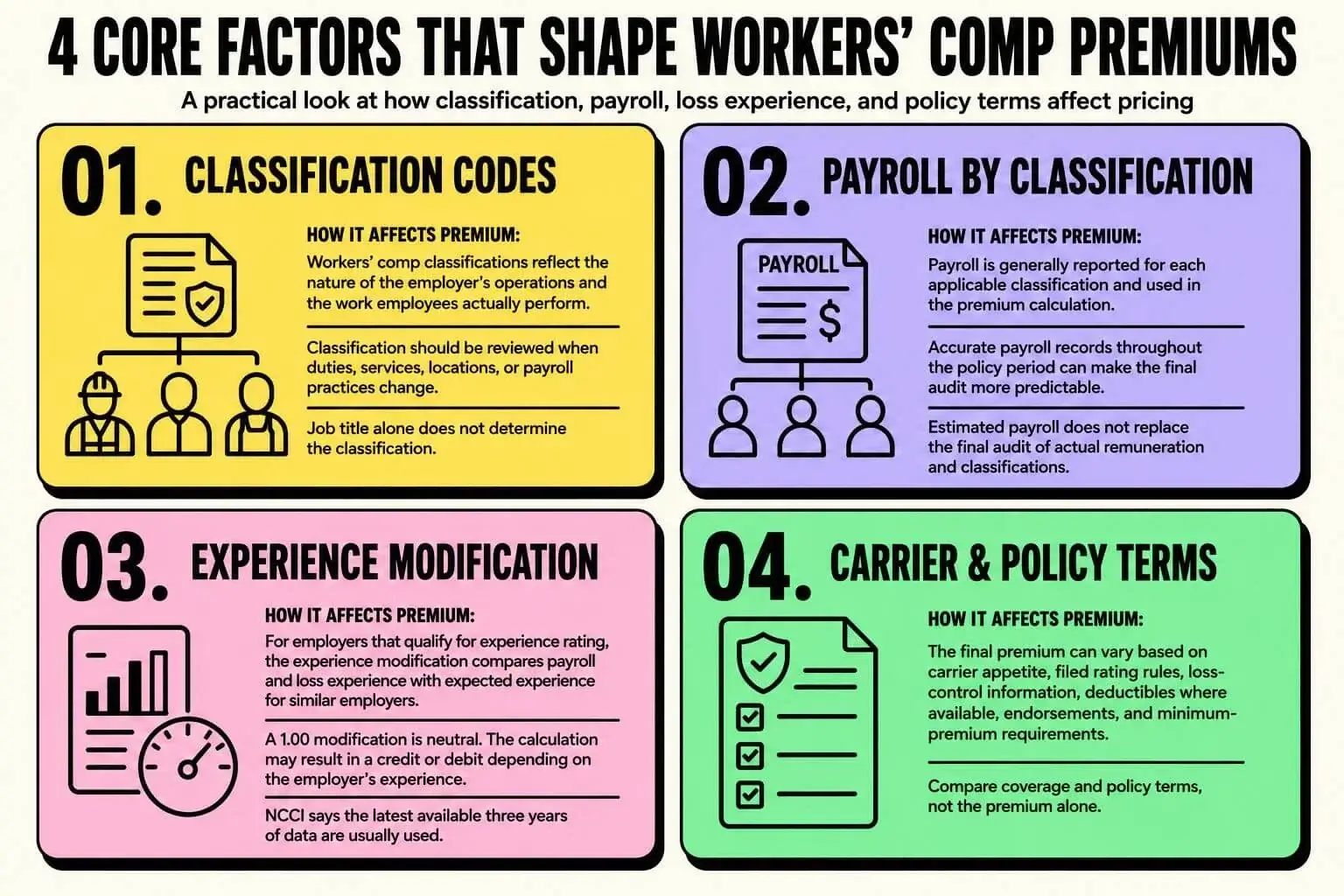
Workers’ compensation premiums are not based on one number or a generic city average. They reflect the work employees perform, the payroll assigned to each classification, the employer’s loss experience when experience rating applies, and the carrier’s final underwriting and policy terms.
For a Charleston employer, the useful question is not simply “What does workers’ comp cost?” It is which parts of the current renewal are driving the price and which records should be checked before the policy is bound. This guide is for Charleston business owners, finance leaders, HR teams, and operations managers who want to understand those cost factors.
Key Takeaways
- Workers’ comp pricing is employer-specific. Charleston businesses do not pay a universal local rate; premiums depend on operations, payroll, loss experience, and carrier terms.
- Classification codes and payroll directly affect premium calculations. Employers should make sure employees are classified based on the work they actually perform and that payroll is assigned accurately.
- Loss history can influence costs through the experience modification. For qualifying employers, the e-mod compares payroll and claims experience with expected results for similar businesses.
- Renewal reviews should focus on accurate records. Payroll reports, audits, loss runs, experience-rating worksheets, and changes in operations or job duties should be reviewed before coverage is bound.
- Employers can manage key cost inputs, but savings are not guaranteed. Accurate records, workplace safety practices, prompt claim reporting, and reviewing loss data can support a stronger renewal process.
Who Needs Workers’ Compensation Coverage in South Carolina?
South Carolina generally requires employers with four or more employees to carry workers’ compensation coverage. The South Carolina Workers’ Compensation Commission lists exceptions that can include casual employees, certain agricultural employees, businesses with fewer than four employees or annual payroll below $3,000, and several other categories.
Employee counts, contractor status, voluntary election of coverage, and exemptions can be fact-specific. Confirm the current requirement with the Commission and qualified insurance or legal counsel instead of relying on a general threshold alone.
The Core Workers’ Comp Premium Factors
A simplified way to understand the starting premium is: classification rate x payroll / 100. When experience rating applies, the experience modification can adjust that amount. The policy premium can also reflect approved insurer adjustments, minimum premiums, endorsements, and other policy-specific terms.
Classification codes
South Carolina uses the NCCI workers’ compensation system. Classifications are based on the nature of the employer’s operations and the work performed, not a job title alone. The classification assignment and applicable rate should be reviewed when duties, services, locations, or payroll practices change.
Payroll by classification
Payroll is generally reported for each applicable classification and used in the premium calculation. Accurate records throughout the policy period help make the audit more predictable. A payroll estimate is not a substitute for the final audit of actual remuneration and classifications.
Experience modification
For employers that qualify for experience rating, the experience modification, often called an e-mod or EMR, compares the employer’s payroll and loss experience with expected experience for similar employers. NCCI explains that the latest available three years of data are usually used. A 1.00 mod is neutral; a credit or debit may apply depending on the calculation.
Carrier and policy terms
The final premium can also vary by carrier appetite, filed rating rules, loss-control information, deductibles where available, endorsements, and minimum-premium requirements. Compare coverage and terms, not the premium alone.
A Practical Charleston Renewal Review
Charleston does not have one universal workers’ comp price. The same statewide coverage rules apply, while each employer’s operations, payroll, loss history, and carrier terms determine its renewal. A useful local review is therefore a document review, not an assumption about what other Charleston businesses pay. Before renewal, gather:
- Payroll reports organized by the work employees actually perform
- Current and prior workers’ comp declarations pages, audits, and loss runs
- The current experience-rating worksheet, if one applies
- Details of new operations, new job duties, subcontractor arrangements, or payroll changes
- Any contract or client insurance requirements
Cost Drivers Worth Checking Before Renewal
The following items commonly deserve a closer look:
- Classification changes or errors. Changes in job duties may affect the correct classification and payroll assignment.
- Payroll variance. A material difference between estimated and actual payroll can change the audit result.
- Claim frequency and severity. Loss experience can influence the experience modification for qualifying employers.
- Open claims and reporting. Prompt reporting and active claim coordination may help employees access care and help the employer understand claim status. Outcomes depend on the claim and policy.
- Coverage or contract changes. New operations, certificates, or contract requirements may change what needs to be reviewed.
Ways to Manage the Inputs You Can Control
No action guarantees a lower premium. However, employers can improve the quality of the information used at renewal and support stronger loss-control practices by:
- Reviewing classification and payroll records before the carrier audit
- Maintaining written safety procedures and training relevant to actual job hazards
- Reporting work injuries promptly and following the carrier’s claims process
- Considering modified-duty or return-to-work options when medically appropriate and consistent with the employer’s obligations
- Reviewing the experience-rating worksheet and loss data with the carrier or broker when available
How Workers’ Comp Fits With Other Business Coverage
Workers’ compensation addresses eligible work-related injuries and illnesses under the applicable law and policy. General liability addresses different third-party claims, while commercial auto and property coverage address separate operational risks. A full review helps avoid treating these policies as interchangeable. For broader coordination, explore Benni Agency’s business and commercial insurance options. Charleston employers can also review local insurance options in the context of their own operations.